Vande Bharat Express
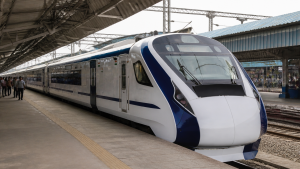
The Vande Bharat Express is a semi-high-speed, self-propelled, air-conditioned trainset operated by Indian Railways. Developed as Train 18, it marked a major step in India’s rail modernization and first entered commercial service on 15 February 2019 on the New Delhi-Varanasi route.
Origin and Development
- Inception: The concept originated during the Rail Vikas Shivir in November 2016, with the aim of building world-class trainsets in India.
- Manufacturing Hub: The first trainset was designed and manufactured by the Integral Coach Factory (ICF), Perambur, Chennai, under the leadership of Sudhanshu Mani, then General Manager of ICF.
- Indigenous Technology: The project was developed under the Make in India initiative, with about 80% indigenous components in the first phase.
Technical Specifications
| Parameter | Vande Bharat 1.0 (16-Coach) | Vande Bharat 2.0 (16-Coach) |
| Maximum Design Speed | 180 km/h | 180 km/h |
| Maximum Service Speed | 160 km/h | 160 km/h |
| Acceleration (0-100 km/h) | 52 seconds | 47 seconds |
| Traction Power | 8,000 kW | 9,600 kW |
| Axle Load | 16.5 tonnes | 15.5 tonnes |
| Body Material | Lightweight Stainless Steel | Lightweight Stainless Steel |
| Anti-Collision Protection | Not integrated initially | Integrated with Kavach |
Key Mechanical and Propulsion Features
- Distributed Power System: Power is distributed across the rake instead of using a single locomotive. In a 16-coach rake, 50% of the coaches are motorized, allowing faster acceleration and deceleration.
- IGBT Propulsion: The train uses a 3-phase Insulated-Gate Bipolar Transistor (IGBT)-based Variable Voltage Variable Frequency (VVVF) traction system.
- Regenerative Braking: The electro-pneumatic disc braking system includes regenerative technology, feeding electricity back into overhead lines during deceleration and reducing energy use by up to 30%.
- Gangways and Aerodynamics: Aerodynamically designed driver cabins at both ends reduce air resistance, while fully sealed flexible gangways allow safe movement between coaches.
Passenger Amenities and Safety
- Kavach System: Second-generation trainsets feature Kavach, an indigenous Automatic Train Protection (ATP) system that prevents signal passing at danger and helps avoid collisions.
- Automatic Doors: Plug-type sliding doors open and close automatically, with retractable footsteps bridging the platform gap when the train stops.
- Seating Comfort: The train has AC Chair Car (CC) and AC Executive Class (EC). Executive Class seats can rotate 180 degrees to face the direction of travel.
- Climate and Odor Control: Fully air-conditioned coaches use an advanced climate control system with photo-catalytic ultraviolet air purification.
- Sanitation: The train is fitted with zero-discharge vacuum-based bio-toilets and touch-free sensory water taps.
- Security and Communication: Coaches include high-definition CCTV cameras, GPS-based Passenger Information Systems, public address speakers, and emergency talkback units.
Variants of the Vande Bharat Series
Vande Bharat Chair Car (VB 1.0 & 2.0)
This is the standard day-travel variant, meant for routes connecting urban centers within about 800 km. It is operated in 8-coach, 16-coach, and 20-coach configurations.
Vande Bharat Sleeper
- Purpose: Developed for overnight, long-distance routes and intended to replace Rajdhani Express services.
- Design and Assembly: Manufactured by BEML in collaboration with ICF Chennai.
- Operational Status: The first prototype was launched in late 2024, and commercial operations began in January 2026.
- Routes: The inaugural service started on the Howrah-Kamakhya corridor, with a Bengaluru-Mumbai service approved later.
- Capacity: A standard 16-coach sleeper trainset accommodates 823 to 887 passengers across AC 3-Tier, AC 2-Tier, and AC 1-Class compartments.
Namo Bharat Rapid Rail (Vande Metro)
- Naming and Scope: Initially called Vande Metro, it was renamed Namo Bharat Rapid Rail in September 2024. It serves short-distance routes of 100 to 350 km between metropolitan centers and peripheral cities.
- First Service: Flagged off on 16 September 2024 between Bhuj and Ahmedabad, covering 359 km in 5 hours and 45 minutes.
- Technical Setup: It operates at a maximum speed of 110-130 km/h and has a 12-coach configuration with capacity for 1,150 seated passengers and 2,058 standing passengers.
Vande Bharat Freight EMU (Cargo Variant)
- Designation: Also called the Freight EMU or Gati Shakti Cargo Train, it is designed for time-sensitive cargo.
- Key Features: The 16-coach prototype can carry up to 395 tonnes and includes automated wide sliding doors, temperature-controlled reefer compartments, and a retractable roller floor for rapid pallet loading.
- Performance: It is designed for speeds up to 160 km/h. In July and August 2026, the prototype reportedly reached 145 km/h during trials in the Kota division.
Key Facts and Trivia for Revision
- First Route: New Delhi-Kanpur-Prayagraj-Varanasi.
- Train 18 Nomenclature: The name came from the fact that the first rake was completed and ready for testing in October 2018.
- Maximum Trial Speed: The trainset achieved a test speed of 183 km/h on broad gauge tracks.
- Suspension System: It uses fully air-spring secondary suspension with hydraulic shock absorbers to reduce jerks and vibration.
- Braking Distance: It can stop within 1,000 meters at 160 km/h.
- Emergency Measures: The train includes emergency escape windows, fire detection systems, and aerosol-based fire suppression systems in electrical cabinets.
Rare Facts for Prelims
- Trainset Type: Vande Bharat is an EMU-style trainset, not a conventional locomotive-hauled train.
- Coach Design: The train uses lightweight stainless steel bodies to improve speed and efficiency.
- Motorization: Half of the coaches in a 16-coach rake are motorized for distributed traction.
- Energy Saving: Regenerative braking can reduce power consumption significantly during deceleration.
- Safety Upgrade: Kavach integration is a major feature of the second-generation trainsets.
- Executive Seating: The 180-degree rotating seats in AC Executive Class are a distinctive passenger feature.
Current General Studies comprises current-affairs-based, General Studies-rich study material on policies, laws, institutions, economy, science, environment, governance, international relations, and other varied but important topics for UPSC and State PSC Prelims examinations.
Fortnightly PDF compilations: Available here
Originally written on
August 3, 2026
and last modified on
August 18, 2026.
| Related | |
|---|---|