Gender Equality Schemes and Policies in India
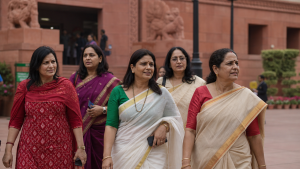
India’s framework for gender equality rests on constitutional guarantees, targeted welfare schemes, and judicial interventions. Together, these measures seek to reduce structural inequality, improve access to education, health and safety, and expand representation in public life.
Constitutional Amendments and Electoral Representation
- 106th Constitutional Amendment Act, 2023: Also known as the Nari Shakti Vandan Adhiniyam, it provides 33% reservation for women in the Lok Sabha, State Legislative Assemblies and the Delhi Legislative Assembly.
- Implementation clause: The reservation will take effect only after a delimitation exercise based on the first census published after the commencement of the Act.
- Article 334A: This provision links the operationalisation of women’s reservation to the post-census delimitation process.
- 131st Constitutional Amendment Bill, 2026: The bill sought to expand Lok Sabha strength to 850 and delink women’s reservation from post-census delimitation, but it was defeated in the Lok Sabha on April 17, 2026.
Mission Shakti and Gender Budgeting
- Gender Budget 2026-27: The allocation rose to 9.37% of the total Union Budget, up from 8.86% in FY 2025-26.
- Mission Shakti allocation: The Centre allocated Rs. 3,200 crore for FY 2026-27 under the umbrella scheme.
- Sambal sub-scheme: It received Rs. 627 crore and focuses on women’s safety and protection-related interventions.
- Samarthya sub-scheme: It received Rs. 2,573 crore and supports women’s empowerment and welfare measures.
- Funding pattern: Sambal is 100% centrally funded for states and Union Territories.
- Samarthya funding: The Centre-state sharing pattern is 60:40, 90:10 for North Eastern and Himalayan states, and 100% for Union Territories without a legislature.
- Odisha and PMMVY: Odisha integrated and began active implementation of the Pradhan Mantri Matru Vandana Yojana under Mission Shakti in FY 2025-26.
Women’s Welfare Schemes and Economic Security
- Beti Bachao Beti Padhao: The Ministry of Women and Child Development marked the scheme’s 10th anniversary on January 22, 2025.
- School awareness: NCERT included the initiative in Class 7 textbooks in 2025 to strengthen awareness of gender equality.
- Sukanya Samriddhi Yojana: The interest rate stood at 8.2% in mid-2026.
- Coverage: More than 4.53 crore accounts had been opened under the scheme as of December 2025.
- Deposits: Total deposits crossed Rs. 3.33 lakh crore by December 2025.
- Policy significance: These schemes combine financial security, education support and long-term savings for the girl child.
Property Rights and Family Law
- Equal coparcenary rights: In N.P. Rajani v. Radha Nambidi Parambath, the Kerala High Court affirmed that daughters have equal coparcenary rights in Hindu Undivided Family property under the Hindu Succession (Amendment) Act, 2005.
- Repugnancy principle: The court held that the Kerala Joint Hindu Family System (Abolition) Act, 1975, could not override the central law due to constitutional repugnancy.
- Exam relevance: The case reinforces the legal principle that gender equality in inheritance is protected by statutory and constitutional interpretation.
Menstrual Hygiene and Access to Education
- Supreme Court ruling: In Dr. Jaya Thakur v. The Government of India, the Court held that access to menstrual hygiene facilities in schools is part of the right to life under Article 21 and the right to education under Article 21A.
- Directions to states: The Court asked states to provide separate toilets and free sanitary napkins in schools.
- Policy focus: The ruling links gender-sensitive infrastructure with constitutional rights and school retention of girls.
Transgender Rights and Anti-Discrimination Framework
- Jane Kaushik v. Union of India: The Supreme Court held that employment discrimination against transgender persons in public and private sectors violates Articles 14, 15, 16 and 21.
- Equal Opportunity Policy: The Court ordered a committee led by retired Justice Asha Menon to draft a model policy for transgender persons in employment.
- Transgender Persons (Protection of Rights) Amendment Act, 2026: The amendment replaced self-perceived gender identity with mandatory medical verification for legal gender recognition.
- Judicial review: The Supreme Court stayed pending High Court challenges to the amendment and transferred the cases to itself.
- Identity cards: The Central Government assured the Court that previously issued Transgender Identity Cards remain valid.
Key Prelims Takeaways
- Women’s reservation: The 106th Constitutional Amendment Act provides 33% reservation in elected legislative bodies.
- Article 334A: Women’s reservation becomes operational only after delimitation based on the first post-commencement census.
- Gender Budget 2026-27: It reached 9.37% of the Union Budget.
- Mission Shakti: The umbrella scheme has two components, Sambal and Samarthya.
- Funding pattern: Sambal is fully centrally funded, while Samarthya follows shared funding norms.
- Menstrual hygiene: The Supreme Court linked school sanitation and sanitary napkins with Articles 21 and 21A.
- Transgender rights: The Court recognised workplace discrimination against transgender persons as unconstitutional.
Current General Studies comprises current-affairs-based, General Studies-rich study material on policies, laws, institutions, economy, science, environment, governance, international relations, and other varied but important topics for UPSC and State PSC Prelims examinations.
Fortnightly PDF compilations: Available here
Originally written on
March 22, 2026
and last modified on
September 5, 2026.
| Related | |
|---|---|