India’s Trade Policy and Participation in the WTO
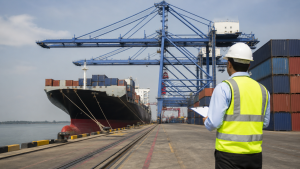
India’s trade policy combines export promotion, domestic industrial support, and compliance with WTO rules. The framework is designed to expand trade through facilitation and remission of duties while protecting sensitive sectors such as agriculture.
India’s Foreign Trade Policy and Export Framework
India’s Foreign Trade Policy (FTP) 2023 came into effect on April 1, 2023. It is an open-ended framework, replacing the earlier five-year policy cycle and allowing continuous updates in response to trade developments.
The policy aims to support India’s integration into global value chains and has set a target of USD 2 trillion in total exports by 2030. The approach has shifted from incentive-based support to a system focused on duty remission, ease of doing business, and technology-driven facilitation.
- FTP 2023: Open-ended and regularly adaptable, unlike the older fixed-term policy model.
- Export target: USD 2 trillion in total exports by 2030.
- Policy focus: Remission of duties, export facilitation, and technology-enabled processes.
- Trade profile: The WTO Secretariat’s eighth Trade Policy Review noted an average annual economic growth rate of 7.3% for India between FY 2022–23 and FY 2025–26.
- Exports: Overall exports reached a record USD 863.1 billion in FY 2025–26.
Export Promotion Mission and Sub-Schemes
To streamline export promotion, the government set up the ₹25,060 crore Export Promotion Mission (EPM). It consolidated earlier standalone export support schemes, including the Interest Equalisation Scheme (IES) and the Market Access Initiative (MAI).
The mission operates through two sub-schemes: Niryat Protsahan and Niryat Disha. These are meant to improve access to finance, enhance market preparedness, and strengthen compliance support for exporters.
- Niryat Protsahan: Focuses on trade finance, liquidity support, and credit lines for exporters.
- Niryat Disha: Focuses on market readiness, capacity building, and regulatory compliance.
- EPM outlay: ₹25,060 crore.
- Scheme consolidation: Brought together older export support initiatives under a more integrated structure.
Market Access Support Scheme
Under Niryat Disha, the government launched the ₹4,531 crore Market Access Support (MAS) Scheme on December 31, 2025. It is designed to help exporters participate in trade events and improve visibility in overseas markets.
- Financial outlay: ₹4,531 crore.
- Government support: 60% of approved trade event costs.
- Priority areas: 80% support for approved costs.
- MSME requirement: At least 35% participation from MSMEs.
Agricultural Subsidies and the WTO Peace Clause
The WTO Agreement on Agriculture (AoA) limits trade-distorting domestic support, measured as Aggregate Measurement of Support (AMS), to a de minimis level of 10% of the value of production for developing countries.
India invoked the WTO peace clause for the seventh consecutive year in April 2026 after breaching the 10% ceiling for rice subsidies.
- Rice subsidies: USD 7.6 billion in 2024–25.
- Production value: USD 64.13 billion.
- Subsidy ratio: 11.85% of total rice production value.
- Bali Peace Clause: Agreed at MC9 in 2013; it protects developing countries from legal challenges over public stockholding, subject to transparency and notification requirements.
Agreement on Fisheries Subsidies and India’s Position
The WTO Agreement on Fisheries Subsidies (AFS) is a major multilateral effort to curb subsidies that contribute to overfishing and depletion of marine resources. It entered into force on September 15, 2025, after securing the required ratifications.
India became the 123rd party to the AFS by depositing its Instrument of Acceptance on July 20, 2026. The agreement prohibits subsidies for illegal, unreported and unregulated (IUU) fishing, fishing of overfished stocks, and unregulated high-seas fishing.
- Coverage: The current agreement excludes inland fisheries and aquaculture.
- India’s concern: Protection of domestic food security and livelihood interests.
- Phase II negotiations: India seeks a 25-year transition period for developing countries.
- Additional demand: Stricter limits on distant-water industrial fleets.
- Small fishers: India wants a permanent carve-out for small-scale and artisanal fishers.
WTO Engagement and Recent Trade Review
India continues to engage actively in WTO processes while defending policy space for agriculture, food security, and development needs. The WTO’s 14th Ministerial Conference (MC14), held from March 26 to 29, 2026, in Yaoundé, Cameroon, focused on WTO reform, agricultural public stockholding, fisheries subsidies, and the e-commerce moratorium.
India also concluded its Eighth Trade Policy Review (TPR) at the WTO on July 23, 2026. The review covered the period from January 1, 2021, to December 31, 2025, and assessed India’s economic and trade policies.
Key Prelims Takeaways
- FTP 2023: Open-ended policy framework effective from April 1, 2023.
- Export goal: USD 2 trillion in total exports by 2030.
- EPM: ₹25,060 crore export promotion framework replacing older schemes.
- Niryat Protsahan: Trade finance and credit support for exporters.
- Niryat Disha: Market readiness and compliance support.
- MAS Scheme: ₹4,531 crore, launched on December 31, 2025; 35% MSME participation required.
- Peace Clause: Invoked in April 2026 for rice subsidies exceeding the 10% de minimis limit.
| Related | |
|---|---|