Major Astronomical Observatories Studying Black Holes
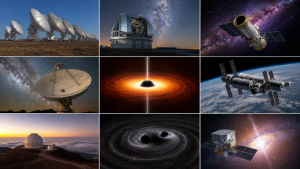
Black holes are studied by observing their effects on nearby matter, light and spacetime rather than by seeing them directly. Ground- and space-based observatories use radio, optical, infrared and X-ray observations, alongside gravitational-wave detection, to investigate their properties and evolution.
Black Hole Properties and Accretion
Black holes are commonly classified by mass. Stellar-mass black holes form from the collapse of massive stars, while supermassive black holes—with masses millions to billions of times that of the Sun—are found at the centres of most galaxies, including the Milky Way.
- Event horizon: The boundary beyond which light and information cannot escape; it marks the point of no return.
- Accretion disk: A rotating structure of gas and other matter spiralling towards a compact object such as a black hole. Friction and other dissipative processes heat the material, producing radiation that includes X-rays.
- Black hole spin: The rotation of a black hole, represented as a parameter in models of the surrounding spacetime. Spin can influence the flow of matter and the behaviour of jets.
- Frame-dragging: In general relativity, a rotating mass drags the spacetime around it. The Lense-Thirring effect can cause the inner region of an accretion disk to precess, or change orientation over time.
How Black Holes Are Studied
Their presence and properties are inferred from their gravitational effects and emissions from surrounding matter. Different techniques reveal different stages and scales of black hole activity.
- X-rays and QPOs: Hot accreting matter emits X-rays. Quasi-periodic oscillations (QPOs) are recurring variations in this emission; their frequencies can help investigate conditions near a black hole.
- Gravitational lensing: A black hole’s gravity bends light travelling past it, distorting the appearance of background objects and contributing to observations near the event horizon.
- Tidal disruption events: When a star passes close enough to a black hole, its gravity can tear the star apart. The resulting flare provides an opportunity to study the black hole and its surroundings.
- Gravitational waves: Merging black holes produce ripples in spacetime. Detectors measure the minute distortions caused by these waves and can provide information about the merging objects, including their masses and spins.
Major Observatories and Instruments
Observations across the electromagnetic spectrum are complemented by gravitational-wave measurements. International collaboration is central to some of these efforts, including networks that combine instruments in different locations.
- Event Horizon Telescope (EHT): A global network of radio telescopes using Very Long Baseline Interferometry (VLBI) to operate as an Earth-sized virtual telescope. It has produced images of M87″ and Sagittarius A”. The images allow researchers to study light bent by gravity and investigate spin-related signatures.
- Chandra and XMM-Newton: These space-based X-ray observatories study hot regions and X-ray sources, including accretion disks, active galactic nuclei and black hole binaries. Their observations can help examine variability and QPOs.
- NuSTAR: NASA’s Nuclear Spectroscopic Telescope Array observes cosmic X-rays and provides high-energy images used to study energetic phenomena near black holes.
- LIGO, Virgo and KAGRA: These gravitational-wave observatories have detected signals from merging black holes, enabling researchers to investigate the systems through spacetime vibrations.
- James Webb Space Telescope (JWST): This infrared observatory helps study the environments of supermassive black holes and their influence on galaxy evolution, including in the early universe.
- Hubble Space Telescope (HST): Optical observations of the motion of stars and gas near galactic centres have helped infer the presence and mass of supermassive black holes.
Systems and Evidence of Spin
Observations of individual systems help test models of accretion, spin and black hole behaviour. Estimates of spin are not always independent of interpretation: values inferred from X-ray radiation can vary with the model used.
- Cygnus X-1: A binary star system containing a black hole. Its X-ray emissions have made it an important system for studying accretion. A 2026 analysis produced spin estimates ranging from near zero to close to the maximum physically allowed value under different models.
- M87″: The supermassive black hole at the centre of the Messier 87 galaxy and the first black hole to be imaged by the EHT. Observations in 2023 found an approximately 11-year cycle in its jets, associated with misalignment between the black hole’s spin axis and its accretion disk.
- Sagittarius A”: The supermassive black hole at the centre of the Milky Way, also imaged by the EHT. Its study provides information about the dynamics at the centre of our galaxy.
- Spin and disk precession: In 2025, observations of the tidal disruption event AT2020afhd provided evidence of Lense-Thirring precession around a rapidly rotating black hole. Researchers had also reported, in 2024, a method for estimating spin by measuring the wobble of a disk formed after a tidal disruption event.
Research Significance
Black hole research connects fundamental physics with observations of energetic astronomical systems. QPO frequencies, disk precession, jet behaviour and gravitational-wave signals each offer different ways to investigate spin and the conditions around a black hole. These methods are complementary: conclusions drawn from one kind of signal can be compared with evidence from other instruments and wavelengths. The work also highlights broader research priorities. International cooperation enables shared observations and coordinated analysis, while sustained investment in research capacity supports the development of expertise, instruments and simulation methods. Space science policy is relevant to the planning and operation of observatories that extend observations beyond the limits of ground-based facilities.
Key Prelims Takeaways
- Event horizon: Boundary beyond which light and information cannot escape.
- Accretion disk: Heated, rotating matter around a black hole that emits radiation, including X-rays.
- QPO: Quasi-periodic oscillation; a recurring variation in an astronomical signal.
- Lense-Thirring effect: Relativistic frame-dragging by a rotating mass, which can make an inner disk precess.
- Observatories: The EHT uses VLBI; Chandra and XMM-Newton observe X-rays; LIGO, Virgo and KAGRA detect gravitational waves.
- Named systems: Cygnus X-1 is a black hole binary; M87″ and Sagittarius A” are supermassive black holes.
Recent Context
A study published on October 23, 2026, in the Journal of High Energy Astrophysics examined spin and X-ray variability using simulations of viscous accretion flows. Researchers from ARIES, Poland’s Nicolaus Copernicus Astronomical Center and MJP Rohilkhand University found that rapidly rotating black holes pull accretion shocks closer, affecting QPO frequencies; simulated frequencies exceeded 100 hertz for black holes about ten times the Sun’s mass.
| Related | |
|---|---|