Internal Security Institutions and Coordination Mechanisms in India
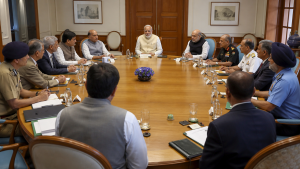
India’s internal security system works through coordination among national agencies, state police, intelligence platforms, and specialized forces to handle terrorism, extremism, cyber threats, and border-related challenges.
Apex Policy and Coordination Bodies
National Security Council (NSC)
- Premier body: The National Security Council is the chief advisory body on national security and strategic issues.
- Established: 1998, under the Prime Minister’s Office.
- Head: The National Security Advisor (NSA) heads the National Security Council Secretariat (NSCS).
- Structure: It has three tiers — Strategic Policy Group, National Security Advisory Board, and Secretariat.
Multi-Agency Centre (MAC)
- Central intelligence platform: MAC is used for real-time intelligence sharing among security agencies in India.
- Control: It functions under the administrative control of the Intelligence Bureau (IB) in the Ministry of Home Affairs.
- Established: 2001, based on the Kargil Review Committee recommendations.
- Role: It collates and disseminates terrorism-related inputs.
- Coverage: It connects 28 central and state organizations, including military intelligence, state police special branches, and external intelligence.
- SMACs: Subsidiary Multi-Agency Centres operate in state capitals for local intelligence analysis and sharing.
- Technology: The revamped platform uses AI and GIS tools for hotspot mapping.
- CyMAC: The Ministry of Home Affairs also runs the Cyber Multi Agency Centre to counter cyber espionage and online threats.
National Intelligence Grid (NATGRID)
- Integrated platform: NATGRID was conceived after the 2008 Mumbai terror attacks.
- Status: It functions as an attached office under the Ministry of Home Affairs.
- Data linkage: It connects databases related to immigration, banking, telecommunications, airline travel, and tax records.
- NPR integration: It integrates with the National Population Register for authorized real-time searches of family-level records.
- Analytics: It uses data analytics tools such as the Gandiva system to match suspect entities.
Premier Intelligence and Investigation Agencies
Intelligence Bureau (IB)
- Domestic intelligence agency: The Intelligence Bureau is India’s internal intelligence agency.
- Established: 1887, as the Central Special Branch.
- Control: It operates under the Ministry of Home Affairs.
- Focus: Counter-terrorism, counter-intelligence, and border intelligence.
National Investigation Agency (NIA)
- Counter-terror law enforcement: The NIA is India’s central agency for investigating terrorism-related cases.
- Established: Under the National Investigation Agency Act, 2008, after the 26/11 Mumbai attacks.
- Jurisdiction: It has concurrent jurisdiction and can take over terror-related cases in any state without state government permission.
- Analytical unit: It runs the National Terror Database Fusion and Analysis Centre (NTDFAC).
- Scope: It handles terror cases, terror funding, and left-wing extremism-related investigations.
Central Bureau of Investigation (CBI)
- Premier investigative agency: The CBI functions under the Ministry of Personnel, Public Grievances and Pensions.
- Law: Its investigative powers come from the Delhi Special Police Establishment Act, 1946.
- International role: It is India’s designated national central bureau for Interpol cooperation.
Financial Intelligence Unit – India (FIU-IND)
- Established: 2004, under the Department of Revenue, Ministry of Finance.
- Role: It receives, processes, analyzes, and disseminates information on suspicious financial transactions.
- Support function: It helps track money laundering and terror financing.
Specialized Cyber Security and Technology Bodies
Indian Cyber Crime Coordination Centre (I4C)
- Purpose: I4C provides a unified framework to counter cybercrime across India.
- Conceived by: The Ministry of Home Affairs.
- Components: It includes seven functional units, such as the National Cyber Crime Threat Analytical Unit and the National Cyber Crime Reporting Portal.
- Coordination: It works with law enforcement, banks, and telecom intermediaries to freeze fraudulent accounts.
National Critical Information Infrastructure Protection Centre (NCIIPC)
- Nodal agency: NCIIPC is the national nodal agency for protecting critical information infrastructure (CII).
- Legal basis: It was created under Section 70A of the Information Technology Act, 2000.
- Coverage: It protects vital digital assets in energy, transport, finance, and telecommunications.
- Control: It works under the National Technical Research Organisation (NTRO).
Border Management and Border Guarding Forces
Central Armed Police Forces (CAPFs)
- Border and internal security: Specialized forces under the Ministry of Home Affairs guard borders and support internal law enforcement.
- Principle: The “One Border, One Force” model is followed to avoid overlapping responsibilities.
- Border Security Force (BSF): Guards borders with Pakistan and Bangladesh.
- Indo-Tibetan Border Police (ITBP): Protects high-altitude borders with China.
- Sashastra Seema Bal (SSB): Secures open borders with Nepal and Bhutan.
- Assam Rifles (AR): Guards the Myanmar border and handles counter-insurgency in the Northeast.
- Central Reserve Police Force (CRPF): Manages internal security, counter-naxal operations, and election security.
- Central Industrial Security Force (CISF): Secures vital government installations, airports, and space centres.
- National Security Guard (NSG): An elite counter-terrorism and hostage-rescue force.
Coastal Security Architecture
- Three-tier system: After the 2008 Mumbai attacks, India created a three-tier coastal security mechanism.
- Indian Navy: Oversees overall maritime security, including coastal and offshore security.
- Indian Coast Guard: Patrols territorial waters and coordinates with local agencies.
- Coastal Police: Maritime state police patrol shallow waters up to 12 nautical miles using specialized patrol boats.
Overview of Internal Security Bodies
| Body | Year of Establishment | Administrative Ministry | Primary Focus Area |
| Intelligence Bureau (IB) | 1887 | Ministry of Home Affairs | Domestic counter-intelligence and security inputs |
| National Security Council (NSC) | 1998 | Prime Minister’s Office | Strategic national security planning and advice |
| Multi-Agency Centre (MAC) | 2001 | Ministry of Home Affairs | Intelligence collation and inter-agency coordination |
| Financial Intelligence Unit (FIU-IND) | 2004 | Ministry of Finance | Analyzing suspicious financial transactions |
| National Investigation Agency (NIA) | 2008 | Ministry of Home Affairs | Investigation of terror offenses and funding |
| National Intelligence Grid (NATGRID) | 2009 | Ministry of Home Affairs | Common security database linking for agencies |
| National Critical Information Infrastructure Protection Centre (NCIIPC) | 2014 | Prime Minister’s Office (under NTRO) | Protecting critical information systems |
| Indian Cyber Crime Coordination Centre (I4C) | 2018 | Ministry of Home Affairs | Cybercrime research and law enforcement coordination |
Recent Context
- National Security Strategies Conference: An annual forum for internal security coordination in India.
- 9th Conference: Conducted in a hybrid format in August 2026.
- PRAHAAR: Launched by the Ministry of Home Affairs in February 2026 as India’s first comprehensive National Counter-Terrorism Policy and Strategy.
- Acronym: PRAHAAR stands for Prevention of terror attacks, Responses, Aggregating internal capacities, Human rights and Rule of Law, Attenuating conditions enabling terrorism, Aligning international efforts, and Recovery and resilience.
- Principal law: The Unlawful Activities (Prevention) Act, 1967 is India’s main anti-terror legislation.
- Trial-in-absentia: A legal trial conducted in the physical absence of the accused.
Rare Facts for Prelims
- MAC origin: It was strengthened after the Kargil Review Committee highlighted the need for better intelligence sharing.
- IB legacy: The Intelligence Bureau is often described as one of the oldest intelligence organisations in the world.
- Interpol link: The CBI acts as India’s national central bureau for international police coordination.
- Maritime layers: India’s coastal security system involves the Navy, Coast Guard, and Coastal Police in distinct roles.
- Critical infrastructure: NCIIPC focuses not on physical assets alone but on digital systems that support essential services.
- Martyrs’ Column: In New Delhi, it is associated with the remembrance of security and intelligence personnel who died in the line of duty.
Current General Studies comprises current-affairs-based, General Studies-rich study material on policies, laws, institutions, economy, science, environment, governance, international relations, and other varied but important topics for UPSC and State PSC Prelims examinations.
Fortnightly PDF compilations: Available here
Originally written on
August 25, 2026
and last modified on
August 25, 2026.
| Related | |
|---|---|