Major Types of Artificial Islands and Land Reclamation
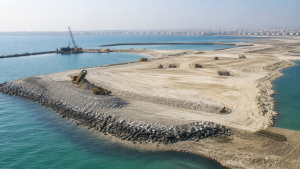
Land reclamation creates new land from the sea, lakes, riverbeds, or wetlands, while artificial islands are human-made landmasses built in water for urban, industrial, transport, strategic, or energy-related uses.
Major Methods of Land Reclamation
Modern reclamation uses different engineering techniques to convert water areas into stable land.
Dry Land Reclamation
- Method: Filling a targeted water area with large quantities of rock, clay, and soil.
- Transport: Materials are brought from inland quarries using trucks and barges.
- Stabilization: The fill is compacted with heavy rollers to form a solid base above the water line.
- Use: Commonly used for coastline expansion and harbor facilities.
Hydraulic Reclamation and Dredging
- Method: Specialized vessels extract material directly from the seabed.
- Dredging: Ships vacuum sand, silt, and clay and pump them to the reclamation site.
- Rainbowing: Dredged material is sprayed in a high arc into the reclamation zone.
- Stability: The slurry has high water content and needs compaction and drainage.
- Soil treatment: Geotextile tubes and vertical drains are often used to speed up water removal.
Polder Systems
- Definition: A polder is low-lying land enclosed by dikes and reclaimed by pumping out water.
- Pioneer: The Netherlands pioneered this method to reclaim large areas from sea and marshes.
- Maintenance: Continuous pumping is needed because the land often lies below sea level.
- Use: Mainly used for agriculture and urban development.
Classification of Artificial Islands
Artificial islands are classified by their structure and construction material.
Hydraulic Fill Islands
- Method: Dredged sand is deposited directly on the seabed until it rises above the water surface.
- Protection: Outer boundaries are reinforced with concrete armor units, tetrapods, or large boulders.
- Examples: Palm Islands in Dubai and Kansai International Airport island in Japan.
Fixed Pile-Supported Platforms
- Structure: Supported by heavy steel or concrete piles driven deep into the seabed.
- Use: Common in offshore oil and gas extraction, scientific research, and deep-water ports.
- Advantage: They reduce disruption to marine currents and seabed ecosystems.
Floating Artificial Islands
- Structure: Large pontoon-like platforms made of steel or composite concrete that float on the water surface.
- Anchoring: Secured with tension legs, anchors, or mooring lines to prevent drifting.
- Use: Suitable for deep-water areas where solid-fill reclamation is too costly.
- Future use: Being developed for offshore wind farms, solar energy platforms, and floating cities.
Purposes and Uses of Reclaimed Land and Artificial Islands
- Urban expansion: Land-scarce cities such as Singapore and Monaco extend seaward for housing and business districts.
- Transport infrastructure: Offshore airports help avoid noise pollution and land constraints, as seen in Kansai Airport and Hong Kong International Airport.
- Industrial and port development: Deep-water container terminals and industrial zones need large flat areas near the sea; Maasvlakte 2 in Rotterdam is a key example.
- Tourism and luxury estates: Artificial archipelagos such as Palm Jumeirah and The World in Dubai attract tourism and premium real estate.
- Strategic and military use: Remote reefs may be converted into airfields, radar stations, and forward naval bases.
- Renewable energy hubs: Energy islands can serve as connection points for offshore wind farms.
Legal Status Under International Law
The legal status of artificial islands is governed by international maritime law, especially UNCLOS.
Status of Artificial Islands Under UNCLOS
- Article 60: Coastal states have the exclusive right to construct and regulate artificial islands within their Exclusive Economic Zone (EEZ).
- Article 80: These rights also extend to the continental shelf.
- No natural island status: Artificial islands are not treated as natural islands.
- No maritime zones: They do not generate a territorial sea, EEZ, or continental shelf.
- Boundary limits: They cannot extend maritime boundaries or sovereign claims.
Safety Zones and Navigation
- Safety zones: Coastal states may create reasonable safety zones around artificial islands.
- Limit: These zones must not exceed 500 meters from the outer edge.
- Navigation: They cannot obstruct important international sea lanes.
Distinctions Under UNCLOS Article 121
- Natural islands: Naturally formed land areas above water at high tide; they generate a 12-nautical-mile territorial sea, a 24-nautical-mile contiguous zone, a 200-nautical-mile EEZ, and a continental shelf.
- Rocks: Natural formations that cannot sustain human habitation or economic life; they generate only a territorial sea.
- Low-tide elevations: Land areas above water at low tide but submerged at high tide; they do not generate maritime zones unless within the territorial sea of mainland or an island.
- Artificial islands: Human-made structures that do not generate maritime zones or affect boundary delimitation.
Environmental and Geological Challenges
- Habitat destruction: Dredging and filling damage coral reefs, seagrass meadows, and benthic habitats.
- Water siltation: Fine sediments increase turbidity, block sunlight, and harm marine organisms.
- Soil liquefaction: Reclaimed land is vulnerable during earthquakes when loose, saturated sand behaves like a liquid.
- Subsidence: Reclaimed islands may gradually sink as underlying sediment compacts.
- Erosion and sea-level rise: Artificial coastlines can alter sand movement, erode nearby beaches, and remain highly vulnerable to storms and rising seas.
Key Global Examples of Reclaimed Land and Artificial Islands
| Island/Project Name | Location | Primary Reclamation Method | Primary Purpose | Key Facts & Trivia |
| Flevopolder | Netherlands | Draining of the Zuiderzee (Polder System) | Agriculture and Urban Expansion | The largest artificial island in the world, covering 970 square kilometers. |
| Kansai International Airport | Japan | Hydraulic Sand Fill and Compaction | Civil Aviation | Built on a massive artificial island in Osaka Bay; it has experienced substantial subsidence. |
| Palm Jumeirah | United Arab Emirates | Dredging and Vibro-compaction | Tourism and Luxury Real Estate | Shaped like a palm tree; surrounded by an 11-kilometer crescent breakwater made of rock. |
| Chek Lap Kok | Hong Kong, China | Land leveling of two natural islets and hydraulic fill | Civil Aviation | Expanded Hong Kong’s total land area by nearly 1% when completed. |
| Fiery Cross Reef | South China Sea | Dredging and Reef Reclamation | Military and Geopolitical | Transformed from a submerged coral reef into a fortified island with a 3,000-meter military runway. |
| Maasvlakte 2 | Netherlands | Hydraulic Sand Fill and Dyke Construction | Deep-Water Port Expansion | Built in the North Sea to double the capacity of the Port of Rotterdam. |
| Eko Atlantic | Nigeria | Sand Dredging and Sea Wall Construction | Urban Business District | Built on land reclaimed from the Atlantic Ocean to protect Lagos from coastal erosion. |
Recent Context
China’s reclamation work at Antelope Reef in the Paracel Islands has renewed attention on strategic island-building in the South China Sea. The project is being viewed through the lens of port facilities, surveillance infrastructure, and military utility, alongside ongoing sovereignty disputes.
Rare Facts for Prelims
- Crannogs: Early artificial islands in Ireland and Scotland were often made of wood, stone, and earth in shallow lakes.
- Nan Madol: This Micronesian site consists of nearly 100 artificial islets built from basalt and coral boulders.
- Depth capability: Modern engineering can support artificial island construction in water depths of up to 75 meters.
- Subsidence problem: Kansai International Airport is one of the best-known examples of a reclaimed island affected by long-term sinking.
- Artificial island rights: Under UNCLOS, even a large artificial island cannot legally create its own EEZ.
- Breakwater use: Many reclaimed islands rely on outer rock barriers or tetrapods to reduce wave erosion and storm damage.
| Related | |
|---|---|