Indian Navy Ship Classes and Major Surface Combatants
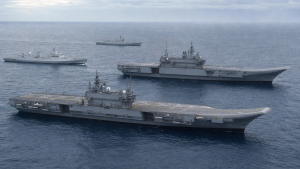
The Indian Navy’s surface combatant fleet combines indigenous shipbuilding, foreign collaboration and phased modernization. For Prelims revision, the most useful approach is to map the fleet by class, project number, displacement and role.
Active Aircraft Carriers and Aviation Upgrades
- Carrier force: The Indian Navy currently operates two active aircraft carriers — INS Vikramaditya, commissioned in 2013, and INS Vikrant, India’s first indigenous aircraft carrier, commissioned in September 2022.
- Rafale-M induction: In April 2025, India finalized a ₹63,000 crore contract with France for 26 Dassault Rafale-M fighters, including 22 single-seat and 4 twin-seat trainers, for deployment from both carriers.
- Replacement role: The Rafale-M fleet will replace the MiG-29K aircraft on carrier decks, with deliveries scheduled from 2028 to 2030.
- IAC-2: The proposed IAC-2 is planned as a repeat Vikrant-class carrier of about 45,000 tonnes, with an estimated cost of ₹40,000 crore and government approval expected in 2026.
- IAC-3 / INS Vishal: INS Vishal is a planned 65,000–70,000-tonne carrier for the 2030s, described as nuclear-capable and intended to use CATOBAR technology.
Guided-Missile Destroyer Projects
- Current destroyer fleet: The Indian Navy has 10 guided-missile destroyers — three Delhi-class (Project 15), three Kolkata-class (Project 15A) and four Visakhapatnam-class (Project 15B).
- Project 15B status: All four stealth destroyers of Project 15B are commissioned: INS Visakhapatnam (2021), INS Mormugao (2022), INS Imphal (2023) and INS Surat (January 15, 2025).
- Shipbuilder: The Visakhapatnam-class destroyers are built by Mazagon Dock Shipbuilders.
- Project 18: Concept finalization in June 2026 outlined a Next-Generation Destroyer class of six to twelve ships, with a displacement of 10,000 to 13,000 tonnes.
- Weapons fit: Project 18 destroyers are planned to carry up to 144 VLS cells.
- Cost estimate: The program is estimated at about ₹80,000 crore.
Frigate Classes and Follow-on Programs
- Existing frigates: The active frigate fleet includes three Shivalik-class (Project 17) ships and six early-batch Talwar-class (Project 1135.6) frigates.
- Project 17A: The Nilgiri-class stealth frigates are being inducted in batches, with six of the seven planned ships commissioned.
- Project 17A ships: The commissioned ships listed in the source are INS Nilgiri, INS Udaygiri, INS Himgiri, INS Taragiri, INS Dunagiri and INS Mahendragiri.
- Final ship: INS Vindhyagiri is the final ship of the class and is undergoing final outfitting for late 2026 delivery.
- Shipyards: Project 17A frigates are being built by Mazagon Dock Shipbuilders and Garden Reach Shipbuilders & Engineers.
- Project 1135.6 follow-on: Russian-built INS Tushil and INS Tamal have been commissioned, while Indian-built sisters Triput and Tavasya are under construction at Goa Shipyard Limited.
- Induction schedule: Triput is slated for October 2026 induction and Tavasya for April 2027.
Corvettes and Next-Generation Corvette Program
- Current corvette fleet: The principal corvette force consists of four Project 28 Kamorta-class anti-submarine warfare corvettes — INS Kamorta, INS Kadmatt, INS Kiltan and INS Kavaratti.
- Role: Project 28 ships are specialized ASW platforms.
- Next-Generation Corvette: The proposed NGC programme is valued at ₹36,000–40,000 crore for eight stealth vessels.
- Approval status: The programme is awaiting Cabinet Committee on Security clearance.
- Allocation: Garden Reach Shipbuilders & Engineers is slated to build five vessels, while Goa Shipyard Limited will build three.
- Bid status: GRSE emerged as the L1 bidder in May 2025 for five vessels.
| Project / Class | Vessel Type | Main Shipyards | Key Deliveries & Status |
| Project 15B (Visakhapatnam-class) | Destroyer | Mazagon Dock Shipbuilders | 4 commissioned; INS Surat commissioned Jan 15, 2025 |
| Project 17A (Nilgiri-class) | Frigate | MDL & GRSE | 6 of 7 commissioned; INS Vindhyagiri due late 2026 |
| Project 1135.6 (Talwar-class) | Frigate | Yantar (Russia) & GSL | INS Tushil/Tamal active; Triput/Tavasya due 2026/27 |
| Project 18 (Next-Gen Destroyer) | Destroyer | To be decided | Concept finalized June 2026; up to 144 VLS cells |
| Project 28 (Kamorta-class) | Corvette | GRSE | 4 active ASW vessels |
Key Prelims Takeaways
- Two carriers: India currently has INS Vikramaditya and INS Vikrant in service.
- Carrier aviation: Rafale-M aircraft will replace MiG-29K fighters on Indian carriers from 2028 onward.
- Destroyer strength: The Navy has 10 guided-missile destroyers across Project 15, 15A and 15B.
- Project 15B: All four Visakhapatnam-class destroyers are commissioned.
- Project 17A: The Nilgiri-class stealth frigate programme is a major domestic construction effort by MDL and GRSE.
- Project 1135.6: The Talwar-class follow-on programme combines Russian and Indian shipbuilding.
- Corvettes: Project 28 Kamorta-class ships are anti-submarine warfare corvettes, while the NGC programme is the next big corvette project.
Current General Studies comprises current-affairs-based, General Studies-rich study material on policies, laws, institutions, economy, science, environment, governance, international relations, and other varied but important topics for UPSC and State PSC Prelims examinations.
Fortnightly PDF compilations: Available here
Originally written on
March 15, 2026
and last modified on
September 5, 2026.
| Related | |
|---|---|