Important National and International Biological Institutions and Museums
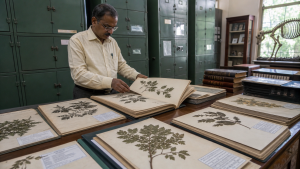
India’s biological institutions and museums are central to documenting flora, fauna, germplasm, fossils and other natural specimens. They support taxonomy, biodiversity conservation, wildlife management and agricultural research, while global organizations and treaties guide biodiversity governance, species trade and data sharing.
Premier Indian Biological and Taxonomic Institutions
- Botanical Survey of India (BSI): Established on 13 February 1890 under Sir George King, with headquarters at Kolkata, West Bengal. It functions under the Ministry of Environment, Forest and Climate Change (MoEFCC).
- BSI core work: Conducts floristic surveys, prepares the National Flora of India, and documents plant resources across all biogeographic zones of the country.
- BSI collections: Maintains the Central National Herbarium at Shibpur, Howrah, which houses over two million plant specimens. It also manages experimental gardens and the Acharya Jagadish Chandra Bose Indian Botanic Garden in Howrah.
- Zoological Survey of India (ZSI): Established on 1 July 1916 under Dr. Thomas Nelson Annandale, arising from the Zoological Section of the Indian Museum. Its head office is at Kolkata and it works under MoEFCC.
- ZSI core work: It is the premier organisation for faunal surveys, taxonomic identification and animal documentation in India.
- ZSI collections: Maintains the National Zoological Collection with over five million identified animal specimens and operates 16 regional stations across varied ecosystems.
- Wildlife Institute of India (WII): Set up in 1982 at Chandrabani, Dehradun, Uttarakhand. It is an autonomous institution under MoEFCC that provides training and academic courses in wildlife research.
- WII functions: Conducts the national tiger census, elephant monitoring and endangered species recovery programmes. It also advises on Environmental Impact Assessment (EIA) for linear infrastructure passing through protected areas.
- Forest Research Institute (FRI): Founded in 1906 as the Imperial Forest Research Institute in Dehradun and now functions under the Indian Council of Forestry Research and Education (ICFRE).
- FRI museums: Houses the Silviculture Museum, Non-Wood Forest Products Museum, Timber Museum and Entomology Museum.
- National Biodiversity Authority (NBA): Located in Chennai, Tamil Nadu, and responsible for implementing the Biological Diversity Act, 2002 under MoEFCC.
- Salim Ali Centre for Ornithology and Natural History (SACON): Located in Coimbatore, Tamil Nadu. It is noted for avian ecology and wetland conservation.
National Bureaus of Genetic Resources
The Indian Council of Agricultural Research (ICAR) maintains five specialised national bureaus to conserve agricultural, animal, fish, microbial and insect biodiversity. These bureaus are important for gene conservation, breeding support and biological resource management.
- National Bureau of Plant Genetic Resources (NBPGR): Located in New Delhi. It manages the National Gene Bank, one of the largest seed repositories globally for crop germplasm.
- National Bureau of Animal Genetic Resources (NBAGR): Located in Karnal, Haryana. It characterises and registers newly identified indigenous breeds of livestock and poultry.
- National Bureau of Fish Genetic Resources (NBFGR): Located in Lucknow, Uttar Pradesh. It maintains live fish gene banks and catalogues marine and freshwater fish diversity.
- National Bureau of Agricultural Insect Resources (NBAIR): Located in Bengaluru, Karnataka. It conducts research on beneficial insects, biological control agents and agricultural pests.
- National Bureau of Agriculturally Important Microorganisms (NBAIM): Located in Mau, Uttar Pradesh. It preserves cultures of plant-growth-promoting rhizobacteria, fungi and actinomycetes.
Major Natural History and Biological Museums in India
Natural history museums preserve holotypes, fossil collections, taxidermy mounts and herbarium sheets. They are essential for research, reference work and public education in biodiversity and evolution.
- National Museum of Natural History (NMNH): Established in 1972 at New Delhi under MoEFCC. It depicts India’s flora, fauna and mineral wealth.
- Regional Museums of Natural History (RMNH): Function under NMNH at Mysuru, Bhopal, Bhubaneswar and Sawai Madhopur.
- Indian Museum: Founded in 1814 in Kolkata by the Asiatic Society. It is the oldest and largest multipurpose museum in India, with zoological, botanical and fossil galleries.
- Bombay Natural History Society (BNHS): Founded in 1883 in Mumbai. It is a non-governmental organisation that curates specimen collections, publishes the Journal of the Bombay Natural History Society and designated Important Bird Areas (IBAs).
- Birbal Sahni Institute of Palaeosciences (BSIP): Located in Lucknow, Uttar Pradesh. It houses fossil plant collections and studies palaeoclimatology and plant evolution.
Key International Biodiversity Bodies and Treaties
Global biodiversity governance depends on intergovernmental bodies, treaty secretariats and scientific platforms. These institutions guide conservation policy, threatened-species assessment, trade regulation and open-access biodiversity data.
| Organisation / Body | Headquarters | Established | Core mandate |
| IUCN | Gland, Switzerland | 1948 | Publishes the IUCN Red List of Threatened Species |
| WWF | Gland, Switzerland | 1961 | Promotes global wildlife conservation and publishes the Living Planet Report |
| CBD Secretariat | Montreal, Canada | 1992 | Administers the Cartagena and Nagoya Protocols |
| CITES | Geneva, Switzerland | 1973 | Regulates international commercial trade in wild animal and plant specimens |
| IPBES | Bonn, Germany | 2012 | Synthesises global scientific assessments on biodiversity loss |
| GBIF | Copenhagen, Denmark | 2001 | Provides an open-access international online database of biological occurrence data |
| CGIAR | Montpellier, France | 1971 | Coordinates international agricultural research centres for food security |
Why These Institutions Matter for Prelims
- Taxonomy and identification: BSI and ZSI are the key Indian bodies for plant and animal classification.
- Specimen preservation: Museums and herbaria preserve reference material such as holotypes, fossils and herbarium sheets.
- Gene conservation: ICAR bureaus safeguard plant, animal, fish, insect and microbial genetic resources.
- Wildlife management: WII and NBA support conservation planning, monitoring and legal implementation.
- Forestry research: FRI remains an important institution for silviculture and forest-related studies.
- International regulation: CBD, CITES and IPBES are central to biodiversity governance and species protection.
Key Prelims Takeaways
- BSI: Kolkata; established in 1890; under MoEFCC; plant taxonomy and floristic surveys.
- ZSI: Kolkata; established in 1916; under MoEFCC; faunal exploration and animal taxonomy.
- WII: Dehradun; established in 1982; tiger census, elephant monitoring and EIA advisory role.
- FRI: Dehradun; founded in 1906; under ICFRE; known for specialised forestry museums.
- NBPGR: New Delhi; manages the National Gene Bank for crop germplasm.
- NBAGR, NBFGR, NBAIR, NBAIM: Located at Karnal, Lucknow, Bengaluru and Mau respectively; each preserves a different category of genetic resource.
- Important global bodies: IUCN, WWF, CBD Secretariat, CITES, IPBES, GBIF and CGIAR are must-remember names for prelims.
| Related | |
|---|---|