Major Central and State Infrastructure Development Schemes
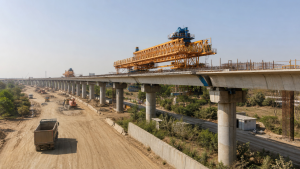
India’s infrastructure strategy is built around large central and state schemes that link transport, housing, urban services and logistics reform. The focus is on faster project delivery, better asset use, and coordinated planning to reduce costs and improve connectivity.
National Infrastructure Pipeline and Monetisation
- National Infrastructure Pipeline (NIP): Launched in 2019 with an initial cohort of about 6,800 projects, the NIP has expanded to 14,563 projects as of March 2026.
- Sector coverage: These projects span 33 sectors and 79 sub-sectors, with a cumulative investment value of ₹213 trillion.
- National Monetisation Pipeline (NMP) 1.0: This asset recycling initiative was designed to unlock value from brownfield public assets by leasing them to private operators.
- NMP 1.0 performance: It completed nearly 90% of its overall target of ₹6 lakh crore, setting a model for capital recycling.
- NMP 2.0: Launched in February 2026, it covers FY 2026 to FY 2030.
- NMP 2.0 target: The aggregate asset monetization target is ₹16.72 lakh crore, including a projected ₹5.8 lakh crore in private investment.
PM GatiShakti and Logistics Reform
- GIS-based planning: PM GatiShakti functions as a geospatial platform to coordinate multi-modal connectivity projects across administrative boundaries.
- Institutional coverage: As of August 2026, 58 Central Ministries and Departments and all 36 States and Union Territories were onboarded.
- Data layers: The platform shares over 1,800 standardized geospatial data layers for infrastructure planning.
- Public portal: Launched in September 2025, the PM GatiShakti Public Platform gives regulated, query-based access to 230 non-sensitive geospatial datasets.
- Use for the private sector: The spatial data helps private entities plan logistical routes and industrial projects.
- Logistics cost: In a late-2025 assessment, DPIIT and NCAER estimated India’s logistics cost at 7.9% of GDP.
Urban Infrastructure and Housing Initiatives
- Smart Cities Mission: The mission formally concluded on March 31, 2025, after a final extension.
- Project completion: By January 15, 2026, it had completed 7,767 of 8,064 planned projects, with expenditure of ₹1,64,811 crore.
- Integrated Command and Control Centres: All 100 designated smart cities established functional ICCCs under the mission.
- AMRUT 2.0: The Atal Mission for Rejuvenation and Urban Transformation 2.0 runs through FY 2025–26 with an indicative outlay of ₹2.77 lakh crore.
- AMRUT focus: It targets statutory towns and aims to provide 2.68 crore tap connections and 2.64 crore sewer and septage connections.
- PMAY-Gramin (PMAY-G): The rural housing scheme has been extended until March 31, 2029.
- PMAY-G target: It has an aggregate target of about 4.95 crore rural houses, with 3.06 crore units completed as of June 2026.
- PMAY-Urban 2.0: This phase provides housing assistance to 1 crore urban poor and middle-class families.
- Funding support: The central government has allocated up to ₹2.50 lakh crore for PMAY-U 2.0.
Connectivity and Port-Led Development
- Bharatmala Pariyojana: Under Phase-I, 22,709 km of roads were constructed out of 26,425 km awarded up to May 2026.
- Project sanctions: Fresh project sanctions under Phase-I were discontinued in November 2023 to focus on completing pending works.
- Sagarmala Programme: Out of 845 identified projects, 315 projects valued at ₹1.57 lakh crore were completed by late March 2026.
- Pipeline of works: Another 210 projects remain under implementation, with the total portfolio valued at ₹6.06 lakh crore.
- Port turnaround time: The average turnaround time for vessels at major Indian ports fell to 48.84 hours in FY 2025–26 from 96 hours in 2014.
- National Waterways: Cargo volume carried through National Waterways reached 218 million metric tons in FY 2025–26.
Key Prelims Takeaways
- NIP scale: 14,563 projects across 33 sectors and 79 sub-sectors, with an investment value of ₹213 trillion.
- NMP 2.0 period: FY 2026 to FY 2030, with a monetization target of ₹16.72 lakh crore.
- PM GatiShakti coverage: 58 Central Ministries/Departments and all 36 States/UTs are onboarded.
- Public geospatial access: The PM GatiShakti Public Platform provides access to 230 non-sensitive datasets.
- Smart Cities Mission: Ended on March 31, 2025; 7,767 projects completed and all 100 ICCCs operational.
- PMAY-G: Extended till March 31, 2029, with a target of about 4.95 crore rural houses.
- Ports and waterways: Major port turnaround time improved to 48.84 hours, while National Waterways cargo reached 218 million metric tons in FY 2025–26.
Current General Studies comprises current-affairs-based, General Studies-rich study material on policies, laws, institutions, economy, science, environment, governance, international relations, and other varied but important topics for UPSC and State PSC Prelims examinations.
Fortnightly PDF compilations: Available here
Originally written on
March 12, 2026
and last modified on
September 5, 2026.
| Related | |
|---|---|