Rohingya Crisis: Timeline, Key Facts and International Responses
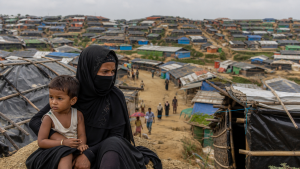
The Rohingya crisis is one of Asia’s most protracted humanitarian and legal emergencies. The Rohingya, a stateless Indo-Aryan Muslim minority from Myanmar’s Rakhine State, have faced repeated waves of persecution, displacement and denial of citizenship.
Most refugees have sought shelter in Bangladesh, where overcrowded camps, limited resources and uncertain legal status have kept the crisis active for decades. The issue now combines humanitarian relief, regional burden-sharing and international accountability.
Origins of Statelessness and Conflict in Rakhine
- Myanmar Citizenship Act, 1982: The law recognized 135 national ethnic groups but excluded the Rohingya, effectively stripping them of citizenship and leaving them stateless.
- Rakhine State: Also known historically as Arakan, it lies on Myanmar’s western coast, bordering the Naf River and Bangladesh’s Chittagong Division.
- Long cycles of violence: Major military operations in 1978, 1991–1992 and August 2017 triggered large-scale refugee movements into Bangladesh.
- 2017 clearance operations: These operations caused the most significant outflow in recent history and turned the Rohingya issue into a major global humanitarian concern.
- Arakan Army (AA): This ethnic armed group has gained control over a substantial part of Rakhine State, including the entire land border with Bangladesh, pushing back the Myanmar military.
- Hoyyar Siri massacre: Human Rights Watch documented that Arakan Army fighters opened fire on Rohingya civilians in Buthidaung Township in May 2024, killing at least 170 people during their advance.
Rohingya Refugees in Bangladesh
- Registered population: As of June 30, 2026, Bangladesh officially hosts 1,200,171 registered Rohingya refugees.
- Women and children: Vulnerable groups, including women and children, make up over 75% of the refugee population.
- Main settlement area: The vast majority live in 33 overcrowded camps in Cox’s Bazar district.
- Kutupalong: This is the largest refugee settlement in the world and remains the best-known camp complex in the area.
- Bhasan Char relocation: Since the decongestion project launched in 2021, about 35,000 Rohingya refugees have been moved to Bhasan Char.
- Bhasan Char: It is an island formed of Himalayan silt in Noakhali district, developed to reduce pressure on Cox’s Bazar camps.
- Legal position in Bangladesh: Bangladesh is not a party to the 1951 Refugee Convention or its 1967 Protocol and manages the crisis through executive and administrative measures.
Joint Response Plan for Humanitarian Support
The refugee response in Bangladesh is coordinated through the Joint Response Plan (JRP), which brings together UN agencies and humanitarian partners to manage funding and logistics for the camps.
| Parameter | Details |
| Coordinating bodies | United Nations agencies and humanitarian partners |
| Funding target (2025) | USD 934.5 million |
| Target population | 1.48 million Rohingya refugees and Bangladeshi host communities |
| Framework duration | Two-year plan (2025–26), launched on March 24, 2025 |
- Core priorities: The JRP focuses on food security, healthcare, water, sanitation and protection services inside the camps.
- Host community support: The plan also covers the ecological and economic burden on Bangladeshi host communities.
- Funding challenge: The crisis remains heavily dependent on international aid, making regular financing a key concern.
International Legal Actions and Accountability
- The Gambia v. Myanmar: In 2019, The Gambia filed a case at the International Court of Justice (ICJ) under the Genocide Convention.
- Provisional measures: In January 2020, the ICJ unanimously ordered Myanmar to prevent genocidal acts against the Rohingya and preserve evidence.
- Merits hearings: Public hearings were held in The Hague from January 12 to 29, 2026, and the case remains under deliberation.
- Third-party interventions: Eleven countries, including Canada, Denmark, France, Germany, the Netherlands and the United Kingdom, have intervened in the case.
- ICC action: On November 27, 2024, the ICC Prosecutor requested an arrest warrant against Senior General Min Aung Hlaing for crimes against humanity, including deportation and persecution.
- Current status: The arrest warrant application remains pending before Pre-Trial Chamber I of the ICC as of September 2026.
Why the Issue Matters for Prelims
- Statelessness: The Rohingya are one of the world’s largest stateless populations.
- Regional displacement: Bangladesh hosts the bulk of the refugees, making it central to any solution.
- Humanitarian burden: Cox’s Bazar is the main operational focus for relief, shelter and protection.
- Legal significance: The ICJ case is linked to the 1948 Genocide Convention.
- Accountability mechanisms: The ICC process shows the role of international criminal justice in mass atrocity cases.
- Conflict actors: The Tatmadaw is Myanmar’s official military, while the Arakan Army is an ethnic armed group active in Rakhine.
- Relocation site: Bhasan Char is used for decongestion, but the core refugee concentration remains in Cox’s Bazar.
Key Prelims Takeaways
- 1982 Citizenship Law: The key legal act that excluded the Rohingya from Myanmar citizenship.
- Cox’s Bazar: The main cluster of Rohingya camps in Bangladesh.
- Bhasan Char: The relocation island used to reduce congestion in refugee camps.
- Bangladesh’s legal status: It has not signed the 1951 Refugee Convention or the 1967 Protocol.
- ICJ case: The Gambia v. Myanmar concerns alleged violations of the Genocide Convention.
- Tatmadaw and AA: The Tatmadaw is Myanmar’s military; the Arakan Army is the armed ethnic group active in Rakhine.
- ICC move: The ICC Prosecutor has sought an arrest warrant against Min Aung Hlaing.
Current General Studies comprises current-affairs-based, General Studies-rich study material on policies, laws, institutions, economy, science, environment, governance, international relations, and other varied but important topics for UPSC and State PSC Prelims examinations.
Fortnightly PDF compilations: Available here
Originally written on
March 12, 2026
and last modified on
September 5, 2026.
| Related | |
|---|---|