Types of Technology Transfer in Defence Sector
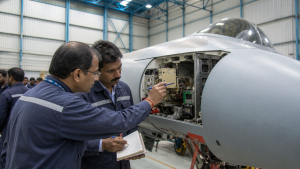
Technology transfer in the defence sector is the structured sharing of design, manufacturing, testing, and integration know-how from a developer to another entity for licensed production. It helps build domestic capability, reduce import dependence, and support self-reliance in military manufacturing.
Categorization of Defence Technology Transfer
Defence technology transfers can be classified based on direction, technical depth, and procurement models.
Classification by Direction
- Vertical Technology Transfer: This transfer occurs between entities at different stages of the research and production chain. It usually moves technology from government research laboratories to commercial manufacturers. An example is the Defence Research and Development Organisation (DRDO) transferring conventional missile designs to private industries for mass production.
- Horizontal Technology Transfer: This transfer occurs between entities operating at similar stages of the production or supply chain. It can happen between two defence companies or across different countries. An example is the transfer of manufacturing technology from a foreign Original Equipment Manufacturer (OEM) to a domestic Defence Public Sector Undertaking (DPSU).
Classification by Technical Depth
- Know-How Transfer (Build-to-Print): This type involves sharing the operational steps and assembly procedures required to manufacture a product. The recipient receives the blueprints and follows exact instructions to assemble the system. It does not explain the engineering principles behind the design.
- Know-Why Transfer (Build-to-Specs): This transfer includes the design philosophy, core mathematical formulas, metallurgy, and scientific reasoning behind a technology. The recipient gains a deep understanding of why specific components function in a certain way. It enables redesign, upgrades, or next-generation development.
| Feature | Know-How (Build-to-Print) | Know-Why (Build-to-Specs) |
| Focus | Production and assembly techniques | Core design philosophy and engineering principles |
| Independence | Low; dependent on supplier for upgrades | High; recipient can modify or upgrade the technology |
| Complexity | Moderate; involves following documentation | Very high; involves transferring scientific research |
| Availability | Easily shared by foreign OEMs | Kept highly secure and rarely shared |
Operational Modes of Defence Technology Transfer
Governments and defence firms use specific contractual frameworks to execute these transfers.
Licensed Production
- A foreign supplier grants a domestic manufacturer the license to produce a specific military platform locally.
- The production usually progresses through sequential phases.
- It begins with Fully Formed (FF) imports, followed by Semi-Knocked Down (SKD) kits, Completely Knocked Down (CKD) kits, and eventually Licensed Manufacture (LM) from raw materials.
- An example is Hindustan Aeronautics Limited (HAL) producing the Sukhoi Su-30MKI fighter aircraft under Russian license.
Co-Development and Co-Production
- Two or more nations jointly invest, research, design, and manufacture a defence platform.
- The collaborating entities share financial risks, intellectual property rights, and production tasks from the initial stage.
- This model ensures access to core technology.
- The BrahMos supersonic cruise missile, developed jointly by India and Russia, is an example of this model.
Defence Offset Agreements
- Defence offset policies mandate that a foreign supplier must invest a portion of the contract value back into the purchasing nation’s domestic industry.
- The foreign supplier can fulfill this obligation by transferring advanced technology to local partners.
- It aims to strengthen the domestic supply chain and encourage investment in local research and development.
Strategic Partnerships
- This model pairs global technology providers with domestic private sector companies to establish local manufacturing hubs.
- It focuses on creating long-term manufacturing capabilities for complex platforms like submarines, fighter jets, and helicopters.
- The purchasing government selects domestic private firms to receive the technology and act as system integrators.
Spin-Off and Spin-In Technology
- Spin-Off: This refers to transferring military-developed technology into the civilian sector. An example is using military-grade Kevlar for civilian safety gear, or DRDO’s biodigester technology being used by public railways.
- Spin-In: This refers to adapting advanced commercial civilian technologies into military systems. Examples include using commercial artificial intelligence, civilian software, or commercial-off-the-shelf (COTS) electronic components in defence equipment.
Stages of Technology Absorption in Defence
In a standard ToT contract, technology absorption follows a step-by-step pathway to ensure local workers can handle the manufacturing processes.
- Fully Formed (FF) Stage: The buyer imports the complete system directly from the OEM to meet urgent operational requirements.
- Semi-Knocked Down (SKD) Stage: The buyer imports major sub-assemblies and puts them together at domestic facilities.
- Completely Knocked Down (CKD) Stage: The buyer imports individual components and performs complete assembly, integration, and testing locally.
- Indigenous Manufacture (IM) Stage: The buyer sources raw materials locally, manufactures components domestically, and carries out full assembly under license.
Key Policy Frameworks in India
India uses structured regulatory guidelines to manage technology inflows and build domestic capacity.
DRDO Technology Transfer Policy 2025
- The Ministry of Defence released this policy to simplify the transfer of technologies to domestic firms.
- It aims to ease the compliance burden and promote the participation of MSMEs and startups in the defence sector.
- The policy uses Licensing Agreements for Transfer of Technology (LATOT) to hand over tested technologies to domestic industry partners.
- Under this framework, DRDO provides handholding support, technical documents, and quality assurance guidelines to ensure smooth production.
Development-cum-Production Partner (DcPP) Model
- This model involves private industries right from the design phase of a defence project.
- The private firm acts as both a development partner and the primary production agency, reducing the overall time taken to transition from lab to factory.
- The Indian government approved the transfer of technology of all conventional missile systems to the domestic private industry under this model.
Challenges in Defence Technology Transfer
- IPR Restrictions: Foreign suppliers protect intellectual property rights tightly. They often restrict the export of finished products to third-party countries.
- Absorption Capability: The recipient nation must possess the industrial infrastructure and skilled workforce to use advanced technical drawings. Without proper absorption capacity, ToT becomes mere assembly.
- Obsolescence: By the time a technology is transferred, licensed, and enters mass production, it may become obsolete compared to newer global standards.
- High Costs: Buying both know-how and know-why is expensive. Governments often compromise by purchasing only assembly licenses due to budget constraints.
Technology absorption in defence manufacturing means the industry’s capacity to assimilate and use transferred technical knowledge for production.
In October 2025, the Ministry of Defence expanded the private sector’s role by opening the development and manufacturing of missiles, artillery shells, and ammunition.
On August 25, 2026, Union Defence Minister Rajnath Singh approved the transfer of technology of all DRDO-developed conventional missile systems to Indian industries for domestic production.
Rare Facts for Prelims
- Conventional missile systems: These are non-nuclear missile platforms used for strike, air defence, and tactical roles.
- DRDO: The Defence Research and Development Organisation functions under the Ministry of Defence.
- MSME link: The technology transfer framework integrates MSMEs classified under the Micro, Small and Medium Enterprises Development Act, 2006 into the missile supply chain.
- Aatmanirbhar Bharat link: Defence ToT supports domestic design, manufacturing, and lifecycle support to reduce import dependence.
- Qualified firms: Eligible Indian companies can manufacture conventional missile systems only after meeting qualification, certification, and regulatory requirements.
- Innovation diffusion: Defence ToT often spreads innovation from public laboratories to private industry, creating wider industrial capability beyond the original project.
| Related | |
|---|---|