Key CSIR Laboratories and Their Contributions
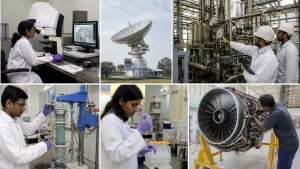
The Council of Scientific and Industrial Research (CSIR) is India’s largest public research network, with laboratories working across science, technology, and industry-linked innovation. Its institutes have made major contributions in metrology, health, aerospace, food technology, environment, and materials science.
Overview of CSIR and Its Network
Established in 1942, CSIR functions as an autonomous body under the Ministry of Science and Technology. The Prime Minister of India serves as its ex-officio President. CSIR operates 37 national laboratories across India, supporting scientific institutions, public research capacity, and industry collaboration.
Key CSIR Laboratories and Locations
| Laboratory Name | Location | Primary Research Focus |
| CSIR-National Physical Laboratory (NPL) | New Delhi | Metrology, physical standards, and timekeeping |
| CSIR-Centre for Cellular and Molecular Biology (CCMB) | Hyderabad | Molecular biology, genetics, and wildlife forensics |
| CSIR-Central Drug Research Institute (CDRI) | Lucknow | New drug discovery and pharmaceutical research |
| CSIR-National Chemical Laboratory (NCL) | Pune | Chemical sciences, polymer chemistry, and catalysis |
| CSIR-Central Food Technological Research Institute (CFTRI) | Mysore | Food science, food safety, preservation, and nutrition |
| CSIR-National Environmental Engineering Research Institute (NEERI) | Nagpur | Environmental monitoring, water treatment, and air quality |
| CSIR-National Aerospace Laboratories (NAL) | Bengaluru | Aerospace engineering and civil aircraft development |
| CSIR-Central Road Research Institute (CRRI) | New Delhi | Highway engineering, road materials, and traffic safety |
| CSIR-Central Electrochemical Research Institute (CECRI) | Karaikudi | Electrochemistry, battery technology, and corrosion control |
| CSIR-Central Salt & Marine Chemicals Research Institute (CSMCRI) | Bhavnagar | Marine chemicals, salt, desalination, and seaweed |
| CSIR-Institute of Genomics and Integrative Biology (IGIB) | Delhi | Genomics, molecular medicine, and genome sequencing |
Detailed Laboratory Contributions
Each CSIR laboratory specializes in a distinct domain and develops technologies that support public health, defense, agriculture, and civilian welfare.
CSIR-National Physical Laboratory (NPL), New Delhi
CSIR-NPL serves as the National Metrology Institute of India and maintains national standards for physical measurements.
- Timekeeper of the Nation: CSIR-NPL is the custodian of Indian Standard Time (IST). It generates time using cesium atomic clocks and hydrogen masers, linked to Coordinated Universal Time (UTC).
- Indelible Ink: Developed in 1952, this ink contains silver nitrate and is used in elections to prevent duplicate voting.
- Bhartiya Nirdeshak Dravya: CSIR-NPL produces certified reference materials for quality control and instrument calibration.
- Constitution Preservation: NPL scientists built special gas-filled chambers to house the original physical copies of the Constitution of India.
CSIR-Centre for Cellular and Molecular Biology (CCMB), Hyderabad
CSIR-CCMB conducts advanced research in biotechnology, genomics, and cellular processes.
- DNA Fingerprinting: Under the leadership of former director Lalji Singh, CCMB developed indigenous DNA fingerprinting technology. Lalji Singh is known as the Father of Indian DNA Fingerprinting.
- Wildlife Forensics: The laboratory established LaCONES to use DNA barcoding for tracking illegal wildlife trade and protecting endangered species.
- Population Genomics: CCMB mapped the genetic history of Indian populations and studied early human migration from Africa.
CSIR-Central Drug Research Institute (CDRI), Lucknow
Inaugurated in 1951, CSIR-CDRI is a major center for pharmaceutical development and drug design.
- Saheli (Centchroman): CDRI developed Centchroman, marketed as Saheli, the world’s first non-steroidal, non-hormonal, weekly oral contraceptive pill.
- Arteether: The institute developed Alpha-Beta Arteether, an important antimalarial drug used against chloroquine-resistant malaria.
- Memory Enhancers: CDRI created standardized herbal formulations such as BESEB (Memory Sure) for cognitive health.
CSIR-National Chemical Laboratory (NCL), Pune
CSIR-NCL works in chemistry, chemical engineering, and polymer sciences.
- Catalytic Materials: The laboratory developed zeolite catalysts used in petroleum refining and petrochemical processing.
- Dimethyl Ether Process: NCL formulated an indigenous catalytic process to produce Dimethyl Ether (DME) from methanol.
- Water Retention Hydrogels: Scientists created super-absorbent polymers that help retain moisture in soil.
- Plant Tissue Culture: NCL pioneered micropropagation protocols for high-value crops and bamboo.
CSIR-Central Food Technological Research Institute (CFTRI), Mysore
CSIR-CFTRI drives innovation in food preservation, processing, and nutritional security.
- Amul Infant Food: CFTRI developed technology to produce baby milk powder from buffalo milk.
- Food Mechanization: The institute designed automated machinery for idlis, dosas, and chapatis.
- Biodegradable Leaf Cup Machine: CFTRI developed automated machines to press leaf plates and cups as a sustainable alternative to single-use plastics.
- Fortified Food Products: The laboratory created double-fortified salt containing iron and iodine.
CSIR-National Environmental Engineering Research Institute (NEERI), Nagpur
CSIR-NEERI focuses on environmental protection, waste utilization, and pollution control.
- Green Crackers: NEERI developed green crackers named SWAS, STAR, and SAFAL, which reduce particulate matter emissions and exclude toxic barium compounds.
- NEERI-Wheel: This portable wheeled water filtration unit provides clean drinking water during floods and in remote rural areas.
- RENEU Technology: NEERI developed this phytoremediation technology to restore polluted urban drains using natural plants.
CSIR-National Aerospace Laboratories (NAL), Bengaluru
CSIR-NAL is India’s primary civilian aerospace research facility.
- Civilian Aircraft: NAL designed and built SARAS, a multi-purpose light transport aircraft, and HANSA, a two-seater basic trainer aircraft.
- Carbon Composites: The laboratory developed carbon-fiber composite materials used in the Tejas Light Combat Aircraft.
- Drishti System: NAL created the Drishti transmissometer to measure runway visibility and aid pilots during low-visibility operations.
- Compact Gas Turbine Engines: CSIR-NAL developed indigenous micro and small gas turbine engines, including NJ-05, NJ-50, and NJ-100, for defence applications such as tactical UAVs, drone interceptors, and compact missile systems.
CSIR-Central Road Research Institute (CRRI), New Delhi
CSIR-CRRI specializes in road construction, highway engineering, and transport planning.
- Steel Slag Roads: CRRI developed a method to use industrial steel slag waste in road construction.
- Cold Mix Technology: The institute formulated a cold mix binder for building roads in cold, high-altitude, and heavy-rainfall regions without heating bituminous material.
CSIR-Central Electrochemical Research Institute (CECRI), Karaikudi
CSIR-CECRI is the largest electrochemical research center in South Asia.
- Battery Technology: CECRI is developing indigenous lithium-ion and sodium-ion battery prototypes.
- Corrosion Control: The laboratory formulated anti-corrosion coatings for concrete structures, pipelines, and naval vessels.
- Titanium Substrate Insoluble Anodes: CECRI introduced these anodes to the Indian chlor-alkali industry to reduce energy consumption in chemical production.
CSIR-Central Salt & Marine Chemicals Research Institute (CSMCRI), Bhavnagar
CSMCRI works on marine resources, desalination, and salt purification.
- Desalination Membranes: The institute developed high-performance reverse osmosis membranes used in seawater desalination plants.
- Seaweed Liquid Fertilizer: CSMCRI formulated liquid fertilizers from brown seaweeds to improve crop yields and soil health.
CSIR-Institute of Genomics and Integrative Biology (IGIB), Delhi
CSIR-IGIB conducts research on genome sequencing and clinical diagnostics.
- IndiGen Program: IGIB led whole-genome sequencing of diverse Indian individuals to map genetic variations and study rare hereditary diseases.
- Feluda Paper-Strip Test: The laboratory developed Feluda, a low-cost CRISPR-based paper strip test for rapid diagnosis of viral infections.
Multi-Institutional and Mission Mode Projects
CSIR laboratories often collaborate on large-scale national projects to address agricultural and industrial challenges.
- Menthol Mint Revolution: Collaborative work by CSIR-CIMAP and other labs transformed India from an importer into a global exporter of menthol mint.
- Swaraj Tractor: CSIR-CMERI in Durgapur designed India’s first completely indigenous tractor in 1974, aiding agricultural mechanization.
- Ksheer-Scanner: Developed by CSIR-CEERI, this electronic system detects milk adulteration and identifies additives like urea, salt, detergent, and boric acid.
- BGR-34: CSIR-NBRI and CSIR-CIMAP jointly developed this Ayurvedic formulation for managing Type-II diabetes.
Important: CSIR-NAL is a constituent laboratory of CSIR, and its compact gas turbine engines are relevant for defence and unmanned systems.
Director General: Dr. N. Kalaiselvi is the Director General of CSIR and Secretary of DSIR.
Director, CSIR-NAL: Dr. Abhay A. Pashilkar is the Director of CSIR-NAL.
Recent Context
CSIR-NAL’s indigenous NJ-05, NJ-50, and NJ-100 engines highlight India’s push for compact propulsion technologies. The program also reflects growing defence-relevant research in high-RPM turbomachinery and high-temperature combustion systems.
Rare Facts for Prelims
- IST Custodian: CSIR-NPL maintains Indian Standard Time using atomic clocks and time transfer links to UTC.
- First Indian DNA Fingerprinting: Lalji Singh’s work at CCMB made DNA fingerprinting an important forensic tool in India.
- Weekly Oral Contraceptive: Saheli remains a notable Indian innovation in non-hormonal contraception.
- Green Crackers: NEERI’s cracker formulations are designed to lower emissions compared to conventional fireworks.
- RO Membranes: CSMCRI’s desalination membranes support drinking water supply in coastal regions.
- CrISPR-Based Diagnosis: Feluda was among India’s early low-cost paper-strip diagnostic innovations based on CRISPR technology.
| Related | |
|---|---|