Chronology of Major Global Events and Turning Points
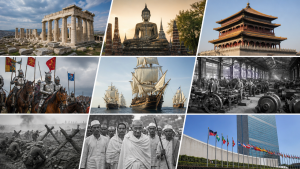
Human history is marked by a series of turning points that reshaped states, economies, religions, and global power. A quick chronological review helps in revision because many Prelims questions link events to their broader historical consequences.
From the rise of agriculture and writing to revolutions, world wars, and decolonization, each phase created the foundations of the modern international order. The sequence below highlights the major milestones in a compact, exam-oriented format.
Ancient Era: Foundations of Civilization and Classical Empires
Dawn of Agriculture and Urbanization
- Neolithic Revolution (c. 10,000 BCE): The shift from hunter-gathering to settled agriculture and animal domestication began in the Fertile Crescent.
- River Valley Civilizations (c. 3500 BCE – 2500 BCE): Mesopotamian, Egyptian, Indus Valley, and Chinese civilizations developed early administration, irrigation, and written scripts.
- Invention of Writing (c. 3300 BCE): Sumerians developed cuneiform in Mesopotamia, marking the transition from prehistory to recorded history.
Classical Age and Imperial Expansion
- Greco-Persian Wars (499–449 BCE): Greek city-states resisted Achaemenid Persian invasions, preserving Athenian political structures and early democratic ideals.
- Conquests of Alexander the Great (334–323 BCE): Greek influence expanded across Egypt, Persia, and northwestern India, beginning the Hellenistic period.
- Unification of China (221 BCE): Qin Shi Huang unified China under the Qin Dynasty, standardized measures, and began Great Wall construction.
- Establishment of the Roman Empire (27 BCE): Octavian became Augustus, replacing the Roman Republic with an imperial system dominating the Mediterranean basin.
- Collapse of the Western Roman Empire (476 CE): Odoacer deposed Emperor Romulus Augustulus, ending centralized Roman rule in Western Europe and opening the early medieval period.
Medieval Era: Faith, Expansion, and Trade Networks
Rise of World Religions and Trans-Regional Trade
- Origins and Spread of Islam (622 CE): The Hijra from Mecca to Medina laid the basis for the Caliphates, which expanded across the Middle East, North Africa, and Iberia.
- Coronation of Charlemagne (800 CE): Pope Leo III crowned Charlemagne Emperor of the Romans, leading to the Holy Roman Empire in Western Europe.
- The Great Schism (1054 CE): The Eastern Orthodox Church in Constantinople and the Roman Catholic Church in Rome formally split.
- The Crusades (1095–1291 CE): Military expeditions to capture Jerusalem stimulated Mediterranean trade and cultural exchange between Europe and the Islamic world.
Mongol Conquests and Interconnected Eurasia
- Rise of the Mongol Empire (1206 CE): Genghis Khan united the Mongol tribes and created the largest contiguous land empire, securing Pax Mongolica across the Silk Road.
- Signing of Magna Carta (1215 CE): King John of England signed the document, placing limits on monarchical power and laying early foundations of constitutional law.
- The Black Death (1346–1353 CE): Bubonic plague killed an estimated 30% to 60% of Europe’s population, reshaping feudal economies and labor markets.
- Fall of Constantinople (1453 CE): Ottoman Sultan Mehmed II captured the Byzantine capital, ending the Eastern Roman Empire and encouraging European search for sea routes to Asia.
Early Modern Era: Exploration, Reform, and Revolutions
Age of Discovery and Scientific Awakening
- Invention of the Printing Press (c. 1440 CE): Johannes Gutenberg’s movable metal type accelerated literacy, scientific exchange, and information spread.
- Voyage of Christopher Columbus (1492 CE): His arrival in the Americas began the Columbian Exchange of crops, diseases, technologies, and populations across the Atlantic.
- Protestant Reformation (1517 CE): Martin Luther published the Ninety-five Theses, splitting Western Christianity and triggering long religious conflicts in Europe.
- Treaty of Westphalia (1648 CE): It ended the Thirty Years’ War and established principles of state sovereignty, territorial integrity, and non-interference in domestic affairs.
Age of Political and Industrial Revolutions
- Industrial Revolution (c. 1760 CE): Beginning in Great Britain, mechanization, steam power, and factory production shifted economies from agrarian to industrial output.
- American Revolution (1776 CE): The thirteen North American colonies issued the Declaration of Independence and formed a federal constitutional republic based on Enlightenment ideals.
- French Revolution (1789 CE): It overthrew the Bourbon monarchy, issued the Declaration of the Rights of Man and of the Citizen, and challenged feudal structures.
- Meiji Restoration in Japan (1868 CE): The end of the Tokugawa Shogunate restored imperial rule and began rapid industrialization and military modernization.
Contemporary Era: World Wars, Cold War, and Globalization
Era of Global Conflicts
- World War I (1914–1918 CE): Triggered by the assassination of Archduke Franz Ferdinand, it led to the collapse of the German, Austro-Hungarian, Ottoman, and Russian empires.
- Russian Revolution (1917 CE): Bolsheviks led by Vladimir Lenin overthrew the Russian Provisional Government, leading to the USSR.
- Great Depression (1929 CE): The Wall Street crash triggered a global economic downturn, protectionism, and political extremism.
- World War II (1939–1945 CE): Axis and Allied powers fought across multiple theaters, ending with the atomic bombings of Hiroshima and Nagasaki and the formation of the United Nations.
Bipolar World and Post-Cold War Order
- Beginning of Decolonization (1947 CE): Indian independence marked the weakening of the British Empire and triggered decolonization across Asia and Africa.
- Cold War Dynamics (1947–1991 CE): The United States and the USSR entered an ideological and geopolitical rivalry marked by alliances such as NATO and the Warsaw Pact and by proxy wars.
- Fall of the Berlin Wall and USSR Collapse (1989–1991 CE): These events symbolized the end of the Cold War and the dissolution of the Soviet Union.
Key Prelims Takeaways
- Neolithic Revolution: Marks the beginning of settled agriculture and domestication in the Fertile Crescent.
- Writing and cities: Cuneiform and river valley civilizations are key markers of early state formation.
- Westphalia (1648): Important for the principles of sovereignty and territorial integrity.
- Magna Carta (1215): Often asked for its role in limiting royal power and constitutional development.
- Industrial Revolution: Associated with mechanization, steam power, and factory production.
- World War II: Linked to the UN, nuclear bombings, and the post-war international order.
- Cold War: Know the rivalry between the USA and USSR, along with NATO and the Warsaw Pact.
Current General Studies comprises current-affairs-based, General Studies-rich study material on policies, laws, institutions, economy, science, environment, governance, international relations, and other varied but important topics for UPSC and State PSC Prelims examinations.
Fortnightly PDF compilations: Available here
Originally written on
May 10, 2026
and last modified on
September 6, 2026.
| Related | |
|---|---|