Major National Child Health and Nutrition Programmes
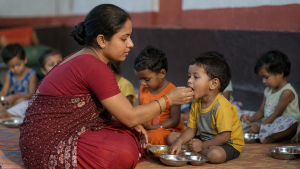
India runs multiple child health and nutrition programmes to reduce malnutrition, prevent disease, and improve survival and development from birth to adolescence. These interventions are spread across the Ministry of Women and Child Development and the Ministry of Health and Family Welfare, with school nutrition support under the Ministry of Education.
Mission Saksham Anganwadi and Poshan 2.0
Mission Saksham Anganwadi and Poshan 2.0 is a Centrally Sponsored integrated nutrition support programme implemented by the Ministry of Women and Child Development. It is being implemented during the 15th Finance Commission cycle, from FY 2021-22 to FY 2025-26.
- Objective: To address malnutrition among children, adolescent girls, pregnant women, and lactating mothers through a more focused nutrition delivery framework.
- Consolidated schemes: It combines the Supplementary Nutrition Programme, POSHAN Abhiyaan, Scheme for Adolescent Girls, and National Creche Scheme.
- Budget support: For FY 2025-26, the Union Budget allocated ₹21,960 crore, which was 10.2% higher than the previous year’s allocation.
- Transparency: The Poshan Tracker mobile application is used to track beneficiaries and reduce leakages.
- Aadhaar seeding: As of July 24, 2026, 99.88% of registered beneficiaries were Aadhaar-verified through the platform.
PM POSHAN Scheme
The Pradhan Mantri Poshan Shakti Nirman (PM POSHAN) Scheme, earlier known as the Mid-Day Meal Scheme, is a centrally sponsored programme under the legislative mandate of the National Food Security Act (NFSA), 2013.
- Coverage: It provides one hot cooked meal per day to children in Bal Vatika (pre-school) and Classes I to VIII in Government and Government-aided schools.
- Main aims: To improve nutritional status, support school enrolment, increase attendance, and promote social integration.
- Legal basis: The scheme derives support from the NFSA, 2013, which gives school-based nutrition a statutory backing.
- Extension: In June 2026, the Union Government extended the scheme beyond March 31, 2026, up to September 30, 2026, or until formal approval under the 16th Finance Commission cycle, whichever is earlier.
Rashtriya Bal Swasthya Karyakram (RBSK) 2.0
Rashtriya Bal Swasthya Karyakram is an initiative under the National Health Mission aimed at early identification and early intervention for children. The Ministry of Health and Family Welfare released updated RBSK 2.0 guidelines on May 3, 2026.
- Original framework: The scheme was based on the “4Ds” — Defects at Birth, Diseases, Deficiencies, and Developmental Delays.
- Expanded scope: RBSK 2.0 covers 38 common health conditions for children from birth to 18 years.
- New focus areas: The updated framework includes non-communicable disease risk factors, mental health conditions, and behavioural concerns.
- Exam significance: It extends child screening beyond basic physical conditions to wider developmental and adolescent health concerns.
Samagra Shishu Bal Swasthya Karyakram (SSBSK)
Launched on June 29, 2026, the Samagra Shishu Bal Swasthya Karyakram aims to create an uninterrupted 36-month continuum of care under the vision Pehle Teen Saal Sampoorn Dekhbhal (Complete Care for the First Three Years).
- Integration: It brings together Home-Based Newborn Care (HBNC) and Home-Based Care for Young Child (HBYC) into one framework.
- Home visits for at-risk newborns: Such newborns receive up to nine home visits during the first 42 days of life.
- Home visits up to early childhood: At-risk children receive up to eight home visits up to 36 months of age.
- Maternal mental health: Postpartum maternal mental health screening is conducted by ASHAs.
- Child development support: The programme includes responsive caregiving, age-appropriate play, and Early Childhood Development counselling during home visits.
- Community platforms: Well-Baby Sessions are held during Village Health, Sanitation and Nutrition Days (VHSND) and monthly Shishu Shivir events at Ayushman Arogya Mandirs.
- Digital systems: It uses the Shaishav App, U-WIN portal, POSHAN Tracker, and RBSK 2.0 Portal, linked through ABHA and Baal-ABHA IDs.
Janani Shishu Suraksha Karyakram (JSSK)
Janani Shishu Suraksha Karyakram is a key entitlement-based initiative under the National Health Mission that aims to eliminate out-of-pocket expenditure for pregnant women and sick newborns.
- Free entitlements: Pregnant women and sick infants up to one year of age receive free medical treatment, diagnostics, drugs, consumables, and food in public health facilities.
- Transport support: The scheme also provides free transport from home to the health facility, inter-facility referral transport, and free transport back home.
- Significance: It reduces financial barriers to maternal and neonatal care in public facilities.
Key Prelims Takeaways
- Mission Saksham Anganwadi and Poshan 2.0: Implemented by the Ministry of Women and Child Development during FY 2021-22 to FY 2025-26.
- PM POSHAN: Provides one hot cooked meal daily to children in Bal Vatika and Classes I to VIII in Government and Government-aided schools.
- NFSA link: PM POSHAN is backed by the National Food Security Act, 2013.
- RBSK 2.0: Covers children from birth to 18 years and expands screening to mental health and non-communicable disease risks.
- SSBSK: Integrates HBNC and HBYC into a 36-month continuum of care for early childhood development.
- JSSK: Gives free treatment, diagnostics, medicines, food, and transport to pregnant women and sick infants up to one year of age.
- Digital tracking: SSBSK uses platforms such as Shaishav App, U-WIN, POSHAN Tracker, and RBSK 2.0 Portal through ABHA and Baal-ABHA IDs.
| Related | |
|---|---|