National Steel Policy and Steel Sector Reforms
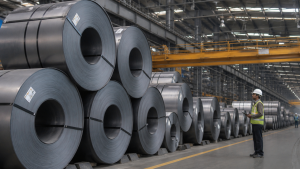
India is among the world’s largest steel producers, and the sector is guided by national policies, incentive schemes, and mining reforms aimed at raising capacity, improving product quality, and reducing emissions. For Prelims, the focus is on production targets, specialty steel incentives, green steel certification, and mineral taxation rules.
National Steel Policy: Capacity Targets
- National Steel Policy (NSP) 2017: It provided the long-term roadmap for domestic steel growth and set a crude steel production capacity target of 300 million tonnes per annum (MTPA) by 2030.
- Current capacity: India’s domestic steelmaking capacity stood at about 220 MTPA as of May 2026.
- Successor policy: The Ministry of Steel is drafting a new policy framework to replace the NSP 2017 and address emerging industrial requirements.
- Future target: The proposed framework aims for 400 MTPA of crude steel capacity by FY 2035-36.
- Investment requirement: Achieving this target is estimated to require capital investment of about ₹17 trillion (USD 183.41 billion) for infrastructure and plant expansion.
- Carbon intensity goal: The proposed policy seeks to reduce carbon emissions from around 2.65 metric tons to 2 metric tons of CO2 per ton of finished steel by FY 2035-36.
Production-Linked Incentive Scheme for Specialty Steel
- Objective: The PLI Scheme for Specialty Steel was introduced to cut import dependence and promote domestic production of high-grade steel.
- Covered products: Coated/plated steel, high-strength steel, specialty rails, and alloy steel products are among the key segments.
- Investment deployed: Participating companies had deployed about ₹26,320 crore under the scheme as of June 30, 2026.
- Committed investment: The total committed investment under the scheme is ₹56,106 crore.
- PLI Scheme 1.2: On February 9, 2026, the Ministry of Steel signed MoUs for 85 projects with 55 companies under PLI Scheme 1.2, the third round for specialty steel.
- Round-wise commitment: PLI Scheme 1.2 secured a committed investment of ₹11,887 crore.
Green Steel and Decarbonization Measures
- Green Steel Taxonomy Framework: This framework is designed to identify and promote low-emission steel production.
- Certifying agency: The National Institute of Secondary Steel Technology (NISST) acts as the certification agency for low-emission production units.
- Certification status: As of March 31, 2026, NISST had issued green steel certificates to 90 steel units.
- Certified output: These units accounted for 12.4 million tonnes of certified green steel production.
- Secondary steel support: The Ministry of Steel is finalizing the National Strategy for the Sustainable Development of the Secondary Steel Industry.
- Financial package: The strategy includes a USD 529 million support package to help secondary metallurgy enterprises shift to low-carbon technologies.
Mineral Sourcing and Fiscal Reforms
- Raw material security: Steady access to iron ore and coking coal is essential for uninterrupted steel production.
- MMDR Amendment Act, 2026: The Mines and Minerals (Development and Regulation) Amendment Act, 2026 took effect on August 22, 2026.
- Taxation uniformity: The amendment was introduced to bring uniformity in mineral taxation.
- State restrictions: It restricts state governments from independently imposing new mining taxes and cesses on mineral concession holders.
- Purpose: The reform is intended to create fiscal predictability in iron ore sourcing across mineral-rich states and help stabilize raw material costs.
Key Prelims Takeaways
- India’s crude steel output: 168.4 million tonnes in FY 2025-26, with 10.7% year-on-year growth.
- Finished steel consumption: About 163.7 million tonnes in FY 2025-26.
- Current capacity: Around 220 MTPA as of May 2026.
- Policy target: 300 MTPA by 2030 under NSP 2017; proposed 400 MTPA by FY 2035-36 under the successor policy.
- Decarbonization target: Reduce carbon intensity to 2 metric tons of CO2 per ton of finished steel by FY 2035-36.
- Specialty steel PLI: ₹26,320 crore deployed out of ₹56,106 crore committed as of June 30, 2026.
- Green steel certification: NISST has certified 90 units and 12.4 million tonnes of green steel production.
Current General Studies comprises current-affairs-based, General Studies-rich study material on policies, laws, institutions, economy, science, environment, governance, international relations, and other varied but important topics for UPSC and State PSC Prelims examinations.
Fortnightly PDF compilations: Available here
Originally written on
March 24, 2026
and last modified on
September 5, 2026.
| Related | |
|---|---|