Major Medieval Indian Kingdoms and Their Capitals
Medieval India was shaped by powerful regional kingdoms spread across the northern plains, the Deccan plateau, and peninsular India. Their capitals were not just administrative seats but also centres of trade, military control, irrigation, religion, and architecture.
For prelims revision, the key is to link each dynasty with its capital, region, and strategic importance. A quick grasp of these capitals also helps in understanding the political geography of medieval India.
Political Geography of Medieval India
- Northern India: After the decline of Harshavardhana’s empire in the 7th century, the north fragmented into rival regional powers. Control of Kannauj and the Gangetic Doab became central to imperial ambition.
- Deccan Plateau: Situated between the Vindhya Range and the Krishna River, the Deccan acted as a bridge between north and south. Its forts, trade routes, and natural barriers helped dynasties preserve autonomy.
- Peninsular South India: River valleys such as the Kaveri, Krishna, and Tungabhadra supported agrarian empires. Coastal access also enabled maritime trade and naval power.
Major Medieval Kingdoms and Their Capitals
| Dynasty / Kingdom | Region | Capital Cities | Founder / Key Rulers | Strategic Importance |
| Gurjara-Pratiharas | Western and Northern India | Avanti (Ujjain), Kannauj | Nagabhata I, Mihira Bhoja | Control over Gangetic trade routes |
| Palas | Bengal and Bihar | Pataliputra, Gauda, Munger | Gopala, Dharmapala | Access to Bay of Bengal maritime trade |
| Rashtrakutas | Deccan Plateau | Manyakheta (Malkhed) | Dantidurga, Amoghavarsha I | Command over Deccan trade corridors |
| Cholas | Tamil Country and Coromandel | Thanjavur, Gangaikonda Cholapuram | Vijayalaya, Rajaraja I, Rajendra I | Kaveri delta agriculture and naval bases |
| Western Chalukyas | Western Deccan | Kalyani (Basavakalyan) | Tailapa II, Vikramaditya VI | Strategic junction in the upper Krishna basin |
| Yadavas (Seunas) | Maharashtra Region | Devagiri (Daulatabad) | Bhillama V, Ramachandra | Hill-fort commanding the Western Ghats |
| Kakatiyas | Telangana Region | Orugallu (Warangal) | Prola II, Rudradeva, Ganapatideva | Tank irrigation networks and fortified city planning |
| Hoysalas | Karnataka Region | Dwarasamudra (Halebidu) | Nripa Kama II, Vishnuvardhana | Foothills of the Western Ghats guarding trade passes |
| Eastern Gangas | Kalinga (Odisha) | Kalinganagara, Cuttack | Anantavarman Chodaganga | Coastal defense and eastern trade control |
| Delhi Sultanate | Pan-Northern India | Lahore, Delhi (Lal Kot/Siri), Daulatabad (briefly) | Qutb-ud-din Aibak, Iltutmish | Gateway to the Indo-Gangetic plains |
| Vijayanagara Empire | South India | Hampi (Vijayanagara), Penukonda, Chandragiri | Harihara I, Bukka I, Krishnadevaraya | Natural boulder fortification on the Tungabhadra |
| Bahmani Sultanate | Deccan Plateau | Gulbarga (Ahsanabad), Bidar | Ala-ud-Din Bahman Shah | Central administrative hub of the Deccan |
Key Capitals and Their Historical Significance
- Kannauj: Located in present-day Uttar Pradesh on the Ganges, it became the ultimate prize of early medieval politics.
- Tripartite Struggle: Control of Kannauj led to prolonged conflict among the Gurjara-Pratiharas, Palas, and Rashtrakutas.
- Devagiri (Daulatabad): Built on a conical hill, it served as the Yadava capital and later became the focus of Muhammad bin Tughlaq’s capital transfer in 1327 CE.
- Daulatabad name: Muhammad bin Tughlaq renamed Devagiri as Daulatabad after shifting the capital from Delhi.
- Thanjavur: Vijayalaya Chola captured Thanjavur in the 9th century and established it as the imperial seat of the Cholas.
- Gangaikonda Cholapuram: Rajendra I founded this city to commemorate his military victories, including his campaigns in North India and Southeast Asia.
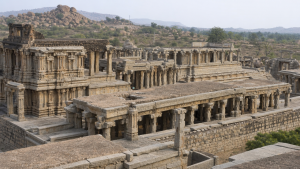
- Hampi: Founded in 1336 CE on the southern bank of the Tungabhadra, it flourished as a major commercial centre for horse, gem, and spice trade until 1565 CE.
- Fortified landscape: Hampi’s rocky terrain provided natural defensive advantages and supported a distinct royal and sacred urban layout.
- Warangal (Orugallu): Under the Kakatiyas, it was known for its circular city plan and dual concentric walls.
Five Deccan Sultanates
- Ahmadnagar Sultanate: Founded by Malik Ahmad Nizam Shah in 1490 CE; capital at Ahmadnagar.
- Bijapur Sultanate: Founded by Yusuf Adil Shah in 1489 CE; capital at Bijapur (Vijayapura).
- Golconda Sultanate: Founded by Sultan Quli Qutb-ul-Mulk in 1512 CE; capital at Golconda and later Hyderabad.
- Berar Sultanate: Founded by Fathullah Imad-ul-Mulk in 1490 CE; capital at Ellichpur (Achalpur).
- Bidar Sultanate: Founded by Qasim Barid I in 1492 CE; capital at Bidar.
Quick Revision Facts
- Pala dynasty: Gopala founded the dynasty around 750 CE through selection by regional chieftains.
- Rashtrakuta rise: Dantidurga strengthened Rashtrakuta power by performing the Hiranyagarbha ritual at Ujjain.
- Delhi’s early name: The city was founded as Dhillika by the Tomara Rajputs under Anangpal I in the 8th century.
- Eastern Ganga capital: Anantavarman Chodaganga shifted the capital to Cuttack and initiated the Jagannath Temple at Puri.
- Hoysala capital: Vishnuvardhana shifted the primary administrative centre to Dwarasamudra (Halebidu).
- Kannauj conflict: It remained central to power politics in early medieval North India.
Key Prelims Takeaways
- Kannauj was the most contested political centre of early medieval North India.
- Devagiri became famous both as a Yadava capital and for Muhammad bin Tughlaq’s capital transfer.
- Thanjavur and Gangaikonda Cholapuram are the two major Chola capitals to remember.
- Hampi was the core capital of Vijayanagara and a major trade hub.
- Warangal, Dwarasamudra, and Manyakheta are important Deccan capitals linked to fortification and trade routes.
- The five Deccan Sultanates emerged after the decline of the Bahmani Sultanate.
- Delhi Sultanate capitals included Lahore, Delhi, and briefly Daulatabad.
Current General Studies comprises current-affairs-based, General Studies-rich study material on policies, laws, institutions, economy, science, environment, governance, international relations, and other varied but important topics for UPSC and State PSC Prelims examinations.
Fortnightly PDF compilations: Available here
Originally written on
May 17, 2026
and last modified on
September 6, 2026.
| Related | |
|---|---|