Major Indian Industrialists and Business Families
Introduction
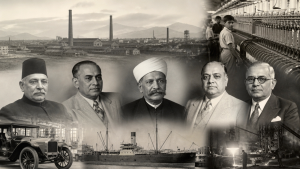
Indian industrialists and business families played a central role in the rise of indigenous enterprise, from colonial-era trade networks to modern diversified conglomerates. Their businesses helped build core sectors such as steel, textiles, shipping, cement, automobiles, IT, and infrastructure.
Over time, these groups adapted to swadeshi mobilization, the License-Permit Raj, and post-1991 liberalization, expanding from family-run firms into professionally managed global enterprises.
Historical Evolution
- Colonial era roots: Merchant communities such as Parsis, Marwaris, Gujaratis, and Chettiars accumulated capital through trade in cotton, opium, tea, and money-lending.
- Swadeshi link: Early industrial pioneers aligned business growth with the Indian National Movement and helped build domestic capacity in steel, textiles, hydro-power, and shipping.
- National support: Jamsetji Tata and Ghanshyam Das Birla gave financial and structural support to constructive swadeshi programmes.
- Industrial policy after independence: The Industrial Policy Resolutions of 1948 and 1956 reserved heavy industries mainly for the public sector.
- MRTP regime: The Monopolies and Restrictive Trade Practices (MRTP) Act, 1969 limited output expansion and market dominance by large business houses.
- Diversification strategy: Business families responded by entering non-competing sectors such as cement, heavy engineering, synthetic textiles, and chemicals.
- Post-1991 expansion: Abolition of industrial licensing and capacity ceilings allowed Indian conglomerates to scale up rapidly in software services, telecommunications, renewable energy, and pharmaceuticals.
- Management shift: Professional management increasingly replaced purely family-centric operational structures in major business groups.
Major Heritage Business Families
- Tata Group: Founded by Jamsetji Nusserwanji Tata in 1868, it began as a trading firm and expanded into cotton mills in Nagpur.
- Early milestones: The group established India’s first integrated steel plant, Tata Steel, at Jamshedpur in 1907, and built the Taj Mahal Palace Hotel in Mumbai in 1903.
- Expansion under J.R.D. Tata: The group entered civil aviation through Tata Airlines, later Air India, and grew into motor vehicles and IT services.
- Philanthropic structure: More than 65% of Tata Sons equity is held by philanthropic trusts.
- Birla family: Tracing its origin to Seth Shiv Narayan Birla, the family began a cotton trading firm in Pilani in 1857.
- Industrial growth: Ghanshyam Das Birla founded Birla Jute Mills in 1918 and later expanded into automotive manufacturing with Hindustan Motors in the 1940s.
- Branches of the family: Over generations, the family split into separate groups, including the Aditya Birla Group, BK Birla Group, and CK Birla Group.
- Key sectors: Metals, cement, textiles, telecommunications, and financial services remain major focus areas.
- Godrej Group: Ardeshir and Pirojsha Godrej founded the group in 1897, beginning with locks and fireproof safes.
- Product innovation: Ardeshir Godrej pioneered soap production from vegetable oil instead of animal fat.
- Business spread: The group expanded into consumer goods, real estate, industrial engineering, and agricultural inputs.
- Wadia Group: Founded by Lovji Nusserwanjee Wadia in 1736, it started as a shipbuilding firm for the British East India Company.
- Later diversification: The group later moved into textiles and consumer products.
Modern Conglomerates and Post-Independence Pioneers
- Reliance Group: Dhirubhai Ambani founded Reliance Commercial Corporation in 1958 as a spice and yarn trading firm.
- Industrial base: The company set up a synthetic textile mill at Naroda, Gujarat, in 1966 and launched the “Vimal” brand.
- Capital market impact: Reliance popularised retail equity participation through public share and convertible debenture issues in the late 1970s and 1980s.
- Scale of operations: It built the world’s largest single-location refining complex at Jamnagar, Gujarat.
- New sectors: The group later expanded into telecommunications through Jio and into retail.
- Bajaj Group: Jamnalal Bajaj founded the group in 1926 and developed close ties with Mahatma Gandhi and the freedom movement.
- Automobile leadership: Rahul Bajaj scaled Bajaj Auto into one of the world’s largest two- and three-wheeler manufacturers.
- Mahindra Group: Kailash Chandra Mahindra and Jagdish Chandra Mahindra co-founded Mahindra & Mohammed in 1945 with Malik Ghulam Muhammad.
- Rebranding: The company became Mahindra & Mahindra in 1948.
- Business focus: The group emerged as a major producer of utility vehicles, tractors, and information technology services.
Information Technology and New-Age Pioneers
- Infosys: N. R. Narayana Murthy and six colleagues founded Infosys in 1981 with an initial capital of USD 250.
- Industry practice: Infosys introduced employee stock option plans (ESOPs) in India.
- Wipro: Azim Premji transformed Wipro from Western India Vegetable Products, a vegetable oil business, into a global IT services company.
- HCL: Shiv Nadar founded HCL in 1976, initially producing microcomputers before moving into IT services and technology hardware.
- Adani Group: Gautam Adani founded the group in 1988 as a commodity trading firm.
- Infrastructure expansion: The group later built large businesses in ports, airports, power generation, and green energy infrastructure.
Profiles of Selected Business Groups
| Business Group | Founder(s) | Founding Year | Early Sectors | Present Key Verticals |
| Wadia Group | Lovji Nusserwanjee Wadia | 1736 | Shipbuilding, textiles | FMCG (Britannia), aviation, real estate |
| RPG Group | Ram Dutt Goenka | 1820 | Banking, tea trade | Tyres (CEAT), power (CESC), IT services |
| Aditya Birla Group | Seth Shiv Narayan Birla | 1857 | Cotton trading | Metals, cement, financial services, telecom |
| Shapoorji Pallonji Group | Pallonji Mistry lineage | 1865 | Construction, civil engineering | Infrastructure, real estate, renewable energy |
| Tata Group | Jamsetji Nusserwanji Tata | 1868 | Textiles, international trade | Steel, auto, IT services, power, hospitality |
| Godrej Group | Ardeshir & Pirojsha Godrej | 1897 | Locks, safes | Consumer goods, real estate, industrial engineering |
| Murugappa Group | A. M. Murugappa Chettiar | 1900 | Banking, money-lending | Agriculture, engineering, financial services |
| TVS Group | T. V. Sundram Iyengar | 1911 | Passenger transport, freight | Automotive components, two-wheelers, logistics |
| Bajaj Group | Jamnalal Bajaj | 1926 | Sugar, trading | Two-wheelers, financial services, consumer electricals |
| Mahindra Group | K. C. Mahindra & J. C. Mahindra | 1945 | Steel trading, assembly | Automotive, farm equipment, IT services |
| Reliance Industries | Dhirubhai Ambani | 1958 | Textile trading | Refining, telecom, retail |
Key Prelims Takeaways
- Swadeshi and enterprise: Indian business families were closely linked with indigenous industrial growth during the national movement.
- Policy environment: The 1948 and 1956 Industrial Policy Resolutions, along with the MRTP Act, shaped the post-independence business landscape.
- Liberalisation effect: The 1991 reforms enabled rapid expansion into new sectors and global markets.
- Tata milestone: Tata Steel at Jamshedpur was established in 1907 and is India’s first integrated steel plant.
- Godrej origin: The Godrej Group began in 1897 with locks and fireproof safes.
- Reliance growth: Reliance moved from trading to textiles, refining, telecom, and retail.
- IT pioneers: Infosys, Wipro, and HCL represent the rise of new-age Indian business leadership.
Current General Studies comprises current-affairs-based, General Studies-rich study material on policies, laws, institutions, economy, science, environment, governance, international relations, and other varied but important topics for UPSC and State PSC Prelims examinations.
Fortnightly PDF compilations: Available here
Originally written on
April 30, 2026
and last modified on
September 5, 2026.
| Related | |
|---|---|