Biological Control Agents in Agriculture
Introduction
Biological control in agriculture uses living organisms to suppress pest populations and reduce crop damage. It is a key part of Integrated Pest Management, especially where farmers need sustainable alternatives to heavy chemical use. The method focuses on keeping pests below economically damaging levels rather than eliminating them completely.
Core Concepts of Biological Control
Biological control means the use of natural enemies to manage pests. These natural enemies may be predators, parasitoids, pathogens or parasites. The approach is widely used in crop protection because it can be targeted, environmentally safer and suitable for long-term pest suppression.
- Predators: Organisms that directly consume other organisms. Ladybugs feeding on aphids and spiders preying on insects are common examples.
- Parasitoids: Insects that lay eggs in or on a host insect. The developing larva feeds on the host and eventually kills it.
- Pathogens: Disease-causing microorganisms such as bacteria, fungi, viruses and nematodes that attack specific pests.
- Parasites: Organisms that live on or in a host and obtain nutrients at the host’s expense, often weakening it.
- Targeted control: Biological control usually aims at pest suppression, not total eradication.
Integrated Pest Management
Biological control is most effective when used within Integrated Pest Management (IPM). IPM combines biological, cultural, mechanical and chemical methods in a coordinated way. The aim is to manage pest populations while reducing economic losses, health risks and environmental harm.
- Biological methods: Use of natural enemies and microbial agents.
- Cultural methods: Farm practices that make fields less favourable for pests.
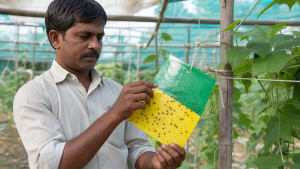
- Mechanical methods: Physical removal or trapping of pests.
- Chemical methods: Pesticides used selectively when needed.
- Practical advantage: IPM helps prevent excessive dependence on chemicals.
Key Biological Control Agents
Several organisms are used as biological control agents in crop systems. Their value lies in specificity, compatibility with sustainable farming and reduced impact on non-target organisms. In many cases, they are developed for particular pests or crop environments.
- Trichogramma species: Minute parasitoid wasps widely used against the eggs of lepidopteran pests.
- Trichogramma galloi: A specific species used in some crop systems to target insect eggs.
- Bacillus thuringiensis (Bt): A bacterium that produces toxins lethal to certain insect larvae.
- Entomopathogenic fungi: Fungi that infect and kill insect pests.
- Microbial control: Bacteria, fungi, viruses and nematodes can all be deployed against selected pests.
Trichogramma wasps are among the most important biological control agents because they attack insect eggs before the pest can develop.
Brazil as a Global Leader
Brazil has become a major global user of biological control in agriculture. Large-scale farming, especially in tropical systems, has helped accelerate adoption. Biological agents are increasingly used in Brazil’s pest-management strategies, with a strong emphasis on sustainability and field-scale applicability.
- Farm adoption: About 55% of farms in Brazil use biocontrol methods.
- US comparison: The United States has about 6% farm adoption of biocontrol methods.
- Sugarcane area: Around 90% of Brazil’s sugarcane cultivation area uses natural enemies for pest control.
- Trigger for adoption: The emergence of Helicoverpa armigera in 2013 accelerated the use of biological agents.
- Policy relevance: Brazil’s experience highlights the link between eco-friendly farming and crop biosecurity.
Research, Technology and SPARCBio
Technological innovation is expanding the reach of biological control. In Brazil, the Advanced Research Center on Biological Control (SPARCBio) in Piracicaba, São Paulo, is focused on tropical agriculture and large-scale deployment of biological agents. It works with research and industry partners to improve application methods.
- Location: SPARCBio is based in Piracicaba, São Paulo.
- Partners: It collaborates with the University of São Paulo’s Luiz de Queiroz School of Agriculture, the São Paulo Research Foundation and Koppert.
- Research areas: Drones, automation and artificial intelligence are being studied for pest control.
- Distribution methods: The centre plans to use drones for dispersing biological agents across large areas.
- Example agent: Trichogramma galloi wasps are among the organisms being considered for drone-based release.
- Scale: The objective is to improve delivery across millions of hectares where manual release is difficult.
Market Trends and Regulation
The agricultural biologicals market in Brazil is expanding rapidly, reflecting both farmer adoption and technological innovation. At the same time, regulatory timelines remain important because biological products also require oversight, approval and quality control before large-scale use.
| Indicator | Fact |
| Brazil biological-control market value | BRL 1.82 billion in the first half of 2026 |
| Year-on-year growth | 9.6% increase from the same period in 2025 |
| Treated acreage | 46.2 million hectares in H1 2026 |
| Treated acreage growth | 18.3% year-on-year increase |
| Market value in 2025 | USD 914.20 million |
| Approval period | About 20 months as of September 2026 |
- Market growth: Rising acreage and value show wider acceptance of biological products.
- Regulatory concern: Longer approval periods can affect product rollout and commercialization.
- Long-term outlook: The market expansion reflects demand for sustainable pest management tools.
Key Prelims Takeaways
- Biological control: Uses living organisms such as predators, parasitoids, pathogens and parasites to reduce pest populations.
- IPM: Integrates biological, cultural, mechanical and chemical methods for sustainable pest management.
- Trichogramma: A parasitoid wasp group used against insect eggs in crop systems.
- Bt: Bacillus thuringiensis is a bacterial biocontrol agent used against specific insect larvae.
- Brazil leadership: Around 55% of farms in Brazil use biocontrol methods, compared with about 6% in the US.
- Sugarcane use: About 90% of Brazil’s sugarcane area uses natural enemies for pest control.
- Market and regulation: Brazil’s biocontrol market reached BRL 1.82 billion in H1 2026, while approval periods rose to about 20 months.
Recent Context
Brazil is expanding biological control technologies through SPARCBio in Piracicaba, with a focus on tropical agriculture and large farm systems. The centre’s work on drones, automation and artificial intelligence reflects the push to scale up biological-agent delivery, including Trichogramma galloi, across extensive crop areas.
| Related | |
|---|---|