Types of Archery Competitions and Classification Systems
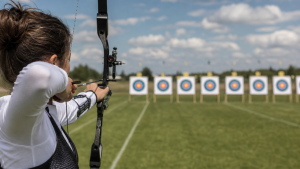
Competitive archery is organized into multiple formats, bow divisions, and athlete classes to ensure fair and precise competition.
Major Types of Archery Competitions
Target Archery
- Most common format: It is the discipline used in the Olympic Games.
- Setting: Archers shoot at stationary circular targets on flat, open outdoor fields.
- Target face: The standard target has five concentric colors: gold, red, blue, black, and white, divided into 10 scoring rings.
- Scoring: The center gold ring scores 10 points, while the outermost white ring scores 1 point.
- Standard distance: 70 meters for recurve bow competitors and 50 meters for compound bow competitors.
Indoor Archery
- Setting: This variation of target archery takes place inside buildings, protecting players from wind and weather.
- Standard distance: International indoor events are usually held at 18 meters.
- Target face: The target is smaller, often 40 centimeters in diameter, with a 10-ring diameter of 4 centimeters for recurve and 2 centimeters for compound bows.
- Multiple spots: Archers often shoot at vertical three-spot target faces to prevent arrows from hitting and damaging each other.
Field Archery
- Terrain: Field archery takes place in natural outdoor settings such as forests, woods, and rough countryside.
- Course format: Archers walk a course and shoot at stationary yellow and black targets set at various distances, heights, and angles.
- Distances: Shots may be marked, meaning known to the archer, or unmarked, meaning unknown.
- Range: Shooting distances range from 5 meters to 60 meters.
- Skill tested: It tests fieldcraft, including distance estimation, uphill/downhill adjustment, and shooting under natural shadows.
3D Archery
- Targets: Competitors shoot at three-dimensional, life-sized foam targets shaped like wild animals.
- Setting: The targets are placed in wooded environments at unmarked distances to simulate hunting conditions.
- Scoring: Circular rings over the animal’s vital areas are used for scoring.
- Physical demand: It requires stamina as archers navigate uneven trails while carrying equipment.
Specialty Archery Disciplines
- Clout Archery: Archers shoot arrows high into the air, aiming to land them as close as possible to a horizontal target on the ground called a clout. A small flag marks the target, placed at distances up to 165 meters.
- Flight Archery: The aim is to shoot an arrow as far as possible. Accuracy is not scored, and competitors use lightweight bows and aerodynamic arrows.
- Ski/Run Archery: This is an archery biathlon in which competitors combine cross-country skiing or running with target shooting at stations.
Equipment-Based Classification Systems
Archers compete in separate divisions depending on the bow and accessories they use. World Archery recognizes several equipment divisions.
Recurve Bow Division
- Olympic bow: This is the classic bow style featured at the Olympic Games.
- Design: The limbs curve away from the archer when unstrung, storing more energy than a traditional straight bow.
- Allowed aids: Archers may use technical aids such as bow stabilizers, sight pins, and clickers.
- Materials: These bows are typically made using fiberglass, carbon fiber, and laminated wood.
Compound Bow Division
- Mechanism: This bow uses pulleys, cams, and cables.
- Let-off effect: The pulley system reduces holding weight at full draw, helping the archer aim more steadily.
- Allowed aids: Competitors may use magnifying sights with leveling bubbles and mechanical release aids.
- Recognition: World Archery officially recognized compound archery in the 1990s.
Barebow Division
- Basic setup: The barebow is a basic recurve bow stripped of accessories.
- Prohibited items: Sights, clickers, and stabilizers are not allowed.
- Aiming method: Archers aim by looking down the length of the arrow.
- Common techniques: String walking and gap shooting are commonly used.
Longbow and Traditional Divisions
- Longbow: A simple, straight piece of wood that bends into a single curve when strung.
- Use: Traditional divisions are standard in 3D and field archery events.
- Restrictions: No mechanical aids, sights, or modern tuning marks are permitted.
Para-Archery Classification Systems
Para-archery is open to athletes with physical and visual impairments. World Archery uses a strict classification system to ensure fair competition based on functional ability.
World Archery currently classifies para archery into four competitive divisions: Recurve Open, Compound Open, W1, and Visually Impaired.
W1 Class (Wheelchair 1)
- Eligibility: Reserved for athletes with the most severe physical impairments.
- Impairment level: Competitors typically have impairments in at least three limbs and the torso, often due to high-level spinal cord injuries.
- Position: Archers shoot while seated in a wheelchair and may use straps for chest stability.
- Equipment limits: Recurve or compound bows may be used with specific limits, including a maximum draw weight of 45 pounds.
- Prohibited aids: Magnifying sights, peep sights, and leveling bubbles are banned.
Open Class (Recurve Open and Compound Open)
- Eligibility: Includes archers with less severe impairments, usually limited to the lower body.
- Shooting position: Competitors may stand, rest on a stool, or shoot from a wheelchair.
- Divisions: Athletes are split into Recurve Open and Compound Open.
- Rules: They compete under nearly the same technical rules and distances as able-bodied archers.
Visually Impaired Classes (VI)
- VI1 Class: For archers who are completely blind. They must wear a blindfold during competition and use a tactile sight with a spotter.
- VI2/3 Class: For archers with partial visual impairment. They use tactile sights but do not wear blindfolds.
Age and Competition Categories
- Under 18 (Cadet): Open to archers who are 17 years of age or younger on 31 December of the competition year.
- Under 21 (Junior): Open to archers who are 20 years of age or younger.
- Senior: The standard category open to archers of all ages.
- Master (50+): Open to archers who are 50 years of age or older.
Comparison of Key Archery Competitions
| Discipline | Target Environment | Target Type | Standard Distances | Bow Styles Permitted |
| Outdoor Target | Flat open field | 5-color, 10-ring circular face | 70m (Recurve), 50m (Compound) | Recurve, Compound, Barebow |
| Indoor Target | Closed building | Small 3-spot or 10-ring circular face | 18 meters | Recurve, Compound, Barebow |
| Field Archery | Forest, hills, natural terrain | Black and yellow circular face | 5m to 60m (Marked/Unmarked) | Recurve, Compound, Barebow |
| 3D Archery | Forest, wooded trails | 3D foam animal silhouettes | Varying unmarked distances | Barebow, Longbow, Instinctive |
| Clout Archery | Open field | Horizontal ground target with flag | Up to 165 meters | Recurve, Compound, Traditional |
Archery Scoring Systems
Competitive archery uses different scoring frameworks depending on the target face and competition type.
Ten-Ring Metric Scoring
- Use: Standard scoring system for target and indoor archery.
- Top score: Arrows in the inner gold ring score 10 points.
- Lower rings: The outer rings decrease by one point per ring down to the outermost white ring, which scores 1 point.
- Line rule: If an arrow touches the dividing line between two rings, the higher score is awarded.
Five-Ring Metric Scoring
- Use: This system is used in field archery competitions.
- Target face: The circular targets consist of black and yellow rings.
- Scoring: The center gold ring scores 6 points, while the outer black rings score down to 1 point.
Five-Four-Three (3D Scoring)
- Use: Standard scoring for 3D foam animal targets.
- Vital zone: A small central circle representing the heart/lung area scores 11 or 10 points.
- Secondary zone: The larger vital zone scores 8 points.
- Body hit: An arrow landing anywhere else on the animal scores 5 points.
- Miss: Misses score zero.
Recent Context
World Archery’s para-archery circuit is expanding through the 2026 Hyundai World Archery Para Series, with Ahmedabad scheduled as Stage 3 in India. The event highlights governance, classification fairness, and training support for elite para archers.
Rare Facts for Prelims
- World Archery name: The governing body was earlier known as FITA, a French acronym.
- Olympic relevance: Recurve is the only bow style used in Olympic archery.
- Field archery challenge: Unmarked distances are a major reason field archery is considered more difficult than target archery.
- Compound advantage: The let-off system helps archers hold at full draw with less strain.
- VI equipment: Tactile sights are used by visually impaired archers to align their shots physically rather than visually.
- 3D scoring idea: The scoring zone on 3D targets is designed to mimic hunting-style vital areas rather than ring-based faces.
| Related | |
|---|---|