National Education Policy 2020: Features and Implementation
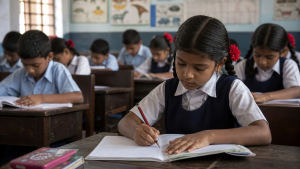
The National Education Policy (NEP) 2020 is the major policy framework intended to reshape India’s education system from early schooling to higher education. Drafted by a committee chaired by Dr. K. Kasturirangan, it replaces the National Policy on Education, 1986 and seeks alignment with Sustainable Development Goal 4.
School Education Reforms
- New school structure: NEP 2020 replaces the 10+2 system with a 5+3+3+4 structure.
- Foundational Stage: 3 years of preschool/Anganwadi plus Grades 1 and 2, for children aged 3–8 years.
- Preparatory Stage: Grades 3–5, covering ages 8–11 years.
- Middle Stage: Grades 6–8, covering ages 11–14 years.
- Secondary Stage: Grades 9–12, covering ages 14–18 years.
- Enrolment goal: The policy aims for 100% Gross Enrolment Ratio (GER) in school education by 2030, from preschool to secondary level.
- Vocational integration: Skill-based and vocational exposure begins in middle school and expands through secondary education.
- Early learning focus: The policy gives strong emphasis to foundational literacy and numeracy as the basis of later learning.
Higher Education and Academic Flexibility
- Higher education target: NEP 2020 seeks a 50% Gross Enrolment Ratio in higher education by 2035.
- Flexible learning paths: The National Credit Framework (NCrF) allows academic and skill-based learning to be integrated.
- Vocational credits: Students can earn up to 50% of academic credits through vocational and skill-based learning.
- Multiple Entry-Multiple Exit: The policy supports multiple entry and exit options, with certificate, diploma or degree outcomes depending on years completed.
- Academic Bank of Credits: The Academic Bank of Credits (ABC) is meant to store and transfer earned academic credits.
- APAAR ID: The Automated Permanent Academic Account Registry (APAAR ID) is linked to academic record management.
Regulatory and Research Architecture
- Single regulator proposal: The Higher Education Commission of India (HECI) Bill is intended to replace the University Grants Commission (UGC) as an overarching regulator.
- Regulatory design: Draft iterations have indicated that funding powers may be kept outside the proposed HECI’s regulatory role.
- Research funding body: The Anusandhan National Research Foundation (ANRF) was established under the ANRF Act, 2023.
- Research mandate: ANRF supports scientific and humanities research and has subsumed the Science and Engineering Research Board (SERB).
Implementation Schemes and State Participation
| Initiative | Launch year / timeline | Key features |
| PM SHRI Schools | 2022-23 to 2026-27 | Centrally sponsored scheme with a limit of 14,500 schools; 13,092 have been selected as exemplars. Funding is 60:40 (Centre:States), 90:10 for North Eastern, Himalayan and J&K regions, and 100% for other Union Territories. |
| NIPUN Bharat | July 2021 | Focuses on Foundational Literacy and Numeracy (FLN) for Grade 3 students. Mid-2026 proposals sought extension up to Class 5. |
| Bharatiya Bhasha Pustak Scheme (BBPS) | FY 2025-26 | Supports digital translation and distribution of academic books in all 22 scheduled Indian languages. |
- PM SHRI memorandums: As of March 2026, Tamil Nadu and West Bengal had not signed the PM SHRI MoU.
- State participation: Kerala signed the scheme in October 2025, while Punjab re-joined it in July 2024 after temporarily opting out.
- Multilingual learning: BBPS is designed to strengthen vernacular and multilingual education through digital academic content.
Budgetary Commitments and Spending Trends
- Public education spending target: NEP 2020 recommends public expenditure on education at 6% of GDP.
- Current gap: Combined Centre and State public spending stood at 2.7% of GDP in the FY26 Budget Estimates, compared with 2.9% in FY20.
- Union allocation trend: The Ministry of Education’s share of total Union expenditure declined from 4.6% in 2013-14 to 2.5% in the 2025-26 Budget Estimates.
- Union Budget 2026-27: The Ministry of Education received ₹1,39,289.48 crore, which was 8.27% higher than the 2025-26 Budget Estimates.
Key Prelims Takeaways
- Chairman of drafting committee: Dr. K. Kasturirangan.
- Policy replaced: National Policy on Education, 1986.
- School structure: 5+3+3+4 model with Foundational, Preparatory, Middle and Secondary stages.
- Enrolment targets: 100% GER in school education by 2030 and 50% GER in higher education by 2035.
- Credit flexibility: NCrF, ABC and APAAR ID support academic mobility and record management.
- Vocational learning: Up to 50% of academic credits may come from vocational and skill-based learning.
- Research institution: ANRF, under the ANRF Act, 2023, has subsumed SERB.
Current General Studies comprises current-affairs-based, General Studies-rich study material on policies, laws, institutions, economy, science, environment, governance, international relations, and other varied but important topics for UPSC and State PSC Prelims examinations.
Fortnightly PDF compilations: Available here
Originally written on
March 9, 2026
and last modified on
September 5, 2026.
| Related | |
|---|---|