
ISRO Missions and Milestones Timeline
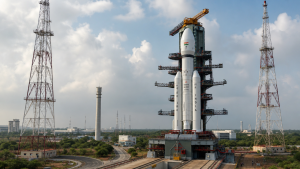
ISRO’s mission profile has evolved from experimental launches to complex scientific, commercial and interplanetary operations. This timeline captures the major milestones, recent launch capabilities and upcoming programmes that are important for Prelims revision.
Institutional Architecture and Leadership
- Leadership: V. Narayanan assumed office as Chairman of ISRO and Secretary, Department of Space on January 14, 2025, succeeding S. Somanath.
- Budget: The Department of Space was allocated ₹13,416 crore for the 2025–2026 financial year to support infrastructure expansion and deep-space missions.
- Commercial arm: NewSpace India Limited (NSIL) launched 399 foreign satellites between 2014 and March 2026, reflecting India’s growing role in the global small-satellite market.
- International cooperation: ISRO and the European Space Agency (ESA) signed a Joint Statement of Intent on May 7, 2025, to deepen cooperation in low-Earth orbit and lunar exploration.
Recent Launch Operations (2024-2026)
- SPADEX: Launched on December 30, 2024, the Space Docking Experiment became a technology testbed for human spaceflight and future in-orbit assembly.
- SPADEX achievements: In March and April 2025, the mission successfully demonstrated autonomous docking, undocking, power transfer and circumnavigation between two spacecraft in orbit.
- POEM-04: Launched in December 2024, the PSLV Orbital Experimental Module completed over 1,000 orbits while testing a robotic arm and microgravity seed germination.
- GSLV-F15/NVS-02: The January 29, 2025 launch marked the 100th orbital spaceflight launch from the Satish Dhawan Space Centre, Sriharikota.
- LVM3-M5: On November 2, 2025, LVM3-M5 placed CMS-03 (GSAT-7R), a military communications satellite, into its target orbit.
- LVM3-M6: On December 24, 2025, the rocket deployed the 6,100 kg BlueBird Block-2 satellite for AST SpaceMobile.
- PSLV-C62/EOS-N1: The January 12, 2026 mission failed because of a flight anomaly during third-stage operation.
- NISAR: The joint NASA-ISRO Synthetic Aperture Radar mission was launched on July 30, 2025 aboard GSLV-F16 to track environmental changes.
Historic Exploratory Missions
- Chandrayaan-3: India achieved a soft landing near the Moon’s south pole on August 23, 2023, becoming the fourth nation to land on the Moon and the first to reach the southern polar region.
- Aditya-L1: Launched on September 2, 2023, it became India’s first dedicated space-based solar observatory and entered halo orbit around the Sun-Earth L1 point on January 6, 2024.
- XPoSat: Launched on January 1, 2024, X-ray Polarimeter Satellite is India’s first dedicated polarimetry mission to study bright astronomical X-ray sources such as black holes and neutron stars.
- Axiom Mission 4 (Ax-4): Group Captain Shubhanshu Shukla served as pilot on this private commercial mission to the International Space Station, launched on June 25, 2025 and returned on July 15, 2025.
Future Space Exploration Pipeline
- Gaganyaan: The first uncrewed demonstration flight (G1) under the human spaceflight programme is targeted for launch by late 2026.
- Bharatiya Antariksha Station: The government approved a modular space station, with BAS-01 targeted for 2028 and full operational capacity expected by 2035.
- Chandrayaan-4: The lunar sample-return mission, designed to retrieve up to 3 kg of soil, is approved for launch around 2028.
- LUPEX (Chandrayaan-5): The ISRO-JAXA Lunar Polar Exploration Mission is planned for 2028–2029 to drill for water ice at the lunar south pole.
- Venus Orbiter Mission: VOM is scheduled for March 2028 and will use aerobraking to study Venus’s atmosphere and surface.
- TRISHNA: The joint Indo-French mission is scheduled for October 2027 to map global land surface temperatures.
Key Prelims Takeaways
- Chairman: V. Narayanan took charge as ISRO Chairman and Secretary, Department of Space on January 14, 2025.
- Budget: The Department of Space received ₹13,416 crore for FY 2025–2026.
- Commercial record: NSIL launched 399 foreign satellites between 2014 and March 2026.
- SPADEX significance: It proved orbital docking, undocking and power transfer capability for future missions.
- Chandrayaan-3: India became the first country to land near the Moon’s south pole.
- NISAR: A joint NASA-ISRO Earth observation mission to monitor environmental change.
- Future missions: Gaganyaan, BAS, Chandrayaan-4, LUPEX, VOM and TRISHNA are the key pipeline missions.
Current General Studies comprises current-affairs-based, General Studies-rich study material on policies, laws, institutions, economy, science, environment, governance, international relations, and other varied but important topics for UPSC and State PSC Prelims examinations.
Fortnightly PDF compilations: Available here
Originally written on
March 9, 2026
and last modified on
September 5, 2026.
| Related | |
|---|---|



Nisarg Amitkumar Vyas
August 22, 2026 at 6:20 pmInteresting information