State-Wise Important Pilgrimage Sites
India’s pilgrimage landscape is spread across regions, reflecting the country’s religious diversity, temple architecture, and centuries-old sacred traditions. From Himalayan cave shrines to coastal temples, the sites below are important for Prelims revision because they link geography with faith, history, and culture.
Northern Region: Jammu & Kashmir and Ladakh
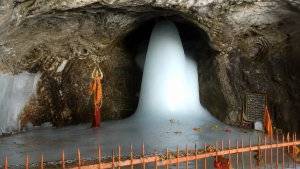
- Amarnath Cave: Located at an altitude of 3,888 metres in the Lidder Valley, it is famous for a naturally formed ice lingam created by dripping water through limestone cracks. It is associated with Lord Shiva’s narration of the Amar Katha to Goddess Parvati.
- Vaishno Devi: Situated on the Trikuta Hills in Katra, this cave shrine contains three natural rock formations called Pindis, representing Goddess Maha Kali, Maha Lakshmi, and Maha Saraswati.
- Hemis Monastery: A 17th-century Buddhist monastery in Leh, Ladakh, belonging to the Drukpa Lineage of Tibetan Buddhism. It hosts the annual Hemis Tsechu festival celebrating Guru Padmasambhava.
- Hazratbal Shrine: Located on the northern bank of Dal Lake in Srinagar, it preserves the Moi-e-Muqqadas, believed to be a hair relic of Prophet Muhammad.
Himachal Pradesh, Uttarakhand, Punjab, Haryana and Uttar Pradesh
- Jawalamukhi Temple (Himachal Pradesh): A Shakti Peetha in Kangra where eternal natural gas flames burning through rock fissures are worshipped as Goddess Jwala Ji.
- Chintpurni (Himachal Pradesh): Located in Una district, this shrine is dedicated to Goddess Chhinnamastika, symbolising ego dissolution.
- Char Dham Circuit (Uttarakhand): Includes Badrinath, Kedarnath, Gangotri, and Yamunotri. Badrinath is dedicated to Lord Vishnu on the Alaknanda River, Kedarnath is a Jyotirlinga on the Mandakini River, Gangotri is the origin site of the Bhagirathi River, and Yamunotri is the origin site of the Yamuna.
- Hemkund Sahib (Uttarakhand): A high-altitude Sikh pilgrimage site at 4,632 metres in Chamoli district, near a glacial lake. It is associated with Guru Gobind Singh’s former life meditation mentioned in the Bachitar Natak.
- Harmandir Sahib / Golden Temple (Punjab): Located in Amritsar, it is a central Sikh shrine. The foundation was laid by the Sufi saint Mian Mir in 1589, and gold leafing was added under Maharaja Ranjit Singh.
- Kurukshetra (Haryana): Regarded as the site of the Mahabharata war, it includes Brahma Sarovar and Jyotisar, where Krishna delivered the sermon of the Bhagavad Gita.
- Kashi Vishwanath (Uttar Pradesh): Located in Varanasi on the banks of the Ganga, it is one of the 12 Jyotirlingas. The present structure was built by Queen Ahilyabai Holkar of Indore in 1780.
- Ayodhya and Mathura-Vrindavan (Uttar Pradesh): Ayodhya on the Sarayu is revered as the birthplace of Lord Rama. Mathura and Vrindavan on the Yamuna are the main centres of Krishna devotion.
- Dargah of Sheikh Salim Chishti (Uttar Pradesh): A red sandstone and white marble Sufi mausoleum inside Fatehpur Sikri, built by Mughal Emperor Akbar to honour the Chishti saint.
Eastern and North-Eastern India: Bihar, West Bengal, Odisha, Assam and Tripura
- Mahabodhi Temple Complex (Bihar): A UNESCO World Heritage Site in Bodh Gaya, built next to the sacred Bodhi Tree where Prince Siddhartha attained enlightenment. The 50-metre brick temple tower dates to the Gupta and post-Gupta periods.
- Vishwa Shanti Stupa, Rajgir (Bihar): A white marble stupa on Ratnagiri Hill, constructed under the guidance of Japanese Buddhist monk Nichidatsu Fujii.
- Jain pilgrimage centres in Bihar: Vaishali is associated with the birthplace of the 24th Tirthankara, Lord Mahavira, while Pawapuri is linked to his Nirvana. Kundalpur is also an important Jain node.
- Kalighat (West Bengal): In Kolkata, this shrine is recognised as an Adi Shakti Peetha.
- Dakshineswar Kali Temple (West Bengal): Located along the Hooghly River and built by Rani Rashmoni in 1855, it is associated with Ramakrishna Paramahamsa.
- Bandel Church (West Bengal): Built by the Portuguese in 1599 along the Hooghly River and dedicated to Our Lady of the Rosary, it is among the oldest Christian structures in eastern India.
- Jagannath Temple, Puri (Odisha): Built in the 12th century by King Anantavarman Chodaganga Deva of the Eastern Ganga Dynasty, this Kalinga-style temple is one of the primary Char Dham sites and hosts the annual Ratha Yatra.
- Konark Sun Temple (Odisha): A 13th-century Kalinga architectural masterpiece built by King Narasimhadeva I, designed as a massive chariot with 12 pairs of carved stone wheels pulled by seven horses.
- Kamakhya Temple (Assam): Located on the Nilachal Hills in Guwahati, this ancient Tantric shrine is an Adi Shakti Peetha centred on the worship of the Yoni. It hosts the annual Ambubachi Mela.
- Tripura Sundari Temple (Tripura): Located in Udaipur, Tripura, this 16th-century temple was built by King Dhanya Manikya. It is one of the 51 Shakti Peethas and follows the Bengali Ek-ratna style.
Western and Central India: Gujarat and Rajasthan
- Somnath Temple (Gujarat): Located at Prabhas Patan, it is revered as the first among the 12 Jyotirlinga shrines. Destroyed and rebuilt several times, the present structure was constructed in the Solanki/Maru-Gurjara style in 1951.
- Dwarkadhish Temple (Gujarat): Also known as Jagat Mandir, this five-storied temple at the mouth of the Gomti River is part of the Char Dham and Saptapuri circuits.
- Palitana Temples (Gujarat): Situated on the Shatrunjaya Hills, this cluster contains over 800 marble-carved Jain temples and is a major Jain pilgrimage centre.
Key Prelims Takeaways
- Highest-altitude shrine: Hemkund Sahib in Chamoli district at 4,632 metres.
- Most important cave shrines: Amarnath Cave and Vaishno Devi in Jammu & Kashmir.
- Four sacred Char Dham sites: Badrinath, Kedarnath, Gangotri, and Yamunotri in Uttarakhand.
- Major Jyotirlingas mentioned: Somnath and Kashi Vishwanath; Kedarnath is also listed in the Char Dham circuit.
- Key Buddhist sites: Mahabodhi Temple Complex, Vishwa Shanti Stupa, and Hemis Monastery.
- Important Shakti Peethas: Vaishno Devi, Jwala Ji, Kalighat, Kamakhya, and Tripura Sundari.
- Major temple architecture styles: Kalinga style at Puri and Konark; Maru-Gurjara style at Somnath; Ek-ratna style at Tripura Sundari.
Current General Studies comprises current-affairs-based, General Studies-rich study material on policies, laws, institutions, economy, science, environment, governance, international relations, and other varied but important topics for UPSC and State PSC Prelims examinations.
Fortnightly PDF compilations: Available here
Originally written on
May 25, 2026
and last modified on
September 6, 2026.
| Related | |
|---|---|