Major Indian Literary Awards, Prizes and Fellowships
Indian literary awards and fellowships highlight creative excellence across languages, genres, and literary traditions. For Prelims revision, the most useful facts are the awarding bodies, eligibility language sets, prize components, and the distinctions between annual awards and lifetime honours.
The Jnanpith Award
- Institution and standing: Instituted in 1961 by the Bharatiya Jnanpith trust, it is regarded as the highest literary honour in India.
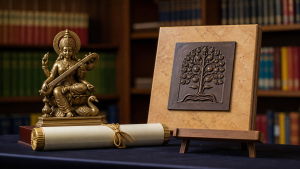
- Award components: The prize includes a cash award of ₹11 lakh, a citation plaque, and a bronze replica of Saraswati (Vagdevi), the goddess of learning.
- Eligibility: It is awarded annually to an Indian citizen for outstanding literary work in any of the 22 languages listed in the Eighth Schedule of the Constitution, as well as English.
- Posthumous rule: The award is not conferred posthumously.
- First recipient: Malayalam poet G. Sankara Kurup received the first Jnanpith Award in 1965 for Odakkuzhal (The Bamboo Flute).
- First woman awardee: Bengali novelist Ashapoorna Devi was the first female recipient in 1976 for Pratham Pratishruti.
- Recent winners: The 59th Jnanpith Award went to Hindi writer Vinod Kumar Shukla, and the 60th award was given to Tamil poet and lyricist R. Vairamuthu.
Sahitya Akademi Awards and Fellowship
- Institution: Founded in 1954, the Sahitya Akademi is India’s National Academy of Letters.
- Language coverage: It honours books in 24 languages, namely the 22 Eighth Schedule languages, English, and Rajasthani.
- Award nature: The annual Sahitya Akademi Award is given for books of outstanding literary merit published during the preceding five years.
- Prize: It carries an engraved copper plaque, a shawl, and a cash prize of ₹1,00,000.
- Sahitya Akademi Fellowship: This is the academy’s highest honour for living writers.
- Membership limit: The fellowship is restricted to a maximum of 21 living persons at any time.
- Recent fellows: In 2024, the academy elected Ajeet Cour, Chandrashekhar Kambar, Pran Kishore Kaul, and Ved Rahi as fellows.
K.K. Birla Foundation Awards
- Saraswati Samman: Instituted in 1991 by the K.K. Birla Foundation, this annual award recognises outstanding prose or poetry published during the previous ten years.
- Language eligibility: The work must be in any of the 22 Eighth Schedule Indian languages.
- Prize details: It carries a cash prize of ₹15 lakh, a plaque, and a citation.
- First recipient: The inaugural award in 1991 went to Harivansh Rai Bachchan for his four-volume autobiography.
- Recent awardee: The 34th Saraswati Samman was awarded to Sanskrit scholar Swami Bhadreshdas for Swaminarayan Siddhanta Sudha.
- Vyas Samman: Also instituted in 1991 by the K.K. Birla Foundation, it honours outstanding Hindi literary work published in the previous ten years.
- Prize details: The Vyas Samman carries a cash prize of ₹4 lakh.
- First recipient: The first Vyas Samman was given to Ram Vilas Sharma for Bharat ke Pracheen bhasha parivar aur Hindi.
- Recent awardee: The 34th Vyas Samman was awarded to Hindi writer Suryabala for Kaun Des Ko Vasi: Venu Ki Diary.
JCB Prize for Literature
- Nature of award: The JCB Prize for Literature was first awarded in 2018 for a distinguished work of fiction in English or translation.
- Final award: The prize was discontinued in 2024 after its seventh and final award went to Upamanyu Chatterjee for Lorenzo Searches for the Meaning of Life.
- Prize value: It was known for its high cash component of ₹25 lakh for the author and ₹10 lakh for the translator.
Important Comparisons for Prelims
| Award | Language coverage | Period of eligibility | Cash prize |
| Jnanpith Award | 22 Eighth Schedule languages + English | Overall literary contribution | ₹11 lakh |
| Sahitya Akademi Award | 24 languages | Books published in preceding 5 years | ₹1,00,000 |
| Saraswati Samman | 22 Eighth Schedule languages | Works published in preceding 10 years | ₹15 lakh |
| Vyas Samman | Hindi only | Works published in preceding 10 years | ₹4 lakh |
Key Prelims Takeaways
- Highest literary honour: The Jnanpith Award is considered India’s top literary prize.
- Not posthumous: Jnanpith is not awarded posthumously.
- Sahitya Akademi scope: It covers 24 languages, including English and Rajasthani.
- Lifetime honour: Sahitya Akademi Fellowship is for living writers and is capped at 21.
- Ten-year window: Saraswati Samman and Vyas Samman examine works from the previous ten years.
- Five-year window: Sahitya Akademi Award considers books published in the preceding five years.
- Cash comparison: Saraswati Samman offers a higher cash award than the Jnanpith Award.
Current General Studies comprises current-affairs-based, General Studies-rich study material on policies, laws, institutions, economy, science, environment, governance, international relations, and other varied but important topics for UPSC and State PSC Prelims examinations.
Fortnightly PDF compilations: Available here
Originally written on
April 22, 2026
and last modified on
September 5, 2026.
| Related | |
|---|---|