Sattriya: Origins, Features and Performance Traditions
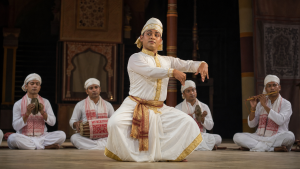
Sattriya is one of India’s eight classical dance forms and grew out of the Vaishnavite bhakti tradition of Assam. It was shaped in the 15th century by Srimanta Sankardeva and later nurtured by Madhavdeva within the monastic sattra system.
For centuries, it remained a ritual performance inside monasteries, especially for worship of Lord Krishna. Today, it is performed on wider stages, but it still retains its devotional base, codified technique, and strong Assamese identity.
Origins and Bhakti Roots
- Religious background: Sattriya developed as part of the Ekasarana Dharma movement, which preached devotion to a single supreme entity, Lord Krishna.
- Founder: Srimanta Sankardeva introduced the tradition in medieval Assam in the 15th century AD.
- Role of Madhavdeva: His chief disciple, Madhavdeva, helped preserve and expand the tradition.
- Monastic setting: The dance was nurtured inside Sattras, the Vaishnavite monastic institutions spread across the Brahmaputra valley.
- Ritual function: It was performed as a devotional offering and remained confined to monasteries for centuries.
- Social role: Sattriya helped communicate Puranic and Vedantic ideas to the masses through dance, music, and drama.
Recognition and Historical Development
- Classical status: The Sangeet Natak Akademi recognised Sattriya as a classical dance form in November 2000.
- Transition to public मंच: After long monastic exclusivity, it moved from sacred spaces to secular and international performance stages.
- Early dramatic base: Sankardeva’s one-act plays, called Ankiya Nats, provided the structural base for Sattriya performance.
- Literary medium: He used Brajavali, a regional literary language blending Assamese, Maithili, and Braj Bhasha.
- First Ankiya Nat: Cihna Yatra is noted as the first Ankiya Nat, created in the mid-15th century and painted on Sanchi-pat.
Performance Structure and Dance Streams
- Two broad streams: Sattriya presentation is commonly divided into Purushic (vigorous, masculine) and Stri (graceful, feminine) styles.
- Core components: The dance combines Nritta (pure dance), Nritya (expressional dance), and Natya (dramatic execution).
- Sutradhari: The central anchor of the Ankiya Nat who introduces the play, recites slokas, gives stage directions, and explains the narrative.
- Bhaona: The theatrical presentation of Ankiya Nat, traditionally held in the Namghar, the village prayer hall and community space.
- Ojapali: A traditional storytelling form in which devotional texts such as the Puranas, Ramayana, and Mahabharata are rendered through rhythm, song, and hand gestures.
- Mukha: Elaborate masks made of paper-mache, bamboo, and clay are used in Bhaona to depict demons, divine beings, animals, and mythical creatures.
Major Dance Varieties
- Chali Nritya: A graceful, feminine dance style marked by delicate footwork and rhythmic movement.
- Jhumura Nritya: A vigorous male-oriented dance created by Madhavdeva, known for swift tempo changes and complex postures.
- Bhor Taal Nritya: A high-energy group performance using large cymbals, with strong rhythm and martial stances.
- Mati Akhara: The basic training framework of Sattriya, consisting of 64 exercises that develop flexibility, posture, balance, and stamina.
- Training purpose: These exercises prepare dancers before they learn formal performance sequences.
Music, Costumes and Instruments
- Borgeets: Sattriya performances are set to devotional songs composed by Sankardeva and Madhavdeva in specific ragas and talas.
- Khol: The principal percussion instrument; it is a two-headed clay drum used to maintain rhythm.
- Bhor Taal and Manjira: Large and small brass or bronze cymbals support the tala structure.
- Baahi: The flute adds melodic texture to the performance.
- Female costume: Dancers wear Assamese silk garments, mainly Muga or Paat silk, with Mekhela, Chador, and Kanchi.
- Male costume: The male attire includes a white silk dhoti, chadar, and a traditional headgear called Paguri.
- Jewellery: Traditional Assamese ornaments include Gām Kharu, Jongbiri, Dholbiri, and Thuriya.
Important Places, Practitioners and Features
- Sattra centres: Important historic Sattras include Kamalabari Sattra, Auniati Sattra, Natun Kamalabari Sattra, Dakhinpat Sattra, and Barpeta Sattra.
- Majuli: The island of Majuli in the Brahmaputra River is a major hub of Sattra culture and has many active historical Sattras.
- Monastic performers: Male celibate monks called Bhokots preserved and performed Sattriya inside the Sattras.
- Monastery head: The head of a Sattra is known as the Adhikar.
- Public stage pioneers: Maniram Dutta Muktiyar Barbayan and Bapuram Barbayan were important in bringing Sattriya out of monastic confines.
- Modern recognition: Guru Jatin Goswami and Ghana Kanta Bora were awarded the Padma Shri for their contribution to the preservation and promotion of Sattriya.
Exam fact: Sattriya was recognised as the 8th classical dance form of India by the Sangeet Natak Akademi on 15 November 2000.
Key Prelims Takeaways
- Origin: Sattriya emerged in 15th century Assam as part of the Vaishnavite bhakti movement.
- Founder: Srimanta Sankardeva introduced and codified the tradition, with Madhavdeva as a key contributor.
- Institutional base: The dance was preserved in Sattras and performed by Bhokots.
- Drama link: Ankiya Nats and Bhaona are central to its performance tradition.
- Music: Borgeets, Khol, Bhor Taal, Manjira, and Baahi form its musical core.
- Training: Mati Akhara is the foundational exercise system of Sattriya.
- Recognition: The Sangeet Natak Akademi recognised Sattriya as a classical dance in November 2000.
Current General Studies comprises current-affairs-based, General Studies-rich study material on policies, laws, institutions, economy, science, environment, governance, international relations, and other varied but important topics for UPSC and State PSC Prelims examinations.
Fortnightly PDF compilations: Available here
Originally written on
May 25, 2026
and last modified on
September 6, 2026.
| Related | |
|---|---|