Major Handicraft and Artisan Schemes in India
Overview
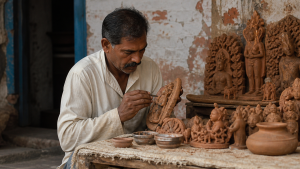
Traditional handicrafts and artisan sectors remain important sources of rural employment, skill preservation, and local enterprise in India. To support them, the government runs schemes that focus on training, credit, infrastructure, cluster development, and market access.
These programmes are implemented mainly by the Ministries of MSME and Textiles through central sector and cluster-based interventions for artisans, craftspeople, and related collectives.
PM Vishwakarma Scheme
- Launch and outlay: The scheme was launched on September 17, 2023, with a total financial outlay of ₹13,000 crore for five years up to FY 2027–28.
- Target group: It provides end-to-end support to traditional artisans and craftspeople engaged in 18 specified trades, such as carpenters, blacksmiths, potters, and weavers.
- Recognition: Beneficiaries receive a PM Vishwakarma digital certificate and identity card for access to scheme benefits.
- Training support: The scheme includes basic and advanced skill upgradation, with a daily stipend of ₹500 during training.
- Toolkit incentive: Eligible artisans get a toolkit incentive of up to ₹15,000 through e-vouchers for modern equipment.
- Credit support: Collateral-free loans of up to ₹3 lakh are provided in two tranches of ₹1 lakh and ₹2 lakh at a concessional interest rate of 5%.
- Interest subvention: The government provides an 8% interest subvention on the loan component.
- Coverage: By early 2026, the scheme had recorded around 30 lakh registered artisans and over 2.72 crore applications nationwide.
NHDP and Ambedkar Hastshilp Vikas Yojana
- National Handicrafts Development Programme (NHDP): It is the main policy vehicle for artisan welfare under the Ministry of Textiles.
- Ambedkar Hastshilp Vikas Yojana (AHVY): Launched in FY 2001–02, it is a key component of NHDP with a cluster-based development approach.
- Community mobilisation: AHVY helps artisans form Self-Help Groups (SHGs) and cooperative societies to strengthen collective bargaining and production capacity.
- Pehchan cards: Under AHVY, artisans receive Aadhaar-linked “Pehchan” identity cards for single-point verification and direct benefit transfer support.
- Artisan Producer Company: For FY 2026–27 proposals, at least 300 Pehchan-cardholder artisans are required to form an Artisan Producer Company (APC).
Cluster Development and Infrastructure Schemes
- CHCDS: The Comprehensive Handicrafts Cluster Development Scheme was extended up to March 2026 with an outlay of ₹160 crore.
- Mega-cluster focus: It supports geographic concentrations of more than 10,000 traditional artisans.
- Infrastructure support: The scheme funds common facility centres, design hubs, raw material depots, and technology upgradation centres.
- Objective: It aims to create world-class infrastructure so that artisans can improve quality, scale up production, and meet larger market demand.
- SFURTI: The Scheme of Fund for Regeneration of Traditional Industries is administered by the Ministry of MSME.
- Cluster facilities: SFURTI supports Common Facility Centres and Raw Material Banks for traditional artisan collectives.
- Grant support: It offers up to ₹2.5 crore for regular clusters of up to 500 artisans and up to ₹5 crore for major clusters with more than 500 artisans.
- Coverage: As of early 2026, 513 SFURTI clusters had been approved, assisting 3.03 lakh traditional artisans with ₹1,332.95 crore in total financial support.
Digital Platforms and Market Linkages
- India Handmade portal: The Ministry of Textiles operates the “India Handmade” e-commerce portal to connect artisans directly with customers.
- Reduced intermediaries: The portal helps artisans access wider markets and improve price realisation by limiting dependence on middlemen.
- GeM support: The Government e-Marketplace provides dedicated registration for artisans.
- EMD exemption: Registered artisans on GeM are exempt from Earnest Money Deposit requirements.
- Public procurement: Artisan enterprises are covered under the mandatory 25% annual MSME procurement quota for government departments.
Important Administrative and Financial Features
| Scheme | Implementing Ministry | Key Focus |
| PM Vishwakarma | Ministry of MSME / Skill Development | Individual artisans in 18 traditional trades |
| NHDP with AHVY | Ministry of Textiles | Cluster mobilisation and Artisan Producer Companies |
| CHCDS | Ministry of Textiles | Mega-cluster infrastructure development |
| SFURTI | Ministry of MSME | Raw Material Banks and Common Facility Centres |
Key Prelims Takeaways
- PM Vishwakarma: Launched on September 17, 2023, with an outlay of ₹13,000 crore for FY 2027–28.
- Training and credit: It provides ₹500 daily stipend during training and collateral-free loans up to ₹3 lakh at 5% interest.
- Toolkit incentive: Beneficiaries can receive e-vouchers worth up to ₹15,000 for tools and equipment.
- AHVY: It is a cluster-based component of NHDP and uses Aadhaar-linked Pehchan cards for artisan identification.
- APC threshold: At least 300 Pehchan-cardholder artisans are required to form an Artisan Producer Company.
- CHCDS and SFURTI: CHCDS targets mega-clusters with over 10,000 artisans, while SFURTI supports clusters through grants up to ₹5 crore.
- Market access: India Handmade, GeM registration, EMD exemption, and MSME procurement support are key channels for artisan sales.
Current General Studies comprises current-affairs-based, General Studies-rich study material on policies, laws, institutions, economy, science, environment, governance, international relations, and other varied but important topics for UPSC and State PSC Prelims examinations.
Fortnightly PDF compilations: Available here
Originally written on
March 28, 2026
and last modified on
September 5, 2026.
| Related | |
|---|---|