India–Pakistan Strategic Balance: Nuclear Doctrine and Command Structures
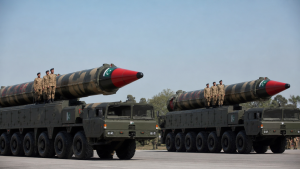
India and Pakistan’s strategic balance rests on nuclear deterrence, divergent doctrine, and tightly controlled command systems. Since the overt nuclear tests of 1998, both sides have combined military preparedness with limited confidence-building measures to reduce the risk of accidental escalation.
Comparative Overview of Nuclear Doctrines
The two countries follow sharply different nuclear approaches, shaped by their security concerns, force structures, and threat perceptions.
- India: Follows a declared doctrine based on No First Use, credible minimum deterrence, and assured retaliation.
- Pakistan: Maintains an ambiguous doctrine that keeps open the option of early nuclear use to offset conventional inferiority.
- Core contrast: India emphasizes restraint and survivable deterrence, while Pakistan emphasizes flexibility and escalation control through ambiguity.
India’s Nuclear Doctrine
- Formal adoption: India operationalized its official Nuclear Doctrine in January 2003, drawing from the National Security Advisory Board (NSAB) draft of 1999.
- No First Use (NFU): India commits to using nuclear weapons only in retaliation to a nuclear attack on Indian territory or on Indian forces anywhere.
- Credible Minimum Deterrence (CMD): The doctrine aims at maintaining a sufficiently survivable arsenal without entering a nuclear arms race.
- Massive retaliation: Any nuclear strike on India would invite punitive retaliation intended to inflict unacceptable damage.
- Non-nuclear-weapon states: India pledges not to use nuclear weapons against non-nuclear-weapon states.
- Biological or chemical attack caveat: India reserves the option of a nuclear response if subjected to a major attack using biological or chemical weapons.
- Civilian control: Authorization for nuclear use rests solely with the civilian political leadership.
Pakistan’s Strategic Posture
- Unwritten doctrine: Pakistan does not follow a declared NFU posture and keeps its doctrine deliberately flexible.
- First-use option: It reserves the right to use nuclear weapons early if it perceives an existential threat to national security, territory, or strategic assets.
- Full Spectrum Deterrence (FSD): Pakistan seeks deterrence across strategic, operational, and tactical levels.
- Tactical nuclear weapons: Short-range systems such as Nasr (Hatf-IX) are designed to counter India’s conventional military options.
- Threshold concept: Retired Pakistani officials have referred to four red lines – spatial, military, economic, and domestic.
- Spatial threshold: Loss of territory.
- Military threshold: Destruction of forces or major military losses.
- Economic threshold: Strangulation of the economy or trade.
- Domestic threshold: Political destabilization.
Nuclear Triad and Delivery Vectors
Both countries possess land, air, and sea-based delivery systems, though the extent of operational integration differs.
| Domain | India | Pakistan |
| Land-based missiles | Agni series (Agni-I to Agni-V), Prithvi-II | Shaheen series (I, II, III), Ghauri, Nasr (Hatf-IX) |
| Air-delivered systems | Mirage 2000, Rafale, Su-30MKI | F-16 A/B, JF-17 Thunder, Mirage III/V |
| Sea-based systems | INS Arihant, INS Arighat (SSBNs equipped with K-15/K-4) | Babur-3 (submarine-launched cruise missile) |
| Cruise missiles | BrahMos (supersonic), Nirbhay (subsonic) | Ra’ad (ALCM), Babur series (GLCM/SLCM) |
Strategic Command Structures
Nuclear weapons in both countries are governed by centralized command mechanisms designed to control custody, authorization, and operational deployment.
India’s Command Structure
- Nuclear Command Authority (NCA): India’s apex body for nuclear command and control has two levels.
- Political Council: Headed by the Prime Minister; it is the only body authorized to order a nuclear strike.
- Executive Council: Chaired by the National Security Advisor (NSA); it provides inputs and executes decisions of the Political Council.
- Strategic Forces Command (SFC): A tri-service command created in 2003 for operational management, delivery, and custody of nuclear assets.
Pakistan’s Command Structure
- National Command Authority (NCA): Established in 2000 and institutionalized under the National Command Authority Act, 2010.
- Apex body: Chaired by the Prime Minister of Pakistan and includes key ministers, the Chairman Joint Chiefs of Staff Committee (CJCSC), and the service chiefs.
- Development Control Committee (DCC): Oversees strategic systems research, development, and force modernization.
- Employment Control Committee (ECC): Handles operational guidance, target selection, and weapon authorization.
- Strategic Plans Division (SPD): Serves as the permanent secretariat of the NCA and manages daily administration, security, custody, and policy enforcement.
- Leadership of SPD: Headed by a senior three-star general officer of the Pakistani Army.
Bilateral Confidence-Building Measures
India and Pakistan have also put in place limited mechanisms to lower the risk of miscalculation and unintended escalation.
- Non-Attack on Nuclear Facilities Agreement (1988): Signed in December 1988 and ratified in January 1991; both sides exchange lists of nuclear installations on the first working day of every calendar year.
- Pre-notification of ballistic missile tests (2005): Requires advance notice of at least three days before flight tests of land- or sea-launched ballistic missiles.
- Hotline communication links: Direct lines exist between the Directors General of Military Operations (DGMOs) and between the respective Foreign Secretaries.
- Agreement on reducing the risk from nuclear accidents (2007): Requires immediate notification in case of a nuclear accident that could cause radioactive fallout or accidental launch.
Important Facts for Revision
- Pokhran-I (1974): India’s first peaceful nuclear explosion, codenamed Operation Smiling Buddha, was conducted on May 18, 1974.
- Pokhran-II (1998): India conducted five underground nuclear tests on May 11 and 13, 1998, under Operation Shakti.
- Chagai-I and Chagai-II (1998): Pakistan conducted six underground nuclear tests on May 28 and 30, 1998, in the Chagai hills and Ras Koh area.
- INS Arihant: Commissioned in 2016, it marked India’s entry into the sea-based leg of the nuclear triad.
- SSBN: A nuclear-powered ballistic missile submarine forms the backbone of a survivable second-strike capability.
Key Prelims Takeaways
- India’s doctrine: NFU, credible minimum deterrence, and massive retaliation are its core pillars.
- Pakistan’s doctrine: It keeps the first-use option open and relies on Full Spectrum Deterrence.
- India’s NCA: The Political Council alone can authorize nuclear use.
- Pakistan’s NCA: It includes the DCC, ECC, and the Strategic Plans Division as the secretariat.
- Sea-based deterrence: India’s INS Arihant class and Pakistan’s Babur-3 are key exam-relevant systems.
- CBMs: Missiles test pre-notification and nuclear accident notification are important bilateral risk-reduction measures.
- 1998 tests: India’s Pokhran-II and Pakistan’s Chagai tests remain the foundational reference points for the bilateral nuclear balance.
| Related | |
|---|---|