Inter-State Council and Centre–State Relations
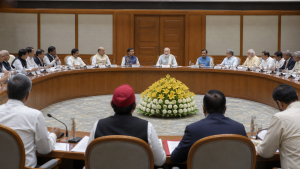
The Inter-State Council is a constitutional forum meant to improve coordination between the Union and the states, and among states themselves. It provides a structured space to discuss common policy issues, reduce friction and strengthen cooperative federalism.
Constitutional Basis
Article 263 of the Constitution of India empowers the President to establish an Inter-State Council by Presidential Order whenever public interest demands it. The Article also allows the President to define its duties, organization and procedure.
- Inquiry and advice: To inquire into and advise upon disputes that may arise between states.
- Common interest: To investigate and discuss subjects in which two or more states, or the Union and one or more states, have a common interest.
- Recommendations: To make recommendations for better policy coordination and administration.
Historical Background
Although Article 263 existed from the beginning, no permanent general council was created for about four decades. The issue gained momentum after the Commission on Centre-State Relations, headed by Justice R.S. Sarkaria, recommended a permanent Inter-State Council in 1988.
Acting on these recommendations, President R. Venkataraman issued the order establishing the Council on 28 May 1990. The Council became an advisory forum for broad Centre-State consultation rather than a body for adjudication.
Composition and Structure
The composition of the Council is designed to balance central and state representation. It brings together political executives from both levels to discuss national priorities and inter-governmental concerns.
| Chairman | The Prime Minister of India, who heads the Council and presides over meetings. |
| State Members | Chief Ministers of all states. |
| Union Territory Members | Chief Ministers of Union Territories with legislatures and Administrators of Union Territories without legislatures. |
| President’s Rule States | Governors of states under President’s Rule. |
| Union Cabinet Members | Six Union Cabinet Ministers nominated by the Prime Minister, including the Union Home Minister. |
| Permanent Invitees | Union Cabinet Ministers and Ministers of State nominated by the Chairman; they participate in deliberations without voting rights. |
- Consensus-based forum: Decisions are arrived at through discussion and consensus, not formal voting.
- Advisory body: The Council is recommendatory and does not issue binding orders.
Standing Committee and Secretariat
To ensure continuous consultation, the Council created a Standing Committee in 1996 at its second meeting. This body helps process agenda items before they are placed before the full Council.
- Chairman: The Union Home Minister serves as the Chairman of the Standing Committee.
- Composition: It includes five Union Cabinet Ministers and eight State Chief Ministers nominated by the Chairman.
- Functions: It processes Centre-State matters, monitors implementation of Council decisions and examines issues referred by the Chairman.
The Inter-State Council Secretariat was set up in 1991 and is headed by a Secretary to the Government of India. In April 2011, it was entrusted with servicing the Zonal Councils as well. It prepares background notes, compiles Action Taken Reports and tracks follow-up measures.
Powers, Scope and Limitations
- Advisory nature: The Council can recommend and advise, but its decisions are not legally binding on the Centre or the states.
- Non-legal disputes: It may inquire into and advise on disputes between states that are not strictly legal in nature.
- Supreme Court jurisdiction: Legal disputes involving constitutional interpretation fall under Article 131, which gives the Supreme Court original jurisdiction in certain federal disputes.
- Water disputes excluded: Inter-State river water disputes are outside Article 263 because Article 262 and parliamentary law provide separate mechanisms, including tribunals.
- No formal voting: The Council works through consensus rather than majority vote.
Role in Centre-State Relations
The Council acts as a high-level platform where state governments can raise concerns directly before the Union executive. It helps bridge political and administrative differences and supports cooperative federalism.
- Commission follow-up: It examined 247 recommendations of the Sarkaria Commission, and consensus was reached on over 180 points.
- Governors and armed forces: Among the issues taken up were guidelines on the appointment of Governors and the deployment of central armed forces.
- Contemporary issues: It also discusses fiscal transfers, GST implementation, disaster management, internal security coordination and public service delivery across state boundaries.
Key Prelims Takeaways
- Article: The Inter-State Council is provided for under Article 263 of the Constitution.
- Part XI: It falls under Part XI, which deals with relations between the Union and the States.
- Establishment: The Council was formally established on 28 May 1990 by a Presidential Order.
- Basis: Its creation followed the recommendations of the Sarkaria Commission.
- Nature: It is an advisory and recommendatory body, not a binding adjudicatory authority.
- Standing Committee: The Standing Committee was created in 1996 and is chaired by the Union Home Minister.
- Secretariat: The Inter-State Council Secretariat was set up in 1991 and later began servicing the Zonal Councils in 2011.
| Related | |
|---|---|