Internationally Honoured Indians and South Asians
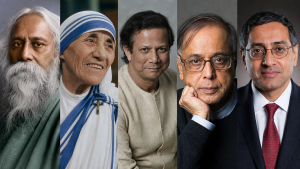
South Asian personalities have earned some of the world’s most prestigious honours in science, economics, literature, peace, public service and the arts. These awards are important for Prelims because they connect individuals, institutions, years and fields of recognition.
Nobel Laureates from South Asia
The Nobel Prize remains the highest global recognition in science, literature and peace. Several laureates of South Asian origin have made lasting contributions to scholarship, humanitarian work and scientific discovery.
- Rabindranath Tagore (1913): First Asian recipient of the Nobel Prize in Literature for Gitanjali.
- Mother Teresa (1979): Nobel Peace Prize for humanitarian work through the Missionaries of Charity in Kolkata.
- Abdus Salam (1979): First Pakistani scientist to win the Nobel Prize in Physics for the electroweak unification theory.
- C.V. Raman (1930): Nobel Prize in Physics for the Raman Effect, the inelastic scattering of light.
- Subrahmanyan Chandrasekhar (1983): Nobel Prize in Physics for theoretical studies on the structure and evolution of stars, including the Chandrasekhar Limit.
- Har Gobind Khorana (1968): Nobel Prize in Physiology or Medicine for deciphering the genetic code and its role in protein synthesis.
- Amartya Sen (1998): Nobel Memorial Prize in Economic Sciences for welfare economics, poverty mechanisms and social choice theory.
- Muhammad Yunus and Grameen Bank (2006): Nobel Peace Prize for developing microcredit and microfinance systems.
- Kailash Satyarthi and Malala Yousafzai (2014): Nobel Peace Prize for campaigns against the suppression of children and young people and for the right to education.
- Abhijit Banerjee (2019): Nobel Memorial Prize in Economic Sciences with Esther Duflo and Michael Kremer for experimental approaches to alleviating global poverty.
- Venkatraman Ramakrishnan (2009): Nobel Prize in Chemistry for atomic-level studies on the structure and function of the ribosome.
Ramon Magsaysay Awardees
Often called Asia’s Nobel Prize, the Ramon Magsaysay Award honours excellence in public service, community leadership and social innovation across Asia.
| Recipient | Country | Year | Area of recognition |
| Vinoba Bhave | India | 1958 | Community Leadership (Bhoodan Movement) |
| Verghese Kurien | India | 1963 | Community Leadership (Operation Flood and White Revolution) |
| Jayaprakash Narayan | India | 1965 | Public Service (Social Reform) |
| M.S. Swaminathan | India | 1971 | Community Leadership (Green Revolution) |
| M.S. Subbulakshmi | India | 1974 | Public Service (Carnatic Music and Philanthropy) |
| Ela Bhatt | India | 1977 | Community Leadership (Self-Employed Women’s Association) |
| Fazle Hasan Abed | Bangladesh | 1980 | Community Leadership (BRAC Foundation) |
| Kiran Bedi | India | 1994 | Government Service (Prison and Police Reforms) |
| T.N. Seshan | India | 1996 | Government Service (Electoral Reforms) |
| Radhika Coomaraswamy | Sri Lanka | 2012 | Emergency Leadership (Human Rights Advocacy) |
| Bezwada Wilson | India | 2016 | Public Service (Campaign Against Manual Scavenging) |
| Sonam Wangchuk | India | 2018 | Emergent Leadership (Educational and Environmental Reforms) |
| Ravish Kumar | India | 2019 | Journalism, Literature and Creative Communication Arts |
| Muhammad Amjad Saqib | Pakistan | 2021 | Community Leadership (Akhuwat Interest-Free Microfinance) |
Global Agricultural, Environmental and Scientific Honours
South Asian contributors have also been recognised for work in food security, environmental protection, mathematics and technology.
- M.S. Swaminathan (1987): First recipient of the World Food Prize for leading the introduction of high-yielding wheat and rice varieties.
- Gurdev Khush (1996): Recognised for developing high-yielding rice varieties that boosted Asian food security.
- Surinder Vasal (2000): Honoured for developing Quality Protein Maize (QPM) varieties.
- Modadugu Vijay Gupta (2005): Honoured for developing low-cost aquaculture and freshwater fish farming techniques.
- Sanjaya Rajaram (2014): Recognised for breeding 480 high-yielding, disease-resistant wheat varieties.
- Shakuntala Haraksingh Thilsted (2021): Awarded for developing holistic, nutrition-sensitive approaches to aquaculture and food systems.
- Gobind Behari Lal (1937): First Indian to win the Pulitzer Prize in Journalism for science coverage.
- Medha Patkar (1992): Won the Goldman Environmental Prize for organising opposition against destructive dam projects along the Narmada River.
- M.C. Mehta (1996): Awarded the Goldman Environmental Prize for public interest litigation protecting the Taj Mahal and reducing industrial pollution.
- Prafulla Samantara (2017): Won the Goldman Environmental Prize for a legal battle protecting Indigenous lands in the Niyamgiri Hills.
- Raj Reddy (1994): First person of Asian origin to receive the Turing Award for contributions to artificial intelligence.
- S.R. Srinivasa Varadhan (2007): Won the Abel Prize in Mathematics for contributions to probability theory and unified large deviations theory.
- Manjul Bhargava (2014): Awarded the Fields Medal in Mathematics for methods in the geometry of numbers.
Literary and Cinematic Achievements
South Asian writers and filmmakers have made a strong mark in global literature and cinema, especially through the Booker Prize, International Booker Prize and Academy Awards.
- V.S. Naipaul (1971): Won the Booker Prize for In a Free State; later received the Nobel Prize in Literature in 2001.
- Salman Rushdie (1981): Won the Booker Prize for Midnight’s Children, which also received the Booker of Bookers award in 1993.
- Arundhati Roy (1997): First resident Indian citizen to win the Booker Prize for The God of Small Things.
- Kiran Desai (2006): Won the Booker Prize for The Inheritance of Loss.
- Aravind Adiga (2008): Won the Booker Prize for The White Tiger.
- Geetanjali Shree (2022): Won the International Booker Prize for Tomb of Sand, translated into English by Daisy Rockwell.
- Bhanu Athaiya (1982): First Indian to win an Oscar, for Best Costume Design for Gandhi.
- Satyajit Ray (1992): Conferred an Honorary Lifetime Achievement Oscar.
Key Prelims Takeaways
- First Asian Nobel in Literature: Rabindranath Tagore won in 1913 for Gitanjali.
- First Pakistani Nobel laureate: Abdus Salam won the Physics Nobel in 1979.
- Indian Nobel trio in sciences: C.V. Raman, Har Gobind Khorana and Subrahmanyan Chandrasekhar are key science laureates.
- Microfinance and peace: Muhammad Yunus and Grameen Bank won the 2006 Peace Prize for microcredit.
- Ramon Magsaysay highlights: Vinoba Bhave, Verghese Kurien, Ela Bhatt and T.N. Seshan are important names.
- World Food Prize: M.S. Swaminathan was the first recipient in 1987.
- Global arts milestones: Bhanu Athaiya was the first Indian Oscar winner, and Geetanjali Shree won the International Booker Prize in 2022.
| Related | |
|---|---|