Chess Rules, Scoring Systems and Tournament Formats
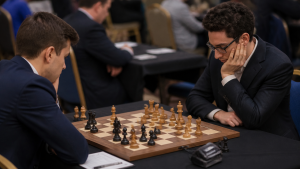
Chess is played between two players on a standard 8-by-8 board, with each side seeking to checkmate the opposing king. Its rules govern how pieces move, when games are drawn and how results are scored. Tournament formats, time controls and fair-play standards shape competitive play.
Board, Pieces and Basic Rules
A standard chessboard has 64 alternating light and dark squares. Each player begins with 16 pieces: one king, one queen, two rooks, two bishops, two knights and eight pawns. Players move in turn, and a piece generally cannot move onto a square occupied by a piece of the same colour. The objective is to attack the opposing king so that it has no legal escape: this is checkmate. Piece movements are distinct. The king moves one square in any direction; the queen moves any distance along a rank, file or diagonal. A rook moves along ranks and files, while a bishop moves diagonally. The knight moves in an L-shape—two squares in one direction and one perpendicular—and can jump over other pieces. A pawn moves forward one square, or two squares on its first move, and captures one square diagonally forward.
Special Moves and Game Results
Three special moves affect how a game is played:
- Castling: The king moves two squares towards a rook, and that rook moves to the square the king crossed. It is permitted only if neither piece has previously moved, the intervening squares are clear, and the king is not in check or moving through or onto an attacked square.
- En passant: If a pawn advances two squares from its starting position and lands beside an opposing pawn, the latter may capture it as though it had advanced only one square. The capture must be made on the immediately following turn.
- Pawn promotion: A pawn reaching the opponent’s back rank is promoted to a queen, rook, bishop or knight. It cannot remain a pawn or become a king.
Checkmate ends the game with a loss for the checkmated player. A player may also resign. A draw gives each player half a point and may arise in several ways:
- Stalemate: The player to move has no legal move, but their king is not in check.
- Threefold repetition: The same position occurs three times, with the same player to move and the same legal moves available.
- 50-move rule: A player may claim a draw after 50 moves by each player without a pawn move or capture.
- Insufficient material: The remaining pieces cannot provide either player with a possible checkmate.
- Agreement: Players may agree to a draw, subject to the rules of the competition.
Scoring and Tournament Formats
The standard scoring system awards one point for a win, half a point to each player for a draw, and zero points for a loss. In a multi-round event, a player’s score is the total points earned across the games played. Standings are based on these results, with competition regulations determining how tied scores are resolved. Common tournament formats include:
- Round-robin: Each participant plays every other participant at least once. It is suited to a relatively small field.
- Swiss system: Participants play several rounds without elimination. Pairings are generally based on current scores, bringing together players with similar points.
- Knockout: Players are eliminated after a loss, making this a less common format in top-level chess.
- Team competition: Clubs or national teams field players on designated boards. Individual game results contribute to the team’s match score, while team standings and individual board results may be recorded separately.
Team events can award team medals separately from individual board awards, which recognise performances on a particular board. Keeping the two types of result distinct is important when interpreting competition standings.
Time Controls, Administration and Fair Play
Time controls set the amount of time available to each player. Classical games generally allow the most time, often 60 minutes or more per side; rapid games commonly range from 10 to 60 minutes per side. Blitz is usually under 10 minutes per side, while bullet games often allow one or two minutes. Exact classifications and time allowances depend on the competition’s regulations. Competition standards establish the applicable playing rules, time controls and procedures for recording results. Fair play requires players to follow those rules and compete honestly. Consistent administration helps ensure that results are determined by play rather than by breaches of competition regulations. The international governing body is the Fédération Internationale des Échecs (FIDE), which sets chess rules, oversees international competitions and awards titles such as Grandmaster and International Master. The European Chess Union (ECU) is the continental chess body for Europe and organises regional events. The Elo rating system estimates players’ relative strength and is used by FIDE for official rankings. Ratings are adjusted after games according to results and the ratings of opponents: beating a higher-rated player generally produces a larger gain than beating a lower-rated one.
Key Prelims Takeaways
- Standard chess uses an 8-by-8 board with 64 squares and 16 pieces per player.
- Checkmate is the objective; castling, en passant and pawn promotion are special moves.
- A win scores one point, a draw half a point per player and a loss zero points.
- Round-robin and Swiss are common tournament formats; Swiss events do not eliminate players after a loss.
- In team chess, players are assigned boards and individual results contribute to the team match score.
- FIDE is the international governing body; Elo is used for official player ratings.
Recent Context
At the six-round 2026 European Chess Club Cup, organised by the ECU in separate Open and Women’s events, Nihal Sarin won Board 2 gold with five points from six games for Novy Bor, which took Open silver. Koneru Humpy earned Board 2 gold with 4.5 points; her club, Cercle d’Echecs de Monte-Carlo, defended its Women’s team title. Bayegan Pendik won Open team gold.
| Related | |
|---|---|