International Organisations Working on Women and Child Issues
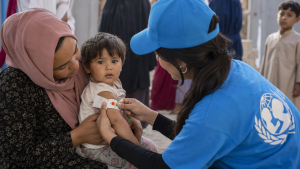
United Nations Children’s Fund (UNICEF)
UNICEF is the main UN agency for child welfare and development. It works on health, nutrition, education, protection and emergency relief for children and mothers, especially in low-income and crisis-affected settings.
- Origin: Created by the UN General Assembly on 11 December 1946 as the International Children’s Emergency Fund to help children affected by World War II.
- Status: Became a permanent part of the UN system in 1953 and later retained the name UNICEF.
- Headquarters: New York.
- Governance: Managed by an Executive Board of 36 member states elected by ECOSOC for three-year terms on regional representation.
- Funding: Depends entirely on voluntary contributions from governments, private sector donors, philanthropic foundations and national committees.
- Key publication: The State of the World’s Children, first published in 1980, provides data on child health, nutrition and safety.
UN Women
UN Women is the UN entity dedicated to gender equality and the empowerment of women. It also supports the integration of women’s rights into UN policies and development work.
- Established: July 2010 by the UN General Assembly.
- Purpose: To accelerate progress on gender equality and women’s empowerment globally.
- Created by merging four UN bodies: Division for the Advancement of Women (DAW), International Research and Training Institute for the Advancement of Women (INSTRAW), Office of the Special Adviser on Gender Issues (OSAGI) and United Nations Development Fund for Women (UNIFEM).
- Headquarters: New York.
- Role: Serves as the Secretariat for the Commission on the Status of Women (CSW).
- Policy focus: Monitors SDG 5 and coordinates UN system-wide gender mainstreaming.
United Nations Population Fund (UNFPA)
UNFPA is the lead UN agency on sexual and reproductive health and rights, family planning, maternal health and population data. It is closely linked to women’s health, adolescent health and demographic planning.
- Origin: Set up as a trust fund in 1967 and began active operations in 1969 as the United Nations Fund for Population Activities.
- Name change: Renamed UNFPA in 1987.
- Headquarters: New York.
- Core work: Sexual and reproductive health, maternal care, family planning and population census support.
- 2030 targets: Ending unmet need for family planning, preventable maternal deaths, and gender-based violence and harmful practices.
- Annual report: State of World Population tracks demographic change, maternal mortality, contraceptive use and child marriage data.
Key Treaties and Global Frameworks
- Convention on the Rights of the Child (CRC): Adopted in 1989; it is a legally binding treaty that defines a child as a person below 18 years.
- Monitoring body: The CRC is monitored by a committee of 18 independent experts.
- CEDAW: The Convention on the Elimination of All Forms of Discrimination Against Women was adopted in 1979.
- CEDAW mandate: It requires states to eliminate discrimination against women in political, public and economic life.
- Beijing Declaration and Platform for Action: Adopted at the Fourth World Conference on Women in September 1995.
- Policy significance: It remains a global framework for advancing women’s rights across 12 critical areas of concern.
- International Labour Organization (ILO): Sets labour standards that protect women and children.
- Important conventions: Minimum Age Convention (No. 138) and Worst Forms of Child Labour Convention (No. 182).
Child Marriage: Legal and Policy Linkages
Child marriage remains a key issue in women and child policy because it combines rights violations, health risks and development setbacks. It is addressed through global treaties, national laws, public health programmes and awareness campaigns.
- Child marriage: In international law and policy, it refers to any formal marriage or informal union where at least one party is below 18 years.
- Early marriage: A broader term used for marriage at a young age.
- Forced marriage: A union entered into without full and free consent.
- Indian law: The Prohibition of Child Marriage Act, 2006 is the principal law dealing with child marriage in India.
- Legal age in India: 18 years for females and 21 years for males.
- Effect of law: Child marriages are voidable at the option of the minor.
Key Prelims Takeaways
- UNICEF: UN agency for child welfare, with headquarters in New York and funding entirely through voluntary contributions.
- UN Women: Established in 2010; it leads the UN gender equality and women’s empowerment agenda.
- UNFPA: Focuses on reproductive health, maternal care and population issues.
- CRC: Adopted in 1989; it defines a child as a person below 18 years.
- CEDAW: Core global treaty against discrimination of women, adopted in 1979.
- Beijing Platform: Important policy framework for women’s rights across 12 critical areas.
- ILO conventions: No. 138 on minimum age and No. 182 on the worst forms of child labour are highly relevant for child protection.
- NFHS-5 to NFHS-6: In India, the share of women aged 20–24 years married before 18 fell from 23.3% to 20.1%.
- Bal Vivah Mukt Bharat: India launched this campaign on 27 November 2024 to eliminate child marriage.
- UNFPA estimate: About 640 million living women and girls were married during childhood, and around 12 million girls are married before 18 each year.
- Assam crackdown: The state reported over 12,000 cases and more than 11,000 arrests in its action against child marriage.
- India Child Protection report: It recorded an 81% reduction in child marriage cases across 20 districts of Assam between 2021–22 and 2023–24.
Recent Context
The UN General Assembly adopted a resolution on 4 September 2026 to observe 27 November every year as the International Day for the Elimination of Child, Early and Forced Marriage. The resolution was adopted by consensus in the 193-member UN and was presented by Dr. Fatima Maada Bio, First Lady of Sierra Leone and President of OAFLAD.
| Related | |
|---|---|