Important Monuments of the Rangpur-Sivasagar Historical Ensemble
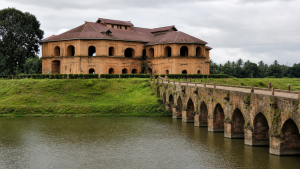
Ahom capital landscape in Assam
The Rangpur-Sivasagar Historical Ensemble represents the pre-modern capital landscape of the Ahom dynasty in Assam. It reflects nearly six centuries of political power, ritual life, brick architecture, water engineering and military planning in the Brahmaputra Valley.
The ensemble includes some of the best-known Ahom monuments such as Rang Ghar, Talatal Ghar, Namdang Stone Bridge and the historic tanks of Sivasagar, Joysagar and Gaurisagar.
Ahom dynasty and the capital shift
- Foundation: The Ahom dynasty was founded in 1228 by Chaolung Sukaphaa, a Shan prince from Mong Mao.
- Rule in Assam: It ruled the Brahmaputra Valley until 1826, when the Treaty of Yandabo ended Ahom rule.
- Capital sequence: The political centres shifted across Charaideo, Garhgaon and Rangpur, with Rangpur in present-day Sivasagar becoming the capital in 1707 under Rudra Singha.
- Statecraft: The Ahoms developed a distinctive system of governance, military organisation and cultural practices.
- Military legacy: Their resistance to Mughal expansion is associated with the Battle of Saraighat in 1671.
Rang Ghar: royal sports pavilion
- Function: Rang Ghar at Rupahi Pathar in Sivasagar served as a royal pavilion for watching sports and cultural celebrations, including Rongali Bihu.
- Construction history: It began as a temporary bamboo-and-wood structure under Rudra Singha and was rebuilt as a permanent two-storeyed brick building by Pramatta Singha between 1744 and 1751.
- Architectural form: Its roof is shaped like an inverted Ahom long boat.
- Decorative features: The crest is adorned with carved stone crocodiles or makaras.
- Material: The structure uses thin baked bricks and indigenous mortar.
Talatal Ghar and Kareng Ghar complex
- Military significance: Talatal Ghar was designed as a strategic military headquarters and administrative base.
- Development: It began as an army camp under Rudra Singha and was later expanded into a brick palace by Rajeswar Singha in 1765.
- Layout: The complex has seven storeys in all, with three underground levels known as Talatal Ghar and four above-ground levels called Kareng Ghar.
- Royal residence: Kareng Ghar functioned as the palace residence.
- Escape routes: The underground levels reportedly had tunnels leading to the Dikhow River and Garhgaon Palace.
- Construction technique: The mortar used was made with sticky rice, duck eggs, black lentils and lime.
Namdang Stone Bridge and monumental tanks
- Namdang Stone Bridge: Built in 1703 during Rudra Singha’s reign, this slightly curved arch bridge was cut from a single massive piece of sandstone.
- Craftsmanship: It was built by specialised craftsmen from Bengal.
- Sivasagar Tank: Built by Queen Ambika in 1733, it is associated with the Sivadol, Devidol and Joydol temples.
- Joysagar Tank: Built by Rudra Singha in 1697, it spans 318 acres and was built in memory of Sati Joymoti.
- Gaurisagar Tank: Built by Queen Phuleswari between 1715 and 1718, it was dedicated to Goddess Durga and has adjacent shrines.
- Water system: These tanks were part of a wider network of embankments, moats and drainage channels that regulated local water levels and supported civic life.
UNESCO Tentative List and heritage status
- Tentative List: UNESCO’s Tentative List is the inventory of properties a State Party may later nominate for the World Heritage List.
- Why it matters: A property must first be placed on the Tentative List before formal nomination for final inscription.
- Criteria used: The ensemble was submitted under cultural criteria (iii) and (iv).
- Criterion (iii): It relates to a unique testimony to a cultural tradition or civilisation.
- Criterion (iv): It relates to an outstanding example of a building type, architectural ensemble or technological landscape.
- India’s Tentative List: With this addition and three other Indian properties, the national Tentative List rose to 73 properties.
| Monument / Water Body | Associated Patron | Year / Period | Key Feature |
| Rang Ghar | Pramatta Singha | 1744–1751 | Brick amphitheatre with inverted boat-shaped roof |
| Talatal Ghar | Rajeswar Singha | 1765 | Seven-storeyed complex with three underground floors |
| Namdang Stone Bridge | Rudra Singha | 1703 | Cut from a single sandstone block |
| Joysagar Tank | Rudra Singha | 1697 | 318-acre tank built in memory of Sati Joymoti |
| Sivasagar Tank | Queen Ambika | 1733 | Associated with Sivadol, Devidol and Joydol |
| Gaurisagar Tank | Queen Phuleswari | 1715–1718 | Dedicated to Goddess Durga with adjacent shrines |
Key Prelims Takeaways
- Rang Ghar: Identified as Asia’s oldest surviving amphitheatre.
- Talatal Ghar: A palace complex notable for military architecture and underground levels.
- Namdang Bridge: A single-stone arch bridge built in 1703.
- Ahom masonry: Used organic mortar with sticky rice, duck eggs, black lentils and lime.
- UNESCO criteria: Cultural criteria (iii) and (iv) were applied for the nomination.
- Other Indian additions: Colonial Penal Settlement of the Andaman Islands, Nicobarese Cultural Continuity in the Central Group of Nicobar Islands, and Painted Haveli Towns of Shekhawati.
- Charaideo Moidams: Inscribed on 26 July 2024 as India’s 43rd UNESCO World Heritage Site; they represent the Ahom royal burial mounds and funerary landscape.
Recent Context
The Rangpur-Sivasagar Historical Ensemble was added to UNESCO’s World Heritage Tentative List in September 2026. India’s Permanent Mission to UNESCO submitted the nomination dossier on 19 June 2026 under cultural criteria (iii) and (iv).
This keeps the Ahom capital landscape in focus for possible future inscription on the UNESCO World Heritage List.
| Related | |
|---|---|