Major India-Afghanistan Relations and Connectivity Channels
Introduction
India and Afghanistan have long shared civilizational, economic and people-to-people ties. In the absence of direct land access, their partnership depends on transit corridors, strategic ports and institutional mechanisms that support trade, development and connectivity.
Institutional Architecture of Bilateral Cooperation
- Joint Working Group on Trade, Commerce and Investment: This is the main bilateral forum for sector-specific economic issues, including trade facilitation, regulatory coordination and follow-up action.
- Participation: The JWG brings together officials from commerce, customs, industry, regulatory bodies and diplomatic missions.
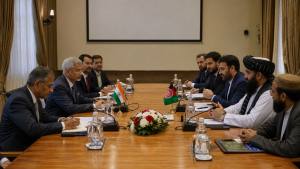
- Joint Committee Meeting (JCM): The fourth round was held in New Delhi on July 9, 2026, to review cooperation in trade, visas, humanitarian aid, healthcare and education.
- Co-chairing: The July 2026 JCM was co-chaired by M. Anand Prakash, Joint Secretary (Pakistan, Afghanistan and Iran) in India’s Ministry of External Affairs, and Shuaib Baryalai, Director General of the First Political Division in Afghanistan’s Ministry of Foreign Affairs.
- Agriculture dialogue: On July 8, 2026, Shivraj Singh Chouhan and Mawlawi Ataullah Omari agreed to establish a separate Joint Working Group on long-term agriculture and livestock cooperation.
Bilateral Trade Profile and Economic Instruments
- Trade volume: Official bilateral trade in 2025–26 stood at USD 907.85 million.
- Trade balance: India’s exports were USD 253.63 million, while imports were USD 654.22 million, indicating a trade deficit for India.
- Major exports: India exports pharmaceutical formulations, raw industrial materials, sugar, vehicle batteries, auto parts and motorcycles to Afghanistan.
- Major imports: India imports dry fruits such as figs, raisins, almonds and pistachios, along with saffron and asafoetida.
- Preferential Trade Agreement (PTA): Signed in March 2003, the PTA provides reciprocal tariff concessions on selected goods and remains an important legal basis for trade.
- Trade facilitation: Commercial attachés and a Joint Chamber of Commerce and Industry support business-to-business contact and market access.
Strategic Transit and Connectivity Channels
- Chabahar Port: India uses the Shaheed Beheshti Terminal at Chabahar Port in Iran under a trilateral arrangement, creating a sea-land route that bypasses Pakistan.
- Air Freight Corridor: Launched in 2017, it connects Kabul and Kandahar with New Delhi and Amritsar for the movement of perishables and high-value goods.
- Zaranj-Delaram Highway (Route 606): Built by India’s Border Roads Organisation and completed in 2009, this 218-km highway links Zaranj on the Iran-Afghanistan border to Delaram and connects Chabahar to Afghanistan’s internal road network.
- International North-South Transport Corridor (INSTC): This 7,200-km multi-mode network connects India, Iran, Azerbaijan and Russia and provides a wider regional connectivity framework.
- TAPI Gas Pipeline: The 1,814-km project is designed to carry natural gas from Turkmenistan’s Galkynysh field to India via Afghanistan.
Key Infrastructure and Development Assistance Projects
- Afghan-India Friendship Dam (Salma Dam): Located on the Hari River in Herat Province, this 42 MW hydroelectric and irrigation project was built with Indian assistance and inaugurated in June 2016.
- Afghan Parliament Building: Inaugurated in December 2015, the Indian-built building in Kabul combines traditional Mughal and modern architectural elements.
- Shatoot Dam (Lalander Dam): An agreement was signed in February 2021 for this dam on the Kabul River basin to help provide drinking water to Kabul city.
- Humanitarian assistance: India’s support includes more than 400 High Impact Community Development Projects covering healthcare, education, vocational training and food security.
Regional Significance
- Connectivity diplomacy: India-Afghanistan connectivity is closely tied to access, transit and the creation of alternative routes for regional trade.
- Strategic outreach: Projects such as Chabahar and the air corridor strengthen India’s outreach to Afghanistan and the wider region.
- Regional stability: Trade and infrastructure cooperation are also linked to stability, economic recovery and long-term engagement in Afghanistan.
- Sectoral focus: Agriculture, pharmaceuticals and cargo movement remain recurring themes in bilateral economic talks.
Key Prelims Takeaways
- Trade figures: India-Afghanistan bilateral trade in 2025–26 was USD 907.85 million.
- Trade balance: India imported more from Afghanistan than it exported in 2025–26.
- PTA: The India-Afghanistan Preferential Trade Agreement was signed in March 2003.
- Chabahar link: The Zaranj-Delaram Highway connects Chabahar Port to Afghanistan’s road network.
- Air corridor: The Afghanistan-India Air Freight Corridor began in 2017.
- Major projects: The Salma Dam is on the Hari River, while the Shatoot Dam is planned in the Kabul River basin.
- Institutional mechanism: Joint Working Groups are used to resolve sector-specific trade and economic issues.
Recent Context
The India-Afghanistan Joint Working Group on Trade, Commerce and Investment held a virtual meeting on September 1, 2026, to review bilateral trade and economic cooperation. The discussion covered customs cooperation, visa facilitation for traders, banking and financial cooperation, tariff concessions, pharmaceuticals, agriculture and cargo connectivity, with follow-up on data-sharing and regulatory coordination.
Current General Studies comprises current-affairs-based, General Studies-rich study material on policies, laws, institutions, economy, science, environment, governance, international relations, and other varied but important topics for UPSC and State PSC Prelims examinations.
Fortnightly PDF compilations: Available here
Originally written on
September 5, 2026
and last modified on
September 5, 2026.
| Related | |
|---|---|