Important Bird Habitats and Offshore Islands
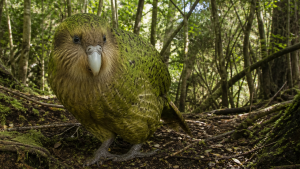
Predator-free offshore islands have become vital refuges for flightless birds that cannot survive where invasive mammals are present. In New Zealand, the recovery of the kākāpō shows how island sanctuaries, habitat restoration and strict biosecurity can pull a critically endangered species back from extinction.
Taxonomy and evolutionary profile
- Scientific name: The kākāpō is Strigops habroptilus, a nocturnal, flightless, herbivorous and ground-dwelling bird endemic to New Zealand.
- Heaviest parrot: It is the world’s heaviest parrot species, with adult males weighing up to 4 kg and females about 1.4-2 kg.
- Classification: It is placed in the family Strigopidae under the superfamily Strigopoidea, not in the family Psittacidae.
- Ancient lineage: Strigopoidea represents an ancient branch of the parrot evolutionary tree that split from other parrots around 82 million years ago.
- Flightlessness: In the absence of mammalian predators in New Zealand, the species lost flight and evolved strong legs, climbing ability, moss-green camouflage and a distinct sweet, musty odour.
- Breeding system: It is the only parrot in the world with a lek breeding system, where males gather in an arena and use low-frequency booming calls to attract females.
Why offshore island sanctuaries matter
- Predator pressure: Ground-dwelling birds in New Zealand suffered heavy losses after the introduction of stoats, feral cats and rats by settlers.
- Survival strategy: Since flightless birds cannot escape ground predators, surviving populations are moved to predator-free offshore islands.
- Island management: These sanctuaries are secured through trapping, fencing, poisoning campaigns and strict biosecurity to prevent reinvasion.
- Ecological value: Offshore islands function as evolutionary lifeboats, preserving species that would otherwise disappear from mainland habitats.
- Habitat needs: The kākāpō depends on mature native vegetation, nesting hollows and suitable microclimates found in restored island ecosystems.
- Habitat restoration: Conservation on islands also helps rebuild native plant communities that support nesting and feeding.
Key kākāpō sanctuaries
| Island sanctuary | Alternative name | Location / region | Key role |
| Whenua Hou | Codfish Island | Off Stewart Island (Rakiura) | Primary breeding sanctuary; about 14 sq km |
| Pukenui | Anchor Island | Dusky Sound, Fiordland | Predator-free habitat with high rimu tree density |
| Te Kāhaku | Chalky Island | Chalky Inlet, Fiordland | Critical translocated population site |
Masting and reproductive biology
- Masting: Kākāpō breeding is highly irregular and is linked to masting, the synchronous and intermittent mass fruiting of native New Zealand trees.
- Rimu tree: The main trigger is the rimu tree (Dacrydium cupressinum), whose abundant fruit provides the energy needed for egg production and chick rearing.
- Breeding frequency: Females nest only once every two to five years, and usually only when food availability is high.
- Incubation: Eggs are incubated for about 30 days.
- Growth milestone: The 150-day mark is used as the official threshold for fledging and independence, after which chicks are counted in population totals.
- Food dependence: In non-masting years, breeding may not occur because the required nutrient-rich food is unavailable.
Recovery programme and conservation management
- Programme launch: The Kākāpō Recovery Programme was launched by the New Zealand Department of Conservation (DOC) in 1995.
- Starting crisis: At that time, only 51 birds survived globally, including 20 breeding females.
- Management tools: The programme uses nest monitoring, disease screening, supplementary feeding and managed breeding to limit inbreeding depression.
- Cultural partnership: The recovery group includes the DOC and Te Rūnanga o Ngāi Tahu representation, reflecting shared conservation stewardship.
- Reduced-intervention trials: Recent efforts have tested remote nest data transmission and lower supplementary feeding to reduce human contact and encourage more natural behaviour.
- Conservation focus: The overall aim is to combine predator control, habitat protection and careful breeding management for long-term recovery.
Key Prelims Takeaways
- Species: Strigops habroptilus, an endemic, nocturnal, flightless and herbivorous bird of New Zealand.
- Unique status: The world’s heaviest parrot and the only parrot with a lek breeding system.
- Habitat strategy: Predator-free offshore islands are essential for flightless birds vulnerable to introduced mammals.
- Main sanctuaries: Whenua Hou (Codfish Island), Pukenui (Anchor Island) and Te Kāhaku (Chalky Island).
- Breeding trigger: Masting of native trees, especially rimu, drives successful breeding seasons.
- Recovery milestone: Chicks are added to the population only after reaching the 150-day fledging threshold.
- Management agency: The programme is led by the New Zealand DOC with Ngāi Tahu involvement.
Recent Context
On 1 September 2026, the official kākāpō population reached 325 birds after 90 fledged chicks were added to the tally. The species had crossed the 300-bird mark for the first time in about 75 years on 31 August 2026, supported by a strong breeding season linked to rimu masting on predator-free offshore islands.
Current General Studies comprises current-affairs-based, General Studies-rich study material on policies, laws, institutions, economy, science, environment, governance, international relations, and other varied but important topics for UPSC and State PSC Prelims examinations.
Fortnightly PDF compilations: Available here
Originally written on
September 5, 2026
and last modified on
September 5, 2026.
| Related | |
|---|---|