Important Farmer Producer Companies in India
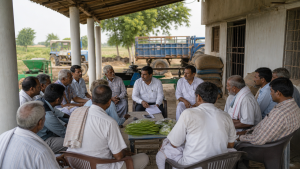
Farmer Producer Companies (FPCs) are producer-owned business entities that combine the mutual-help spirit of cooperatives with the corporate structure of a private company. They are designed to aggregate small farmers, improve bargaining power, and connect producers more efficiently with markets, processing, and exports.
In agriculture revision, FPCs matter because they sit at the intersection of collectivization models, rural livelihoods, and value chain integration.
Legal Framework and Governance
- Legal status: FPCs are registered under the Companies Act, 2013, specifically Sections 378A to 378ZU.
- Earlier law: These provisions replaced Part IXA of the Companies Act, 1956.
- Membership: A minimum of 10 individual producers, or two or more producer institutions, or a combination of both is required for formation.
- No upper limit: There is no maximum cap on the number of members.
- Board strength: The board of directors must have at least five and not more than 15 directors, elected by shareholders.
- Producer ownership: Membership and shareholding are restricted to active producers.
- Transfer limits: Shares are non-transferable to non-producers, which helps prevent external takeover.
Why FPCs Matter for Farmers
- Aggregation: Small and marginal farmers can pool produce for better scale and uniformity.
- Market access: FPCs reduce dependence on middlemen and improve direct linkage with buyers.
- Collective bargaining: Farmers can negotiate better prices for inputs and output.
- Value addition: FPCs can move into grading, processing, packaging, and branding.
- Supply-chain efficiency: They help streamline procurement, storage, and marketing.
- Livelihood support: The model strengthens rural incomes through producer-led enterprise.
Institutional Support and Promotional Schemes
- Central Sector Scheme: The Ministry of Agriculture and Farmers Welfare launched the scheme for Formation and Promotion of 10,000 Farmer Producer Organisations (FPOs) in 2020.
- Implementing agencies: Small Farmers’ Agri-Business Consortium (SFAC) and NABARD are the principal implementing agencies for FPO development.
- Equity support: SFAC administers the Equity Grant Scheme, offering matching grants up to Rs. 15 lakh per FPC.
- Credit support: SFAC also runs a Credit Guarantee Fund Scheme covering loans up to Rs. 2 crore per FPO.
- NCDC role: The National Cooperative Development Corporation supports FPCs through funding and promotional assistance for value-chain development.
- Organic push: In the Northeast, FPC development has also been supported under the Mission Organic Value Chain Development for Northeastern Region (MOVCDNER).
Cooperatives and FPCs: Key Differences
| Feature | Cooperative Societies | Farmer Producer Companies |
| Primary law | State Cooperative Societies Act or Multi-State Cooperative Societies Act | Companies Act, 2013 (Sections 378A-378ZU) |
| Area of operation | Usually restricted to the state or multi-state limits | Can operate across India without geographical restriction |
| Voting rights | One member, one vote | One member, one vote |
| Audit and control | Higher government interference and registrar control | Audited by Chartered Accountants under corporate norms |
| Funding sources | Government equity, member deposits, and state support | Member equity, commercial banks, and venture capital |
Important FPC Ecosystems and Sectors
- Value-addition model: Sahyadri Farmer Producer Company in Maharashtra is a major example of grape export and collective value addition.
- Sector diversity: FPCs operate in seed production, dairy, poultry, organic farming, and non-timber forest produce.
- Input savings: Collective procurement helps reduce the cost of inputs such as seed, fertiliser, and packaging.
- Leading states: Madhya Pradesh, Maharashtra, and Tamil Nadu have large numbers of registered FPCs.
- World Bank support: State agri-business promotion projects have also supported FPC growth in some states.
- Organic markets: FPCs are increasingly relevant in certified organic value chains and export-oriented agriculture.
Key Prelims Takeaways
- Hybrid structure: FPCs combine cooperative principles with the structure of a private limited company.
- Registration law: They are registered under the Companies Act, 2013, Sections 378A to 378ZU.
- Producer ownership: Only active producers can be members or shareholders.
- Board size: An FPC board must have 5 to 15 directors.
- Support institutions: SFAC, NABARD, and NCDC are important institutions linked with FPC promotion.
- Equity and credit: SFAC provides equity grant support up to Rs. 15 lakh per FPC and credit guarantee cover up to Rs. 2 crore per FPO.
- No stock exchange listing: FPC shares cannot be listed on public stock exchanges.
Recent Context
On 2 September 2026, APEDA facilitated Tripura’s first organic agricultural export to Europe, sending NPOP-certified ethnic rice to Austria and the Netherlands. The shipment was sourced from local FPCs supported by the Tripura State Organic Farming Development Agency (TSOFDA) and was executed by Sonepat, Haryana-based Pratithi Organic Foods Pvt. Ltd.
The consignment, flagged off in Agartala, included 10 metric tonnes of Harinarayan rice, 6 metric tonnes of Maimi Hanga black rice, 1.5 metric tonnes of Biron white sticky rice, and 1.2 metric tonnes of Kali Khasa rice. The export followed market linkages created during an APEDA-organised Reverse Buyer-Seller Meet in Tripura in August 2026.
| Related | |
|---|---|