Major Rajput Dynasties of Rajasthan
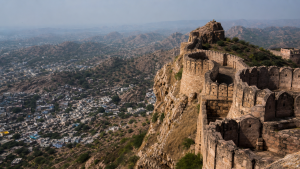
The political history of Rajasthan was shaped by powerful Rajput dynasties that built and defended regional kingdoms across the Thar Desert, the Aravallis and the eastern plains. Their rule combined clan-based polity, fort-centred warfare, agrarian revenue systems and shifting alliances with larger empires.
For Prelims, the important strands are the major ruling houses, their capitals, key rulers, and the forts, temples and political events associated with them.
Gurjara-Pratiharas
The Gurjara-Pratiharas emerged in western Rajasthan around the 6th century CE and became a major line of defence against Arab expansion from Sindh into northern India. They initially operated from Mandore and Avanti, and later extended their authority to Kannauj.
- Nagabhata I (c. 730–760 CE): Consolidated early Pratihara power and repelled major Arab incursions into Gujarat and Rajasthan.
- Vatsaraja and Nagabhata II: Expanded influence into the Gangetic plains and entered the long Tripartite Struggle for Kannauj against the Palas and Rashtrakutas.
- Mihira Bhoja (c. 836–885 CE): Brought the empire to its territorial peak. He was a devotee of Vishnu, used the title Adivaraha, and issued silver coins with the Varaha motif.
- Mahendrapala I: Patronised the court poet Rajasekhara, associated with classical Sanskrit works such as Kavyamimamsa and Karpuramanjari.
- Historical importance: Their rule strengthened northern frontier defence and influenced the development of Maru-Gurjara temple architecture.
Chahamanas or Chauhans
The Chahamanas ruled Sapadalaksha from their early base near Sambhar Salt Lake and later expanded into north Rajasthan and Delhi. Their political and cultural rise is closely linked with Shakambhari and Ajmer.
- Vasudeva: Founded the early lineage at Shakambhari.
- Ajayaraja II: Founded Ajayameru, later Ajmer, in the early 12th century and built Taragarh Fort as the capital.
- Vigraharaja IV (Bisaldeo): Captured Delhi from the Tomara Rajputs, widening Chauhan influence.
- Literary contribution: He authored the Sanskrit drama Harakeli Nataka and established a learning centre in Ajmer later associated with Adhai Din Ka Jhonpra.
- Prithviraj Chauhan III (1177–1192 CE): Extended control over Delhi and defeated the Chandela ruler Paramardi Deva.
- First and Second Battles of Tarain: He defeated Muhammad Ghori in 1191 CE but was captured in 1192 CE, opening the way for Ghurid rule in northern India.
- Branch lineages: After the fall of Ajmer, Chauhan branches established the Hada Chauhans of Bundi and Kota, the Songara Chauhans of Jalore, and the Deora Chauhans of Sirohi.
Guhilots and Sisodias of Mewar
The Guhilas of Mewar formed one of the oldest continuous royal lineages in the southern Aravallis. Their tradition later continued through the Sisodia branch after the fall of Chittorgarh in the early 14th century.
- Guhaditya: Founded the clan in the 6th century.
- Bappa Rawal: Expanded state power in the 8th century by capturing Chittorgarh from the Mori Rajputs and establishing Nagda as the capital.
- Eklingji worship: Bappa Rawal established the worship of Eklingji, a form of Shiva.
- Political ideology: The rulers of Mewar governed as the Diwan of Eklingji, who was treated as the true sovereign.
- Administrative centres: Early Guhilots operated from Nagda, Ahar and Chittorgarh for defence against rivals.
- Rana Hammira: After Alauddin Khalji sacked Chittorgarh in 1303 CE, he established the Sisodia branch in 1326 CE from Sisoda and adopted the title Maharana.
Later Sisodias: Rana Kumbha, Rana Sanga and Maharana Pratap
The Sisodia rulers turned Mewar into a major centre of Rajput resistance. Their fortifications, battlefield campaigns and cultural patronage made them central to Rajasthan’s medieval history.
- Rana Kumbha (1433–1468 CE): Defeated the combined forces of Malwa and Gujarat.
- Fort construction: He built 32 of Mewar’s 84 defensive forts, including Kumbhalgarh, and erected the Vijay Stambha at Chittorgarh.
- Literary work: He authored musicology texts such as Sangeeta Raja.
- Rana Sanga (1508–1527 CE): Unified Rajput clans against outside powers and defeated Ibrahim Lodi at the Battles of Khatoli and Bari.
- Battle of Khanwa (1527 CE): He was defeated by Babur, a turning point in north Indian political history.
- Maharana Pratap (1572–1597 CE): Fought the Mughal army led by Man Singh I at the Battle of Haldighati in 1576 CE.
- Resistance strategy: He continued guerrilla warfare from Chavand until his death.
Rathores of Marwar and Bikaner
The Rathores established strongholds in the arid regions of western and northern Rajasthan. Their rise in Marwar and Bikaner was tied to Mandore, Jodhpur and the wider desert frontier.
- Rao Siha: The clan traces its regional lineage to him in the 13th century.
- Rao Chunda: Consolidated power by acquiring Mandore as a dowry gift from the Inda Rajputs in 1395 CE.
- Rao Jodha: Founded Jodhpur in 1459 CE and built Mehrangarh Fort on Chintamani Hill as Marwar’s capital.
- Rao Bika: Son of Rao Jodha, he moved north into Jangladesh and founded the independent kingdom of Bikaner in 1488 CE.
- Rao Maldeo (1531–1562 CE): Expanded Marwar into a dominant state in western India and fought Sher Shah Suri at Giri-Sumel in 1544 CE.
- Chandrasen Rathore: Resisted Mughal expansion under Akbar through guerrilla warfare from the Bhadrajun and Siwana hills.
Comparative Overview
| Dynasty | Core region | Primary capitals | Key rulers | Major contribution |
| Gurjara-Pratiharas | Western and northern Rajasthan | Mandore, Avanti, Kannauj | Nagabhata I, Mihira Bhoja | Repelled early Arab invasions; supported Maru-Gurjara temple style |
| Chahamanas | Sapadalaksha, central Rajasthan | Sambhar, Ajmer, Delhi | Vigraharaja IV, Prithviraj III | Built Taragarh Fort; resisted Ghurid conquest |
| Guhilots | Mewar, southern Aravallis | Nagda, Ahar, Chittorgarh | Guhaditya, Bappa Rawal | Established Eklingji state ideology |
| Sisodias | Mewar | Chittorgarh, Udaipur, Chavand | Rana Kumbha, Rana Sanga, Maharana Pratap | Built Vijay Stambha and Kumbhalgarh; led resistance to Delhi Sultanate and Mughals |
| Rathores | Marwar and Bikaner | Mandore, Jodhpur, Bikaner | Rao Jodha, Rao Bika, Rao Maldeo | Established desert kingdoms and fortified Marwar |
Key Prelims Takeaways
- Tripartite Struggle: The Gurjara-Pratiharas, Palas and Rashtrakutas fought for control over Kannauj.
- Tarain 1191 and 1192: Prithviraj Chauhan defeated Muhammad Ghori once but lost the second battle, which changed north Indian politics.
- Eklingji: Mewar rulers considered themselves the Diwan of Eklingji, not absolute sovereigns.
- Chittorgarh: It was a major centre for the Guhilots and later the Sisodias, and witnessed Alauddin Khalji’s sack in 1303 CE.
- Vijay Stambha: Built by Rana Kumbha at Chittorgarh, it is one of the most important Rajput memorial structures.
- Mehrangarh and Jodhpur: Rao Jodha founded Jodhpur in 1459 CE and used Mehrangarh Fort as the Marwar capital.
- Bikaner: Rao Bika established an independent Rathore kingdom in 1488 CE after moving into Jangladesh.
| Related | |
|---|---|