Tribal Welfare and Forest Rights Schemes
Overview
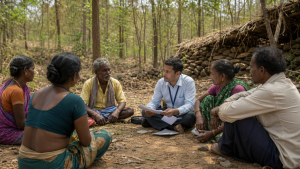
Tribal communities in India, officially designated as Scheduled Tribes (STs), live largely in forested, rural and hilly regions and face distinct social, economic and geographic challenges. To protect their rights and improve welfare, the Constitution, laws and government schemes provide special safeguards for education, employment, land, forest rights and livelihood support.
Constitutional Safeguards for Scheduled Tribes
- Article 15(4) and Article 16(4): Allow special provisions for the advancement of socially and educationally backward classes, including STs, in education and public employment.
- Article 46: Directs the State to promote the educational and economic interests of STs and protect them from social injustice and exploitation.
- Article 244(1) and Fifth Schedule: Provides for administration and control of Scheduled Areas and Scheduled Tribes in states other than Assam, Meghalaya, Tripura and Mizoram.
- Article 244(2) and Sixth Schedule: Enables autonomous district councils and tribal governance structures in Assam, Meghalaya, Tripura and Mizoram.
- Article 275(1): Provides special grants-in-aid from the Consolidated Fund of India for the welfare of STs and for improving administration in Scheduled Areas.
- Article 330 and Article 332: Reserve seats for STs in the Lok Sabha and State Legislative Assemblies.
- Article 338A: Establishes the National Commission for Scheduled Tribes (NCST) as a constitutional body to monitor safeguards and review tribal development.
Forest Rights and Panchayati Raj Provisions
- Forest Rights Act, 2006 (FRA): Aims to correct historical injustices faced by forest-dwelling communities by recognising individual and community rights over forest land.
- Individual Forest Rights (IFR): Recognises the right to hold and live in forest land under occupation prior to 13 December 2005, up to a maximum of 4 hectares per family.
- Community Forest Rights (CFR): Recognises community rights to collect, use and dispose of Minor Forest Produce (MFP), manage water bodies and access grazing grounds.
- Gram Sabha: The statutory authority for initiating the process of determining the nature and extent of individual or community forest rights.
- Panchayats (Extension to Scheduled Areas) Act, 1996 (PESA): Extends Part IX of the Constitution to Fifth Schedule areas across 10 states.
- Gram Sabha empowerment under PESA: Provides for prior consultation before land acquisition in Scheduled Areas, ownership over Minor Forest Produce, and powers to manage local markets, enforce prohibition and prevent land alienation.
- Protection of Civil Rights Act, 1955 and Prevention of Atrocities Act, 1989: Special penal laws meant to prevent offences against members of Scheduled Castes and Scheduled Tribes, with Special Courts for speedy trials and relief and rehabilitation for victims.
Major Government Schemes
- PM-JANMAN: Launched in late 2023, it targets Particularly Vulnerable Tribal Groups (PVTGs) across 18 States and Union Territories.
- PM-JANMAN interventions: Integrates 11 critical interventions across 9 central ministries, including permanent housing, road connectivity, clean drinking water, off-grid power solutions, mobile medical units and vocational centres.
- Eklavya Model Residential Schools (EMRS): Provides quality middle and high school education to ST children in remote areas.
- EMRS coverage norm: Seeks to establish an EMRS in every block having more than 50% ST population and at least 20,000 tribal persons.
- Pradhan Mantri Vanbandhu Kalyan Yojana (VBKY): An overarching framework to improve quality of life, infrastructure and employment opportunities in tribal areas through targeted resource allocation and multi-sectoral planning.
- Pradhan Mantri Janjatiya Vikas Mission (PMJVM): Focuses on livelihood enhancement through institutional support for tribal produce, including marketing of Minor Forest Produce through Minimum Support Price mechanisms and value-addition supply chains.
- Van Dhan Vikas Kendras (VDVKs): Implemented by TRIFED to organise tribal gatherers into self-help groups for processing, packaging and marketing non-timber forest products.
- Minimum Support Price for MFP: Provides a price safety net for specified minor forest produce and reduces dependence on middlemen.
Institutional Framework for Tribal Welfare
| Institution | Foundation / Type | Ministry / Jurisdiction | Primary mandate |
| Ministry of Tribal Affairs (MoTA) | 1999; Independent Ministry | Central Government | Nodal ministry for policy formulation, planning and coordination of tribal development programmes. |
| National Commission for Scheduled Tribes (NCST) | 2004; Constitutional body under Article 338A | Constitutional authority | Investigates civil rights violations, monitors constitutional safeguards and advises on policy planning. |
| TRIFED | 1987; Statutory multi-state cooperative | Ministry of Tribal Affairs | Supports socio-economic development of STs through marketing of tribal products and crafts. |
| NSTFDC | 2001; Government company | Ministry of Tribal Affairs | Provides concessional financial assistance, micro-credit and self-employment funding to tribal entrepreneurs. |
| State Tribal Research Institutes (TRIs) | State level; Central support | State Tribal Departments | Conduct field research, policy evaluation, documentation of indigenous knowledge and training programmes. |
Particularly Vulnerable Tribal Groups (PVTGs)
- Meaning: PVTGs are a subset of Scheduled Tribes with extreme vulnerability and higher deprivation.
- Historical origin: The Dhebar Commission (1960–1961) created the category of “Primitive Tribal Groups”, later renamed PVTGs in 2006.
- Identification criteria: Pre-agricultural level of technology, such as hunting, gathering or shifting cultivation.
- Population trend: Stagnant or declining population is one of the key identifying features.
- Policy relevance: Special schemes such as PM-JANMAN are designed specifically for PVTGs because of their isolation and high vulnerability.
Key Prelims Takeaways
- Article 342: STs are officially designated under Article 342 of the Constitution.
- Article 338A: NCST is the constitutional watchdog for tribal safeguards.
- FRA, 2006: Recognises both individual and community forest rights, with the Gram Sabha at the centre of the process.
- PESA, 1996: Strengthens self-governance in Fifth Schedule areas and gives the Gram Sabha important powers.
- PM-JANMAN: Focuses on PVTGs and combines 11 interventions across 9 ministries.
- EMRS: A key education scheme for ST students in remote blocks with high tribal concentration.
- TRIFED and MSP for MFP: Support tribal livelihoods through marketing and price protection for forest produce.
Current General Studies comprises current-affairs-based, General Studies-rich study material on policies, laws, institutions, economy, science, environment, governance, international relations, and other varied but important topics for UPSC and State PSC Prelims examinations.
Fortnightly PDF compilations: Available here
Originally written on
May 18, 2026
and last modified on
September 6, 2026.
| Related | |
|---|---|