Integration of Princely States into India
Introduction
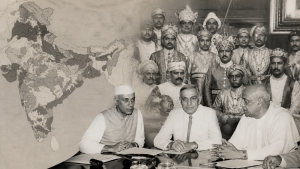
The integration of over 565 princely states into the Indian Union between 1947 and 1950 was one of the most important political consolidations in modern Indian history. These states covered nearly 40% of the landmass and 23% of the population of pre-partition India, and their unification helped prevent the balkanization of the subcontinent.
The process combined legal change, diplomatic negotiation, political pressure and, in a few difficult cases, military action. It laid the foundation for a single constitutional and democratic framework.
Constitutional Basis and End of Paramountcy
The legal position of princely states changed with the Indian Independence Act, 1947. Under Section 7(1)(b), British paramountcy over Indian princely states lapsed on 15 August 1947.
- End of treaties: All treaties, engagements and agreements between the British Crown and native rulers automatically terminated.
- Technical sovereignty: The rulers regained legal freedom to accede to India or Pakistan, or claim independence.
- Cabinet Mission position: The 1946 Cabinet Mission had stated that paramountcy could neither be retained by the British Crown nor transferred to an incoming Indian government.
- Political vacuum: This created an urgent need for negotiation and rapid consolidation by Indian leadership.
States Ministry and Instrument of Accession
To manage negotiations with the princes, the Government of India created a special administrative setup. The States Ministry was established on 27 June 1947 and was headed by Sardar Vallabhbhai Patel as Minister and V.P. Menon as Secretary.
- Patel’s approach: He combined persuasion with firmness, often described as a “carrot and stick” policy.
- Instrument of Accession (IoA): This was the legal document by which princely rulers joined the Dominion of India.
- Initial subjects transferred: Defence, External Affairs and Communications.
- Standstill Agreement: This interim arrangement preserved existing administrative links, trade, customs, transit and communication until final integration.
Major Princely States and Methods of Integration
Most rulers signed the Instrument of Accession before or around independence. However, a few strategically important states resisted integration and required special handling.
| State | Ruler / Key Figure | Core Issue | Mode of Integration | Date |
| Junagadh | Nawab Muhammad Mahabat Khan III; Shah Nawaz Bhutto | Joined Pakistan despite a Hindu majority and no land border with Pakistan | Internal rebellion, Indian troop entry and plebiscite | February 1948 |
| Hyderabad | Nizam Mir Osman Ali Khan; Kasim Razvi | Nizam sought independence and backed the Razakars | Military action, Operation Polo | September 1948 |
| Jammu & Kashmir | Maharaja Hari Singh; Sheikh Abdullah | Strategic border state; invasion by armed tribal raiders backed by Pakistan | Instrument of Accession after military emergency | 26 October 1947 |
| Jodhpur | Maharaja Hanwant Singh | Secret negotiations with Jinnah for accession to Pakistan in exchange for Karachi port access | Persuasion by Patel and Menon | August 1947 |
| Travancore | Maharaja Chithira Thirunal; Sir C.P. Ramaswami Iyer | Declared independence, citing monazite reserves | Public pressure and diplomatic negotiation | July 1947 |
| Bhopal | Nawab Hamidullah Khan | Chancellor of the Chamber of Princes; favoured independent status | Yielded to local protests and signed the IoA | May 1949 |
Detailed Cases: Junagadh, Hyderabad and Jammu & Kashmir
- Junagadh: After the Nawab chose Pakistan in August 1947, popular protests led to the formation of the Aarzi Hukumat in Bombay under Samaldas Gandhi.
- Junagadh: The Nawab fled to Karachi as financial collapse approached.
- Junagadh: Indian forces took over administration in November 1947, and the plebiscite in February 1948 reportedly gave over 99% votes for India.
- Hyderabad: The Nizam declared independence and signed a Standstill Agreement with India in November 1947.
- Hyderabad: The Razakars, led by Kasim Razvi, unleashed violence, leading to a military response under Operation Polo on 13 September 1948.
- Hyderabad: Major General J.N. Chaudhuri led the Indian forces and the Nizam surrendered on 17 September 1948.
- Jammu & Kashmir: Maharaja Hari Singh signed Standstill Agreements with both India and Pakistan.
- Jammu & Kashmir: After tribal raiders entered on 22 October 1947, the Maharaja signed the Instrument of Accession on 26 October 1947.
- Jammu & Kashmir: Indian troops landed in Srinagar the next morning to repel the invaders.
Stages of Administrative Unification
Signing the Instrument of Accession was only the first step. Political integration then proceeded through several administrative stages.
- Merge with adjacent provinces: Small states that could not sustain viable administrations were merged into nearby British Indian provinces.
- Examples: The Orissa and Chota Nagpur states merged into Orissa and Bihar.
- Formation of state unions: Medium-sized states were grouped into larger regional unions.
- Rajpramukh: These unions had a common executive head called the Rajpramukh, usually a senior ruler elected by peers.
- Major unions: PEPSU, the Patiala and East Punjab States Union, and Saurashtra were formed during 1948-49.
- Direct accession with special arrangements: Some states initially retained limited autonomy before full merger under the constitutional process.
Key Prelims Takeaways
- Number of states: More than 565 princely states were integrated into India between 1947 and 1950.
- Legal turning point: British paramountcy ended on 15 August 1947 under the Indian Independence Act.
- Key institution: The States Ministry was set up on 27 June 1947 under Sardar Patel and V.P. Menon.
- Important legal document: The Instrument of Accession transferred Defence, External Affairs and Communications.
- Interim arrangement: The Standstill Agreement preserved existing administrative and economic links.
- Hard cases: Junagadh, Hyderabad and Jammu & Kashmir required special political or military handling.
- Final outcome: The process prevented fragmentation and helped create a unified constitutional republic.
| Related | |
|---|---|