Important Commercial Aircraft Types and Variants
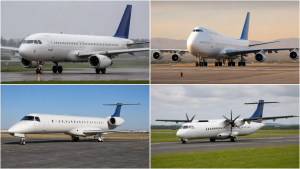
Commercial aircraft are commonly classified by cabin layout, range, and engine type. The major families include narrow-body, wide-body, regional jet, and turboprop aircraft, each suited to different routes and airline needs.
Classification of Commercial Aircraft
Commercial passenger airplanes fall into categories based on fuselage width, seating configuration, and engine type. Knowing these classifications helps in understanding route planning and airline operations.
Narrow-body Aircraft (Single-Aisle)
- Cabin layout: These airplanes have a single passenger aisle in the cabin.
- Fuselage size: The fuselage diameter typically measures under 4 meters.
- Seating: Seating configurations feature 2 to 6 seats abreast.
- Use: Airlines deploy narrow-body jets on short-to-medium-haul domestic and regional routes.
Wide-body Aircraft (Twin-Aisle)
- Cabin layout: These airplanes have two passenger aisles running through the cabin.
- Fuselage size: The fuselage diameter measures 5 to 6 meters or more.
- Seating: Seating configurations typically feature 7 to 10 seats abreast.
- Use: These twin-aisle aircraft operate on long-haul and international routes due to their larger fuel capacities and passenger limits.
Regional Jets
- Capacity: Regional jets are smaller jet aircraft carrying fewer than 120 passengers.
- Role: They connect smaller regional airports to large airline hubs.
- Engines: These jets run on turbofan engines but operate over shorter distances than standard narrow-body aircraft.
Turboprop Aircraft
- Propulsion: These aircraft use gas turbine engines to drive external propellers.
- Efficiency: They are highly efficient at lower altitudes and slower speeds.
- Use: Regional airlines operate turboprops for short flights, often under 500 kilometers, where jet speed is not necessary.
Key Narrow-Body Aircraft Families and Variants
Narrow-body aircraft form the backbone of commercial aviation fleets worldwide. Two primary manufacturing families dominate this segment.
Airbus A320 Family
- A318 and A319: These are shorter, lower-capacity variants. The A318 is the smallest, while the A319 is popular for thin mainline routes.
- A320: The Airbus A320 is the baseline variant. The standard A320ceo (current engine option) has been in service since 1988.
- A321: The Airbus A321 is a stretched variant with a longer fuselage, offering higher seating capacity.
- A320neo and A321neo: These are the “New Engine Option” models that use advanced turbofan engines. This design reduces fuel burn by 15 to 20 percent compared to older generations.
- A321XLR: The Extra Long Range variant features a permanent rear center fuel tank. This allows the narrow-body plane to fly up to 8,700 kilometers, enabling transatlantic narrow-body routes.
Boeing 737 Family
- Classic and NG: The 737 Classic and Next Generation (NG) represent older iterations. The Classic series includes the 737-300, -400, and -500, while the NG series includes the 737-700, -800, and -900 variants.
- 737 MAX: The Boeing 737 MAX series is the fourth generation of the 737 family, utilizing CFM LEAP-1B engines and split-tip winglets.
- 737 MAX 8: The core variant of the MAX family. It carries between 162 and 200 passengers with a range of 6,570 kilometers.
- 737 MAX 10: The largest variant in the 737 family. It features a stretched fuselage to hold up to 230 passengers, but the added weight reduces its maximum range compared to the MAX 8.
Key Wide-Body Aircraft Families and Variants
Wide-body aircraft handle high-density and long-distance intercontinental routes. They are characterized by massive engines and extended ranges.
Boeing 777 Family
- 777-200ER and 777-200LR: These are early long-range models. The 777-200LR (Longer Range) became one of the longest-range commercial planes in the world.
- 777-300ER: A highly successful wide-body twin-engine aircraft. It utilizes the General Electric GE90-115B engine, which is one of the largest and most powerful jet engines in existence.
- 777X: The newest generation of the family, featuring the 777-8 and 777-9 variants. It uses composite wings and unique folding wingtips to fit within standard airport gates.
Airbus A350 Family
- Composite structure: The A350 is the first Airbus aircraft built with over 50 percent lightweight carbon-fiber-reinforced polymers.
- A350-900: The baseline model that carries 300 to 350 passengers with a standard range of approximately 15,000 kilometers.
- A350-1000: The larger variant. It features a longer fuselage, a modified wing trailing edge, and six-wheel main landing gear instead of the four-wheel bogies on the -900.
- A350-900ULR: The Ultra Long Range variant that has a modified fuel system. It can fly for up to 20 hours nonstop, which airlines use for direct flights like Singapore to New York.
Boeing 787 Dreamliner
- Composite materials: The Dreamliner consists of 50 percent composite materials, which allows for higher cabin humidity and lower cabin altitude pressure.
- 787-8: The shortest and original variant, optimized for opening new long-distance routes with lower passenger demand.
- 787-9: The most widely sold variant. It balances seating capacity and fuel efficiency with a range of 14,000 kilometers.
- 787-10: The longest variant. It carries more passengers but has a shorter range because its fuel capacity remains the same as the 787-9.
Airbus A380-800
- Size: The A380 is the world’s largest passenger airliner, featuring two full-length passenger decks.
- Engines: It requires four turbofan engines to fly. This quad-engine configuration makes it less fuel-efficient per passenger compared to modern twin-engine wide-bodies.
- Capacity: It can hold 525 passengers in a typical three-class configuration and up to 853 passengers in an all-economy layout.
Boeing 747 Family
- Design: The 747 is known as the “Queen of the Skies.” It features a partial double-deck hump on the forward fuselage, which was originally designed to allow easy conversion into a nose-loading cargo freighter.
- 747-400: A common historic passenger variant, featuring winglets and a digital glass cockpit.
- 747-8: The final and largest variant. It uses engines and technology from the Boeing 787, but production has now ended for both passenger and freighter versions.
Regional Jets and Turboprops
Smaller regional aircraft operate on short routes where large narrow-bodies are economically unviable.
Embraer E-Jets
- E175 and E190: Brazilian-built regional jets popular in North America and Europe. They offer a 2-2 seating layout, meaning there are no middle seats in the cabin.
- E-Jets E2: The second generation of the E-Jet family. It uses geared turbofan engines and new wings to lower fuel consumption.
ATR 42 and ATR 72
- Manufacturer: ATR is a joint-venture French-Italian aircraft manufacturer.
- ATR 42: The turboprop typically seats 40 to 50 passengers. It operates on short runways and in mountainous regions.
- ATR 72: A stretched version of the ATR 42, seating 70 to 78 passengers. It is popular for regional connectivity in developing aviation markets.
Bombardier Q-Series
- Dash 8 design: The De Havilland Canada Dash 8 (formerly Bombardier Q-Series) features wings attached to the top of the fuselage. This high-wing design keeps the engines high off the ground, preventing damage from unpaved runways.
- Q400: The largest variant, carrying up to 90 passengers. The “Q” stands for “Quiet” because it features an active noise and vibration suppression system in the cabin.
Technical Comparison of Major Commercial Aircraft
The table below compares the technical specifications of key commercial aircraft models operated by airlines around the world.
| Aircraft Model | Manufacturer | Category | Typical Passenger Capacity | Maximum Range (km) | Engine Type |
| Airbus A320neo | Airbus | Narrow-body | 165 – 194 | 6,300 | 2 x Turbofan |
| Boeing 737 MAX 8 | Boeing | Narrow-body | 162 – 200 | 6,570 | 2 x Turbofan |
| Airbus A321XLR | Airbus | Narrow-body | 180 – 244 | 8,700 | 2 x Turbofan |
| Boeing 787-9 | Boeing | Wide-body | 290 – 330 | 14,000 | 2 x Turbofan |
| Airbus A350-900 | Airbus | Wide-body | 300 – 350 | 15,000 | 2 x Turbofan |
| Boeing 777-300ER | Boeing | Wide-body | 350 – 396 | 13,650 | 2 x Turbofan |
| Airbus A380-800 | Airbus | Wide-body | 525 – 853 | 15,200 | 4 x Turbofan |
| ATR 72-600 | ATR | Turboprop | 70 – 78 | 1,500 | 2 x Turboprop |
| Embraer E195-E2 | Embraer | Regional Jet | 120 – 146 | 4,815 | 2 x Turbofan |
Recent Context
In August 2026, SpiceJet suspended all Boeing 737 MAX passenger operations. By 1 September 2026, its active fleet had shrunk to 11 aircraft, while its market share fell to 1.6% in July 2026.
Rare Facts for Prelims
- Folding wingtips: The Boeing 777X uses folding wingtips so the aircraft can fit standard airport gate spaces despite its very large wingspan.
- Fuel tank design: The Airbus A321XLR uses an additional rear center fuel tank to extend range without turning it into a wide-body aircraft.
- Cabin comfort: The Boeing 787 Dreamliner’s composite body helps improve cabin humidity and reduce the feeling of fatigue on long flights.
- All-economy record: The Airbus A380 can carry more than 850 passengers in an all-economy configuration, among the highest for a passenger aircraft.
- Quiet turboprop: The “Q” in the Bombardier Q400 refers to its noise and vibration suppression system, not to a model number.
- Long-range benchmark: The Airbus A350-900ULR is used for some of the world’s longest nonstop passenger flights, including Singapore–New York services.
| Related | |
|---|---|