Major Lunar Exploration Missions
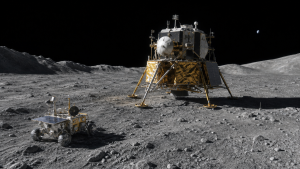
Lunar exploration has moved from Cold War rivalry to international scientific cooperation, with missions now focused on mapping, resource discovery, and future human presence on the Moon.
Historical Overview of Lunar Exploration
Lunar exploration began during the Cold War, when the United States and the Soviet Union competed to reach Earth’s satellite. Today, many countries and private corporations participate in lunar missions. These missions fall into six main categories: flybys, orbiters, impactors, soft landers, rovers, and crewed missions. Each category helps scientists understand the history of the solar system and gather data on potential resources.
The Early Space Race (1950s–1970s)
Soviet Union’s Luna Program
The Soviet Union initiated robotic lunar exploration. This program established several records in space history.
- Luna 1 (1959): It became the first spacecraft to escape Earth’s gravity. The probe performed a flyby of the Moon.
- Luna 2 (1959): This was the first human-made object to reach the lunar surface. It completed an intentional impact near the Aristillus crater.
- Luna 3 (1959): The probe captured the first photograph of the far side of the Moon. It returned images of terrain that was previously hidden from Earth due to tidal locking.
- Luna 9 (1966): This spacecraft completed the first controlled soft landing on the Moon. It transmitted close-up television photographs of the lunar soil.
- Luna 10 (1966): It became the first artificial satellite to orbit the Moon.
- Luna 16 (1970): It carried out the first successful robotic sample-return mission, bringing back 101 grams of lunar soil.
United States’ Apollo and Surveyor Programs
The United States initially used impactors and robotic landers to survey potential human landing sites before launching crewed missions.
- Ranger Program (1961–1965): These impact missions returned high-resolution photos of the lunar surface before crashing.
- Surveyor Program (1966–1968): This series of seven robotic landers tested soft landing techniques on the lunar surface.
- Apollo 8 (1968): This mission carried the first humans to orbit the Moon.
- Apollo 11 (1969): This mission put the first humans on the Moon. Neil Armstrong and Buzz Aldrin landed the lunar module Eagle in the Sea of Tranquility on July 20, 1969.
- Apollo 17 (1972): This was the final crewed mission of the Apollo program. It concluded the first era of human lunar exploration.
The Era of Mapping and Resource Discovery (1990s–2000s)
After a pause in the late 1970s and 1980s, space agencies resumed lunar exploration. The objective shifted from politics to locating resources, especially water ice.
- Hiten (1990): This was Japan’s first lunar probe. Its launch made Japan the third nation to send a spacecraft to the Moon.
- Clementine (1994): A joint mission between NASA and the Strategic Defense Initiative Organization. It mapped the lunar surface in multiple wavelengths and detected hints of water ice in polar craters.
- Lunar Prospector (1998): This NASA orbiter confirmed the presence of hydrogen at both lunar poles, establishing the existence of water ice in permanently shadowed regions.
- SMART-1 (2003): The European Space Agency’s first lunar mission. It tested solar-electric ion propulsion and mapped the elemental composition of the lunar crust.
- Kaguya/SELENE (2007): Japan’s orbiter gathered detailed topographic and gravity data. It provided high-definition video of the lunar landscape.
- Chandrayaan-1 (2008): India’s first lunar mission. It carried the Moon Impact Probe, which struck the surface near Shackleton Crater. Data from the orbiter’s Moon Mineralogy Mapper instrument confirmed the presence of water molecules on the lunar surface.
- Lunar Reconnaissance Orbiter (LRO) (2009–Present): This NASA spacecraft continues to provide high-resolution mapping of the lunar surface. Its data assists in planning landing sites for future missions.
Modern South Pole and Far Side Missions (2010s–Present)
Recent lunar exploration focuses heavily on the lunar South Pole and the far side. These areas offer unique scientific opportunities and potential bases for future deep space exploration.
- Chang’e 3 (2013): This Chinese mission delivered the Yutu (Jade Rabbit) rover to Mare Imbrium, marking the first soft landing on the Moon since 1976.
- Chang’e 4 (2019): This mission placed the Yutu-2 rover on the far side of the Moon inside the Von Kármán crater. It used a relay satellite, Queqiao, to communicate with Earth.
- Chandrayaan-2 (2019): This Indian mission deployed an orbiter and a lander. While the lander failed during touchdown, the orbiter remains active and continues to send scientific data.
- Chang’e 5 (2020): China’s first sample-return mission. It collected 1.73 kilograms of soil from Oceanus Procellarum and returned it to Earth.
- Chandrayaan-3 (2023): This mission landed the Vikram lander and Pragyan rover near the lunar South Pole. It made India the fourth nation to soft-land on the Moon and the first to reach the southern polar region.
- SLIM (2024): Japan’s Smart Lander for Investigating Moon achieved a pinpoint soft landing within 55 meters of its target. This success made Japan the fifth nation to land on the Moon.
- Chang’e 6 (2024): This mission collected the first-ever samples from the far side of the Moon. It landed in the South Pole-Aitken Basin and returned approximately 1,935 grams of material to Earth.
- Intuitive Machines IM-1 (2024): This private US lander, named Odysseus, achieved the first commercial soft landing on the Moon.
The Artemis Program and Upcoming Missions
The United States is leading an international effort to return humans to the Moon. This project aims to establish a sustainable presence.
- Artemis I (2022): This uncrewed mission tested the Space Launch System (SLS) rocket and the Orion spacecraft in lunar orbit.
- Artemis II (2026): This crewed flight carried four astronauts on a loop around the Moon. It set a record for the farthest distance traveled by humans in space.
- Artemis III (Planned 2027/2028): This mission aims to land astronauts, including the first woman and person of color, near the lunar South Pole.
- LUPEX (Planned): The Lunar Polar Exploration Mission is a joint mission by India’s ISRO and Japan’s JAXA. It will send a lander and a rover to study the quantity and quality of water at the lunar South Pole.
Pakistan’s Jinnah-1 Lunar Rover
Pakistan’s first-ever lunar rover, Jinnah-1, has been officially named by the Space and Upper Atmosphere Research Commission (SUPARCO). The rover is targeted for launch in 2029 aboard China’s Chang’e-8 mission to the Moon’s south polar region.
- SUPARCO: Pakistan’s national space agency, established in 1961, and currently led by Chairman Muhammad Yousuf Khan.
- Mission role: SUPARCO handles satellite development, space science, and remote sensing, and represents Pakistan in civil space cooperation with other nations.
- Name significance: Jinnah-1 honors Quaid-i-Azam Muhammad Ali Jinnah, who founded Pakistan in 1947 and served as its first Governor-General.
- Public competition: The name was selected through a nationwide public competition that attracted more than 4,000 entries.
- Winner: The contest was won by 17-year-old Tayyab Karim from Bahawalnagar, who was declared the winner after a lucky draw and received a cash prize of Rs 100,000.
- Mission details: Jinnah-1 weighs approximately 35 kilograms and is designed to land near the Moon’s south pole to study plasma, radiation, and surface geology.
- International collaboration: The mission incorporates collaborative scientific payloads designed by Chinese and European scientists alongside those developed by SUPARCO.
- Strategic importance: The rover is the cornerstone of Pakistan’s inaugural lunar exploration mission and reflects growing international collaboration in lunar science and resource exploration.
Key Lunar Missions at a Glance
| Mission Name | Country / Agency | Year | Mission Type | Key Outcome |
| Luna 1 | Soviet Union | 1959 | Flyby | Escaped Earth’s gravity; flew past the Moon |
| Luna 2 | Soviet Union | 1959 | Impactor | First human-made object to impact the Moon |
| Luna 3 | Soviet Union | 1959 | Flyby | Captured first images of the lunar far side |
| Luna 9 | Soviet Union | 1966 | Lander | Achieved the first controlled soft landing |
| Apollo 11 | United States (NASA) | 1969 | Crewed Lander | First human landing on the Moon |
| Hiten | Japan (ISAS) | 1990 | Orbiter | First Japanese probe; third country to reach the Moon |
| Clementine | USA (NASA/SDIO) | 1994 | Orbiter | Mapped the Moon; detected hints of water ice |
| SMART-1 | Europe (ESA) | 2003 | Orbiter | Tested ion propulsion; mapped crust composition |
| Chandrayaan-1 | India (ISRO) | 2008 | Orbiter / Impactor | Confirmed the presence of water molecules |
| Chang’e 4 | China (CNSA) | 2019 | Lander / Rover | First landing on the far side of the Moon |
| Chandrayaan-3 | India (ISRO) | 2023 | Lander / Rover | First soft landing near the lunar South Pole |
| SLIM | Japan (JAXA) | 2024 | Lander | Achieved pinpoint landing within 100 meters |
| Chang’e 6 | China (CNSA) | 2024 | Sample Return | First sample return from the lunar far side |
| Artemis II | United States (NASA) | 2026 | Crewed Flyby | First crewed lunar mission since 1972 |
Key Facts and Lunar Trivia
- First Earth lifeforms in lunar space: In September 1968, the Soviet Zond 5 mission carried tortoises, wine flies, mealworms, and plants around the Moon. These organisms returned to Earth alive, proving that living creatures could survive deep-space radiation.
- The pioneer of lunar photography: Luna 3 captured 29 photographs of the lunar far side in 1959. These images covered 70% of the hidden hemisphere, mapping mountain ranges and dark plains.
- The heaviest lunar sample: Apollo 17 returned the largest single sample of lunar material, a rock sample weighing 11.7 kilograms (sample 75055).
- Deepest lunar crater: The South Pole-Aitken Basin is one of the largest and deepest known impact craters in the solar system. It measures about 2,500 kilometers in diameter and 6.2 to 8.2 kilometers deep.
- Lunar day and night length: A single day-night cycle on the Moon lasts approximately 29.5 Earth days. This means a lunar day lasts roughly two Earth weeks, followed by two weeks of continuous darkness.
- Extreme lunar temperatures: The lunar equator experiences extreme temperature swings. Temperatures rise to 120 degrees Celsius during the day and drop to minus 130 degrees Celsius at night. Polar craters that remain in permanent shadow stay at minus 246 degrees Celsius.
Rare Facts for Prelims
- Luna 16 sample return: It was the first robotic mission to bring lunar soil back to Earth without human crew involvement.
- Queqiao relay satellite: Chang’e 4 could land on the far side of the Moon only because Queqiao relayed signals between Earth and the rover.
- Water molecules on the Moon: Chandrayaan-1’s Moon Mineralogy Mapper provided key evidence of hydroxyl and water molecules on the lunar surface.
- Pinpoint landing achievement: Japan’s SLIM demonstrated precision landing technology, a major step for future missions to difficult terrain.
- South Pole-Aitken Basin importance: It is considered a major target for studying the Moon’s deep interior because it may expose ancient crustal material.
- Jinnah-1 launch window: Pakistan’s rover is planned for the 2029 Chang’e-8 mission, making it a notable example of international lunar cooperation.
| Related | |
|---|---|