Important Biomass Utilisation and Co-firing Initiatives in India
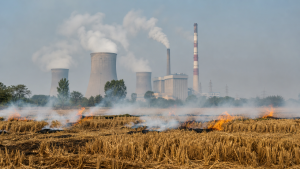
India is expanding biomass use in thermal power plants to cut stubble burning, manage agricultural waste, and support the energy transition through cleaner co-firing practices.
Context of Biomass and Waste Availability in India
India generates approximately 754 million tonnes of agricultural biomass annually. Out of this total, around 228 million tonnes is surplus agricultural residue. The open burning of paddy straw, especially in Punjab, Haryana, and Uttar Pradesh, causes severe air pollution in northern India during the autumn and winter months. Using this agricultural surplus as a fuel source in coal-based power plants offers a practical way to manage waste while lowering carbon emissions.
The Consolidated Co-firing Policy
The Union Ministry of Power issued a consolidated policy on November 7, 2025, integrating the co-firing of both biomass and torrefied charcoal derived from municipal solid waste (MSW). This policy builds on earlier directives issued in 2021 and 2023, replacing them with a single regulatory framework.
- Minimum co-firing mandate: All coal-based thermal power plants (TPPs) in India must co-fire at least 5% biomass pellets and/or torrefied MSW charcoal with coal.
- Higher target for NCR plants: Thermal power plants in the National Capital Region (NCR) and adjoining areas must blend a minimum of 5% biomass pellets plus an additional 2% torrefied MSW charcoal, taking the total target to 7%.
- Local sourcing requirement: For power plants in the NCR, at least 50% of the raw material used for pellet production must consist of stubble, straw, or paddy residue sourced exclusively from the NCR and nearby regions.
- Cost recovery: Expenses incurred by power plants due to biomass co-firing can be recovered through the Energy Charge Rate (ECR) for plants under regulated tariffs under Section 62 of the Electricity Act, 2003. For plants under competitive bidding under Section 63, these costs can be claimed under change-in-law provisions.
- RPO benefit: Electricity generated from co-firing qualifies for the Renewable Purchase Obligation (RPO) of distribution companies.
The SAMARTH National Biomass Mission
To implement these policies effectively, the Ministry of Power established the National Mission on Use of Biomass in Thermal Power Plants, commonly known as SAMARTH (Sustainable Agrarian Mission on use of Agro Residue in Thermal Power Plants).
Key Objectives of SAMARTH
- Supply chains: To establish reliable systems for collecting and transporting agricultural residues from fields to manufacturing units and power plants.
- Research support: To promote research on boiler designs and technical parameters for higher biomass co-firing without operational hazards.
- Testing and standards: To facilitate testing facilities and standardize biomass pellet specifications across the country.
- Capacity building: To organize training, awareness campaigns, and skill-building programmes for agricultural societies, farmers, and power plant engineers.
Governance and Execution
- Steering committee: A committee led by the Union Power Secretary monitors the mission’s execution.
- Coordination: SAMARTH works with the Ministry of New and Renewable Energy (MNRE), the Ministry of Agriculture and Farmers Welfare, the Central Electricity Authority (CEA), NTPC Limited, and the National Power Training Institute (NPTI).
Central Financial Assistance and Funding Schemes
The central government supports pellet manufacturers and power units through financial schemes to bridge the demand-supply gap.
National Bioenergy Programme
- Umbrella scheme: Managed by the Ministry of New and Renewable Energy (MNRE), this scheme has been extended with a budget of ₹858 crore under Phase-I.
- Components: It provides financial support under three components: the Waste to Energy Programme, the Biomass Programme, and the Biogas Programme.
Financial Incentives for Pellet Units
- Briquette and pellet units: Central Financial Assistance (CFA) of ₹9 lakh per Metric Ton per Hour (MTPH) of production capacity, with a maximum limit of ₹45 lakh per project.
- Non-torrefied pellet units: CFA of ₹21 lakh per MTPH.
- Industrial non-bagasse cogeneration projects: ₹40 lakh per MW of installed capacity, with a maximum cap of ₹5 crore per project.
CPCB One-Time Grants
- Special support: The Central Pollution Control Board (CPCB) provides financial support using Environment Protection Charge (EPC) funds to establish pelletization and torrefaction units using paddy straw in the NCR.
Priority Sector Lending (PSL)
- Bank credit: The Reserve Bank of India (RBI) has approved biomass pellet manufacturing as an eligible activity under PSL, enabling manufacturers to access bank credit at competitive interest rates.
Procurement on GeM Portal
- Dedicated category: A specific procurement category for biomass has been created on the Government e-Marketplace (GeM) portal to simplify commercial transactions.
Technological Classifications: Torrefied vs Non-Torrefied Pellets
Power plants use biomass mainly in two forms: non-torrefied pellets and torrefied pellets. Non-torrefied pellets are made from raw agricultural residue that is dried and compressed. They are cheaper to produce but have lower calorific value, absorb moisture easily, and degrade quickly during storage. Torrefied pellets are produced through torrefaction, a thermal process of heating biomass in the absence of oxygen. This creates a hydrophobic, coal-like material with higher energy density, better grindability, and stronger storage stability.
| Operational Parameter | Non-Torrefied Pellets | Torrefied Pellets |
| Manufacturing Process | Physical drying and compression of raw agricultural waste | Thermal heating in the absence of oxygen (torrefaction) followed by pelletization |
| Energy Density / Calorific Value | Lower (approx. 3,000–3,500 kcal/kg) | Higher (approx. 4,000–4,500 kcal/kg) |
| Water Sensitivity | Hydrophilic; absorbs moisture and swells | Hydrophobic; water-resistant and stable outdoors |
| Grindability | Hard to grind; requires specialized mill modifications | High; easily ground in existing coal pulverizing mills |
| Blending Ratios | Limited to 5% to 10% without extensive boiler modifications | Can exceed 20% blending without affecting boiler efficiency |
NTPC Tanda Plant Breakthrough: In March 2024, NTPC successfully co-fired 20% torrefied biomass in Unit 4 of its Tanda thermal power plant in Uttar Pradesh without requiring structural changes to the boiler or mills.
Primary Benefits of Biomass Co-firing
- Carbon neutrality: Biomass is considered carbon-neutral. Each percentage point of coal replaced by biomass reduces carbon dioxide (CO2) emissions accordingly.
- Mitigation of stubble burning: A commercial market for crop residue encourages farmers to collect and sell straw instead of burning it in open fields.
- Additional rural income: Turning agricultural waste into a cash crop provides direct returns to rural households and creates local employment in pelletization plants.
- Import substitution: Greater use of domestic bio-resources reduces coal import bills and strengthens fuel security.
Operational and Structural Challenges
Despite strong government initiatives, the execution of co-firing targets faces several structural obstacles.
- Seasonal biomass availability: The harvest season lasts only 45 to 60 days a year, requiring large logistics and dry storage infrastructure to maintain year-round pellet production.
- Supply chain dispersal: Sourcing crop residue from millions of small-holder farmers creates fragmented logistics and raises transportation costs.
- Technical constraints in boilers: Standard non-torrefied agricultural waste contains high levels of alkali metals such as potassium and sodium, along with chlorine. At higher blending ratios, these cause slagging, fouling, and faster corrosion in boiler superheaters.
- Inadequate torrefaction facilities: Despite subsidies, the number of active torrefaction plants in India remains limited, creating a demand-supply gap for high-quality hydrophobic pellets.
Rare Facts for Prelims
- Forest-fire classification: Forest fires are commonly classified into ground fires, surface fires, and crown fires.
- Chir Pine litter: Chir Pine (Pinus roxburghii) produces resinous dry needle litter called pirul, which is a major fire-prone biomass in the Western Himalayas.
- Fire incidence share: Chir Pine needle litter accounts for approximately 57% of forest fire incidents in the Western Himalayas.
- NDRF status: The National Disaster Response Force (NDRF) was constituted under the Disaster Management Act, 2005.
- FRI location: The Forest Research Institute (FRI) is located in Dehradun and functions under the Indian Council of Forestry Research and Education (ICFRE).
- Satellite monitoring gap: India still relies on foreign polar-orbiting satellites such as AQUA and Suomi-NPP for some forest-fire monitoring needs.
| Related | |
|---|---|