
Key Commodity Monitoring Mechanisms in India
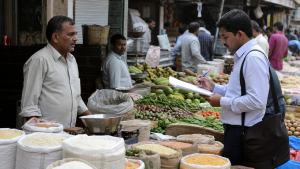
The government monitors essential commodities through price tracking, stock disclosure, buffer management, and trade regulation to curb hoarding, reduce volatility, and support food security.
Price Monitoring Division (PMD)
The Price Monitoring Division functions under the Department of Consumer Affairs, Ministry of Consumer Affairs, Food and Public Distribution, and serves as the central agency for collecting price data.
- Monitored Commodities: It tracks the daily prices of 41 essential food commodities, including food grains, pulses, edible oils, vegetables, milk, tea, and salt.
- Geographic Coverage: Data is collected daily from 579 price monitoring centres across the country.
- Reporting Mechanism: Price collectors use a geo-tagged mobile application to reduce manual errors and ensure local market-based reporting.
- Policy Use: The data helps in decisions on buffer stock release, import-export duty changes, and stock holding limits.
Essential Commodities Act, 1955
The Essential Commodities Act is the main legal framework for regulating the production, supply, and distribution of essential goods.
- Stock Limits: The government can impose stock holding limits on traders, wholesalers, retail chains, and food processors.
- Wheat Stock Regulation: Wheat stock limits are enforced across all states and Union Territories until March 31, 2026, under the relevant amended order.
- Wheat Ceiling: Wholesalers are capped at 3,000 metric tonnes, while retailers can hold up to 10 metric tonnes per outlet.
- Pulses Regulation: Stock limits on Tur, Chana, and other pulses are used to prevent market manipulation.
Stock Disclosure and Management Portals
Online declaration systems are used to monitor stocks held by private entities and to detect hoarding early.
- Foodstock Portal: Managed by the Department of Food and Public Distribution, it requires wheat, rice, and sugar stocking entities to update holdings every Friday.
- Pulses Stock Disclosure Portal: Monitored by the Department of Consumer Affairs, it requires importers, millers, and stockists of Tur, Chana, Masur, and Urad to declare weekly stocks.
- Compliance Enforcement: Incorrect declaration or non-registration can invite action under Sections 6 and 7 of the Essential Commodities Act, 1955.
Price Stabilization Fund (PSF) and Buffer Management
The Price Stabilization Fund was created in 2014-15 to manage price spikes in volatile agricultural commodities, especially onions and pulses.
- Procurement and Release: Commodities are procured at market rates or Minimum Support Price (MSP) and released later to stabilize retail prices.
- Implementing Agencies: NAFED and NCCF act as the central procurement agencies.
- Onion Buffer: For 2026-27, the government fixed a procurement target of 2 Lakh Metric Tonnes (LMT) of Rabi onions.
- Storage Innovation: The Central Warehousing Corporation (CWC) has been engaged as a storage partner to improve handling and reduce post-harvest losses.
- Targeted Logistics: The Kanda Express uses railway rakes to transport onions quickly from Maharashtra to high-demand consumption centres.
Price Support Scheme (PSS)
The Price Support Scheme is managed by the Ministry of Agriculture and Farmers Welfare.
- Objective: It protects farmers from distress sales when market prices fall below the Minimum Support Price (MSP).
- Scope: It covers pulses, oilseeds, and copra.
- Integration with PSF: Stocks procured under PSS are often transferred to the PSF for consumer distribution and buffer management.
Wholesale Market Information Systems
The government tracks wholesale arrivals and prices through digital market information networks.
- AGMARKNET: An e-governance portal managed by the Directorate of Marketing and Inspection (DMI) and the National Informatics Centre (NIC); it links thousands of wholesale markets across India and displays variety-wise daily arrivals and prices in English and eight regional languages.
- e-NAM: The National Agriculture Market is a pan-India electronic trading portal that integrates physical APMC mandis and supports pricing, trade execution, and quality testing.
Key Commodity Monitoring Portals and Systems in India
| Portal / System | Managing Department / Ministry | Primary Function | Key Feature |
| Price Monitoring System (PMS) App | Department of Consumer Affairs | Tracks retail and wholesale prices | Geo-tagged data entry from 579 centres to prevent errors |
| Foodstock Portal | Department of Food and Public Distribution | Declares wheat, rice, and sugar stocks | Mandatory weekly updates on Fridays by stocking entities |
| Pulses Stock Disclosure Portal | Department of Consumer Affairs | Declares stocks of major pulses | Monitors holdings of Tur, Chana, Masur, and Urad |
| AGMARKNET | Ministry of Agriculture and Farmers Welfare | Disseminates wholesale market arrivals and prices | Covers over 350 commodities across linked APMC mandis |
| e-NAM Portal | Ministry of Agriculture and Farmers Welfare | Integrates physical wholesale markets | Facilitates online trading and real-time price discovery |
Regulatory and External Sector Controls
Commodity monitoring also extends to futures markets and foreign trade controls.
- SEBI Commodity Derivatives Surveillance: SEBI regulates futures and options trading on exchanges such as MCX and NCDEX through position limits, margins, and temporary trading restrictions.
- DGFT Trade Controls: The Directorate General of Foreign Trade monitors external trade flows and adjusts import tariffs, Minimum Export Prices (MEP), quantitative restrictions, and export bans as needed.
Recent Context
On September 1, 2026, the government reduced the sugar stock limit for dealers and traders from 4,000 quintals to 2,000 quintals for September 15–November 30, 2026. Kolkata and its extended metropolitan area were exempted; nationwide physical verification was also intensified.
Rare Facts for Prelims
- One quintal: It equals 100 kilograms.
- Sugar stock rule: Dealers cannot hold sugar for more than 30 days from the date of receipt under the revised provisions.
- Single-location cap: The 2,000-quintal sugar limit applies at any single location in India.
- Retail price signal: Ministry data for August 31, 2026, showed the all-India average retail sugar price at ₹63.28 per kg, up 37% year-on-year.
- Ex-mill price movement: Ex-mill sugar prices eased to about ₹45–₹46 per kg after peaking near ₹67–₹70 per kg in mid-August 2026.
- Stock exchange impact: After the sugar stock-limit announcement, shares of some sugar companies fell by around 5% to 7%.
| Related | |
|---|---|


