Government Regulation of Sugar Sector in India
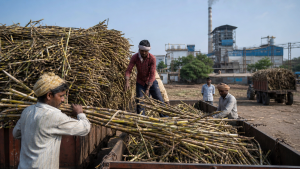
India regulates the sugar sector through a strong legal and administrative framework that covers cane pricing, mill operations, domestic sales, stocks, exports, and by-product use. The system aims to protect farmers, stabilize consumer prices, and ensure timely payment of cane dues.
Constitutional and Legal Basis
- Essential Commodities Act, 1955: Sugarcane and sugar are notified as essential commodities. Under Sections 3 and 5, the Union government regulates production, supply, distribution, and pricing.
- Administrative orders: Major controls are implemented through the Sugarcane (Control) Order, 1966, the Sugar (Control) Order, 2025, and the Sugar Price Control Order.
- Nodal agency: The Directorate of Sugar and Vegetable Oils under the Ministry of Consumer Affairs, Food and Public Distribution monitors domestic sales, stocks, and international trade.
Pricing Mechanism of Sugarcane
Sugarcane does not follow the MSP system used for many other crops. Instead, its price is fixed through a separate regulatory mechanism.
Fair and Remunerative Price (FRP)
- Definition: FRP is the minimum price sugar mills must legally pay to sugarcane farmers.
- Timing: It is fixed by the central government before the start of each sugar season, which runs from October to September.
- Advisory body: The Commission for Agricultural Costs and Prices (CACP) recommends FRP after consultations with state governments and sugar industry associations.
- Approval: The Cabinet Committee on Economic Affairs (CCEA), chaired by the Prime Minister, finalizes FRP.
- Factors considered: Cost of cultivation, returns from alternative crops, sugar recovery rate, and sale value of sugar and by-products.
State Advised Price (SAP)
- Definition: Some sugar-producing states announce their own cane price, called SAP.
- States involved: Uttar Pradesh, Punjab, Haryana, and Uttarakhand are among the states that commonly announce SAP.
- Price difference: SAP is usually higher than the centrally fixed FRP.
- Effect: Mills in these states must pay SAP, often leading to disputes over arrears.
Key Provisions of the Sugar (Control) Order, 2025
The Sugar (Control) Order, 2025 replaces the older control framework and introduces digital monitoring and broader regulatory coverage.
Digital Integration and Transparency
- API integration: The DFPD portal is linked with sugar mills’ ERP systems to provide real-time data on production, sales, and inventory.
- GSTN data sharing: GST Network data is integrated with the DFPD portal to track actual sugar sales and reduce mismatches.
Inclusion of Alternative Sugar Products
- Raw sugar control: Raw sugar is brought under the order to improve stock tracking and prevent misuse of labels such as organic sugar.
- Khandsari units: Khandsari units with a daily crushing capacity above 500 tonnes are brought under formal regulation so that cane suppliers receive FRP.
Unified Pricing Power
- Integrated price control: Price regulation is built into the same order, removing the need for a separate sugar price control order.
Domestic Market and Price Control Measures
Minimum Selling Price of Sugar
- Concept: The government introduced the Minimum Selling Price (MSP) of sugar in 2018.
- Purpose: It prevents ex-mill prices from falling below production cost and helps mills pay cane dues.
Monthly Release Quota System
- Mechanism: The government assigns a monthly quantity of sugar that each mill may sell in the domestic market.
- Purpose: It prevents market flooding, matches supply with demand, and supports price stability.
Stock Holding Limits on Dealers
- Limit: Dealers and traders face stock ceilings to curb hoarding.
- Revised cap: On September 1, 2026, the Ministry of Consumer Affairs, Food and Public Distribution halved the stock limit to 2,000 quintals from 4,000 quintals.
- Validity: The revised limit takes effect from September 15, 2026, and remains in force until November 30, 2026.
- Holding period: Dealers cannot hold sugar for more than 30 days from the date of receipt.
- Exemption: Kolkata and its extended metropolitan areas retain a 4,000-quintal ceiling because of their role as a distribution hub for eastern and north-eastern India.
Sugar is treated as an essential commodity under India’s market regulation framework.
International Trade Policies
The government keeps a close watch on sugar imports and exports to protect the domestic market from global price swings.
Export Restrictions
- Policy basis: Sugar exports are regulated under the Foreign Trade Policy through notifications issued by DGFT under the Foreign Trade (Development and Regulation) Act, 1992.
- Export prohibition: Due to lower production and El Niño-related concerns, exports of raw, white, and refined sugar were prohibited from mid-May 2026 to September 30, 2026.
- Exemptions: Shipments to the European Union and the United States under CXL and TRQ arrangements, duty-free imports under the Advance Authorisation Scheme, and government-to-government food security agreements remain exempt.
Import Tariff Protection
- High duties: India has often imposed customs duties as high as 100% on raw and refined sugar to discourage cheap imports.
By-Products Regulation and the Ethanol Blending Programme
The sugar industry also produces valuable by-products that are regulated for industrial use, energy generation, and ethanol production.
| By-Product | Description and Regulatory Aspect | Primary Uses |
| Molasses | A heavy, dark, viscous liquid left after sugar extraction. Its storage, transport, and pricing are monitored under state excise laws. | Industrial alcohol, potable liquor, and fuel ethanol |
| Bagasse | Fibrous residue left after crushing sugarcane. | Cogeneration for green electricity and paper production |
| Press mud | Cake residue obtained from filtration of cane juice. | Organic manure and compressed biogas (CBG) |
Ethanol Blending Programme (EBP)
- Target: India aims for 20% ethanol blending in petrol by 2025-26.
- Diversion policy: Mills may divert sugarcane juice, B-heavy molasses, and C-heavy molasses for ethanol production.
- Benefit: Ethanol sales provide a steadier income for mills and support timely cane payments.
Sector Reforms and Developmental Funds
Rangarajan Committee Recommendations (2012)
- Levy sugar obligation abolished: Mills earlier had to sell 10% of sugar to the government at subsidized rates for the PDS. This was abolished in 2013.
- Direct PDS procurement: State governments now procure sugar from the open market for the PDS, with a fixed subsidy from the Centre.
- Decontrol: The committee also recommended easing controls over chemical and fertilizer inputs and related by-products.
Sugar Development Fund (SDF)
- Origin: The Sugar Development Fund was established under the Sugar Development Fund Act, 1982.
- Earlier funding: It was funded through a sugar cess collected from mills.
- Current funding: After GST was introduced in July 2017, the sugar cess was abolished and the fund is now supported through budgetary allocations from the Consolidated Fund of India.
- Uses: The fund supports factory modernization, cane development, ethanol units, and bagasse-based power cogeneration.
Recent Context
In September 2026, the government tightened sugar stock limits to curb hoarding and retail inflation. It also shifted to a fortnightly quota system to improve distribution efficiency and keep supplies moving faster.
Rare Facts for Prelims
- Quintal measure: One quintal equals 100 kilograms.
- Season definition: The sugar season in India runs from October to September, not the calendar year.
- FRP vs SAP: FRP is centrally fixed, while SAP is announced by certain state governments and usually exceeds FRP.
- Raw sugar control: Bringing raw sugar under regulation helps the government track total stock more accurately.
- Bagasse value: Bagasse is not waste alone; it is a major input for cogeneration and paper making.
- Ex-mill price role: Ex-mill sugar price matters because it directly affects mills’ ability to clear cane arrears.
| Related | |
|---|---|