Government Initiatives for Port Development in India
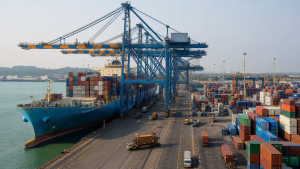
India’s port development strategy combines legal reform, infrastructure expansion, digitalization, and green transition to improve cargo movement, connectivity, and global competitiveness.
Administrative and Legal Framework of Indian Ports
Under the Seventh Schedule of the Constitution of India, ports fall under the Concurrent List. India’s ports are broadly divided into major and non-major categories.
Classification of Ports
- Major Ports: India has 12 operational major ports. They are administered by the Union Ministry of Ports, Shipping and Waterways. The Major Port Authorities Act, 2021 governs them and replaced the Major Port Trusts Act, 1963.
- Autonomous Governance: The 2021 law converted port trusts into autonomous Port Authorities, decentralizing decision-making and allowing port boards to fix tariffs based on market forces, replacing the earlier Tariff Authority for Major Ports (TAMP).
- Non-Major Ports: There are over 200 non-major and minor ports, which are managed by coastal states through State Maritime Boards or transport departments.
Legislative Reforms
- Indian Ports Act, 2025: Replaced the colonial Indian Ports Act of 1908. It updates port administration, safety, and pollution control rules, gives statutory status to the Maritime State Development Council (MSDC), and provides legal backing to State Maritime Boards.
- Merchant Shipping Act, 2025: Replaced the Merchant Shipping Act, 1958 and the Coasting Vessels Act, 1838. It aligns Indian maritime law with IMO treaties, relaxes vessel ownership rules, and strengthens marine safety, environmental compliance, and seafarer welfare provisions.
- Coastal Shipping Act, 2025: Simplifies licensing for vessels operating along the Indian coast and creates a National Strategic Plan to clarify cabotage rules and promote domestic coastal trade.
- Carriage of Goods by Sea Act, 2025: Adopts the Hague-Visby Rules and updates liability norms for sea cargo, bringing greater clarity for international trade.
Flagship Programs for Port Infrastructure
The government has launched major national programs to modernize ports, improve connectivity, and expand cargo-handling capacity.
Sagarmala Programme
- Overview: Launched in 2015, it promotes port-led development across India’s coastline and includes over 800 projects.
- Pillars: Port modernization, port connectivity, port-linked industrialization, and coastal community development.
- Sagarmala 2.0: Expands support for shipbuilding, ship recycling, and advanced port technologies.
PM Gati Shakti National Master Plan
- Multimodal Integration: Port infrastructure projects are integrated with this national transport planning framework.
- Connectivity: More than 180 port-related projects are included to improve road, rail, and inland waterway links to port hinterlands.
Project Unnati
- Performance Benchmarking: Benchmarks major ports against global standards.
- Efficiency: Identifies bottlenecks to reduce vessel turnaround time and improve cargo handling capacity.
Digital Initiatives for Ease of Doing Business
India has introduced digital platforms to reduce paperwork, improve transparency, and speed up cargo movement.
One Nation One Port (ONOP) Process
- Standardization: Standardizes operational processes across all major ports.
- Documentation: Uses a single-window system and has reduced bulk cargo documents by 29% and container operation documents by 33%.
National Logistics Portal (Marine) – SAGAR-SETU
- Connectivity: Connects stakeholders across the maritime sector.
- Tracking: Enables real-time vessel tracking, digital payment of port dues, and digital document exchange.
Sagar Ankalan Logistics Port Performance Index (LPPI)
- Benchmarking: Measures port efficiency across multiple parameters.
- Performance Indicators: Evaluates cargo handling time, vessel turnaround time, and logistics costs.
Vision Roadmaps for Maritime Growth
Long-term policy blueprints guide the expansion of India’s maritime sector.
Maritime India Vision 2030
- Targets: A 10-year roadmap with 150 initiatives across 10 themes.
- Focus: Capacity expansion, ship recycling leadership, and 100% mechanization of berths to reduce logistics costs.
Maritime Amrit Kaal Vision 2047
- Vision: Provides a long-term roadmap for India’s maritime sector up to 2047.
- Investment: Aims to scale national port capacity to 10,000 million metric tonnes (MMT) by 2047 and generate large-scale employment in coastal areas.
Sustainable and Green Port Initiatives
India is promoting low-carbon and environmentally responsible port operations through green policies and clean energy adoption.
Harit Sagar Guidelines
- Targets: Set zero-carbon goals for major ports.
- Focus: Waste reduction and renewable energy adoption.
Green Tug Transition Programme (GTTP)
- Decarbonization: Replaces diesel-powered harbor tugs with electric or hybrid tugs.
- Outcome: Aims to reduce greenhouse gas emissions in port waters.
Onshore Power Supply (OPS)
- Pollution Control: Allows berthed ships to switch off diesel engines and connect to shore power.
- Benefit: Reduces localized air pollution in port areas.
Model Green Port
- Example: V.O. Chidambaranar Port in Tamil Nadu is a green model port.
- Fact: It generates enough renewable energy to offset nearly 94% of its daily energy consumption.
Mega Port Projects and Transshipment Hubs
India is developing deep-draft ports and transshipment hubs to accommodate larger vessels and reduce dependence on foreign ports.
Vadhavan Port (Maharashtra)
- Draft: An upcoming greenfield major port with a natural draft of 20 metres.
- Capacity: Designed to handle mega-container ships of over 24,000 TEUs and strengthen India’s place among the world’s leading container ports.
International Container Transshipment Terminal (ICTT), Vallarpadam
- Location: Located at Cochin Port in Kerala.
- Purpose: India’s first dedicated single-window transshipment facility, reducing dependence on hubs like Colombo and Singapore.
National Maritime Heritage Complex (NMHC), Lothal
- Location: Gujarat.
- Historical Significance: Showcases India’s maritime history dating back to the Indus Valley Civilization, which featured the world’s earliest known tidal dockyard.
Operational Major Ports of India
| Port Name | Coastline | State / UT | Key Characteristics and Cargo Specialization |
| Deendayal Port (Kandla) | West | Gujarat | Natural, tidal port; houses India’s first Export Processing Zone (EPZ); leads in annual cargo volume. |
| Mumbai Port | West | Maharashtra | Natural, deep-water harbor; oldest modern major port in India. |
| Jawaharlal Nehru Port (JNPA) | West | Maharashtra | India’s largest container-handling port; highly automated. |
| Mormugao Port | West | Goa | Natural harbor; primary exporter of iron ore. |
| New Mangalore Port | West | Karnataka | Deep-water, all-weather port; handles iron ore exports and crude oil imports. |
| Cochin Port | West | Kerala | Natural port on Willingdon Island; hosts the Vallarpadam transshipment terminal. |
| Tuticorin Port (V.O. Chidambaranar) | East | Tamil Nadu | Artificial deep-sea port; acts as a model green port using renewable energy. |
| Chennai Port | East | Tamil Nadu | Artificial harbor; second busiest container port on the eastern coast. |
| Kamarajar Port (Ennore) | East | Tamil Nadu | Only corporatized major port; registered as a public limited company. |
| Visakhapatnam Port | East | Andhra Pradesh | Deepest landlocked port on the east coast; primary exporter of coal and iron ore. |
| Paradip Port | East | Odisha | Deep-water port; handles bulk iron ore, coal, and fertilizer; capable of hosting Capesize vessels. |
| Syama Prasad Mookerjee Port (Kolkata) | East | West Bengal | India’s only major riverine port; features two dock systems (Kolkata Dock and Haldia Dock). |
Recent Context
Vizhinjam International Seaport in Kerala began EXIM operations on 18 August 2026. The state also launched Mission Samudra, a ₹400 crore plan to integrate Kerala’s coastline, major seaports, and minor ports into a unified maritime zone.
Rare Facts for Prelims
- V.O. Chidambaranar Port: It is the only major port in India widely noted as a model green port for renewable-energy use.
- Kamarajar Port: Also known as Ennore Port, it is the only corporatized major port in India.
- Syama Prasad Mookerjee Port: It is India’s only major riverine port.
- Vallarpadam Terminal: It was developed to shift Indian cargo away from foreign transshipment hubs.
- Vadhavan Port: Its natural depth of 20 metres is a major advantage for handling ultra-large container vessels.
- Maritime State Development Council: The Indian Ports Act, 2025 gives it statutory status for Centre-state coordination.
| Related | |
|---|---|