Important Biodiversity Hotspots and Ecoregions in India
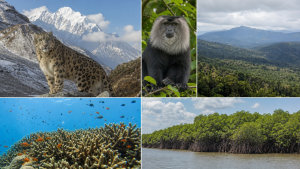
India is one of the world’s major centres of biodiversity, with varied climatic zones, ecosystems and endemic species across the Himalayas, peninsular plateaus, coasts and islands. For Prelims revision, the key areas are the global biodiversity hotspots in India, the national biogeographic classification, Biodiversity Heritage Sites, and the legal framework that protects biological resources.
Global Biodiversity Hotspots in India
A biodiversity hotspot is an area with exceptional plant endemism and severe habitat loss. Conservation International uses two main criteria to identify a global hotspot:
- Endemism: The region must have at least 1,500 endemic vascular plant species.
- Habitat loss: The region must have lost at least 70% of its original primary vegetation.
- India’s hotspots: India contains four of the world’s 36 recognised biodiversity hotspots — the Himalayas, Indo-Burma, Western Ghats and Sundaland.
- Himalayas: This hotspot covers the Himalayan mountain chain across northern and north-eastern India.
- Indo-Burma: In India, this includes the North-Eastern states south of the Brahmaputra River.
- Western Ghats: This hotspot extends along the western peninsula and continues into Sri Lanka.
- Sundaland: In India, this is represented by the Nicobar Islands.
India’s Biogeographic Classification
India’s ecological diversity is also mapped through global ecoregion systems and a national biogeographic framework. These classifications are used for conservation planning and to identify priority areas for protection.
- WWF ecoregions: Under the World Wide Fund for Nature classification, India has 46 terrestrial ecoregions, 14 freshwater ecoregions and 6 marine ecoregions.
- National framework: Biogeographically, India is divided into 10 biogeographic zones and 25 biogeographic provinces.
- Purpose: The classification supports systematic planning of the protected area network.
| Zone | Biogeographic Zone | Key Geographic Coverage |
| 1 | Trans-Himalaya | Cold desert areas of Ladakh and Lahaul-Spiti |
| 2 | Himalaya | North-West, West, Central and East Himalayan ranges |
| 3 | Desert | Arid regions of the Thar Desert and Kutch |
| 4 | Semi-Arid | Transition zones including Punjab plains, Gujarat and Rajasthan |
| 5 | Western Ghats | Mountain ranges and plains along the western coast |
| 6 | Deccan Peninsula | Central highlands, Chhota Nagpur and the eastern plateau |
| 7 | Gangetic Plain | Upper and lower fertile plains of the Ganga river |
| 8 | Coasts | Eastern and western coastal lines, including Lakshadweep |
| 9 | North-East | Brahmaputra valley and the North-East hills |
| 10 | Islands | Andaman and Nicobar archipelago in the Bay of Bengal |
Biodiversity Heritage Sites
Biodiversity Heritage Sites (BHS) protect ecologically fragile and unique areas outside the formal national park and wildlife sanctuary system. They are important for conserving local gene pools, rare species and wild relatives of crops.
- Legal basis: Section 37 of the Biological Diversity Act, 2002 empowers State Governments, in consultation with local bodies, to declare Biodiversity Heritage Sites.
- Scope: These sites are usually small, unique ecosystems with high conservation value.
- Current number: As of March 2026, India has 54 declared Biodiversity Heritage Sites.
- First BHS: Nallur Tamarind Grove in Bengaluru, Karnataka, notified in 2007, was India’s first Biodiversity Heritage Site.
- First water body BHS: Ameenpur Lake in Telangana is the first water body in India designated as a Biodiversity Heritage Site.
- Conservation value: BHS help protect ancient trees, wetlands, sacred groves and other fragile habitats.
Biological Diversity Amendment Act, 2023
The Biological Diversity (Amendment) Act, 2023 updated India’s biodiversity regulation to simplify procedures and support research, while retaining oversight over access to biological resources.
- Commencement: The amended law came into force on 1 April 2024.
- Regulatory shift: It simplifies research compliance, decriminalises certain offences and moves several approvals to a registration-based framework.
- Certificate of Registration: Applicants must obtain a Certificate of Registration from the National Biodiversity Authority before seeking IPR based on biological resources of Indian origin.
- Foreign-controlled entity: Under the amended Section 3(2)(c)(ii), an Indian-incorporated company is treated as a foreign-controlled entity only if it is controlled by a foreigner under the Companies Act, 2013.
- Policy intent: The amendment aims to encourage domestic investment and research in traditional medicine and biotechnology.
Key Prelims Takeaways
- Hotspot criteria: At least 1,500 endemic vascular plant species and at least 70% loss of original primary vegetation.
- India’s hotspots: Himalayas, Indo-Burma, Western Ghats and Sundaland.
- Sundaland in India: Represented by the Nicobar Islands.
- Biogeographic system: India has 10 biogeographic zones and 25 provinces.
- WWF classification: India has 46 terrestrial, 14 freshwater and 6 marine ecoregions.
- First BHS: Nallur Tamarind Grove, Bengaluru, Karnataka.
- NBA headquarters: Chennai, Tamil Nadu.
| Related | |
|---|---|