Major Elephant Landscapes of India
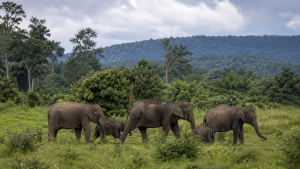
The Asian elephant is India’s National Heritage Animal and is protected as an Endangered species. India manages elephant conservation through landscape-level planning, corridor protection, and inter-state coordination across major habitat blocks.
Taxonomy and Conservation Status of the Asian Elephant
The Asian Elephant (Elephas maximus indicus) is India’s National Heritage Animal, a status designated in 2010. It serves as a keystone species and an ecological engineer. Its movements help disperse seeds, clear pathways, and create water holes used by other wildlife.
- IUCN Red List Status: Endangered
- Wildlife (Protection) Act, 1972: Schedule I
- CITES: Appendix I
- Population Share: India hosts over 60% of the global wild Asian elephant population
Defining the Elephant Landscape Approach
Elephants are wide-ranging mammals. A single herd may need a home range from 250 sq km to more than 3,500 sq km, depending on habitat quality. This makes landscape-level conservation more effective than isolated protected areas.
Elephant landscapes are defined by ecological boundaries rather than administrative boundaries. They integrate national parks, wildlife sanctuaries, reserved forests, and human-use areas into continuous conservation zones. India currently manages its wild elephant population across 10 distinct landscapes, covering 33 notified Elephant Reserves across 14 states.
The 10 Major Elephant Landscapes of India
1. East-Central Landscape
- Coverage: South-West Bengal, Jharkhand, Odisha, and Chhattisgarh
- Key Elephant Reserves: Singhbhum, Mayurjharna, Mayurbhanj, Mahanadi, Sambalpur, Baitarani, South Odisha, Lemru, and Badalkhol-Tamorpingla
- Characteristics: Highly fragmented dry deciduous forests with intense human-elephant conflict due to mining and agriculture
2. Kameng-Sonitpur Landscape
- Coverage: Arunachal Pradesh and Assam
- Key Elephant Reserves: Kameng and Sonitpur
- Characteristics: Rich wet evergreen forests and an important corridor for seasonal altitudinal migration
3. Eastern-South Bank Landscape
- Coverage: Assam and Arunachal Pradesh
- Key Elephant Reserves: Dehing-Patkai and South Arunachal
- Characteristics: A mix of evergreen and semi-evergreen forest patches; faces pressure from tea plantation expansion
4. Kaziranga-Karbi Anglong-Intanki Landscape
- Coverage: Assam and Nagaland
- Key Elephant Reserves: Kaziranga-Karbi Anglong, Dhansiri-Lungding, and Intanki
- Characteristics: Connects the Brahmaputra floodplains with the hills of Nagaland, supporting grasslands and hill forests
5. North Bengal-Greater Manas Landscape
- Coverage: Assam and West Bengal
- Key Elephant Reserves: Chirang-Ripu and Eastern Dooars
- Characteristics: Critical for transboundary elephant movement between India and Bhutan
6. Meghalaya Landscape
- Coverage: Meghalaya
- Key Elephant Reserves: Garo Hills and Khasi Hills
- Characteristics: Large share of community-owned forest lands; corridor conservation must balance traditional land rights
7. Brahmagiri-Nilgiri-Eastern Ghat Landscape
- Coverage: Karnataka, Kerala, Tamil Nadu, and Andhra Pradesh
- Key Elephant Reserves: Mysore, Wayanad, Nilgiri, and Rayala
- Characteristics: The largest contiguous elephant habitat in Asia and the strongest concentration of wild Asian elephants in India
Nilgiri Elephant Reserve is the largest elephant reserve in India.
8. Anamalai-Nelliyampathy-High Range Landscape
- Coverage: Tamil Nadu and Kerala
- Key Elephant Reserves: Anamalai and Anamudi
- Characteristics: High-altitude montane grasslands (sholas) and wet evergreen forests in the southern Western Ghats
9. Periyar-Agasthyamalai Landscape
- Coverage: Kerala and Tamil Nadu
- Key Elephant Reserves: Periyar, Srivilliputhur, and Agasthyamalai
- Characteristics: Southernmost end of the Western Ghats with tropical forests and crucial river basins
10. North-Western Landscape
- Coverage: Uttarakhand and Uttar Pradesh
- Key Elephant Reserves: Shivalik, Uttar Pradesh, and Terai Elephant Reserve
- Characteristics: Covers the Shivalik hills and Terai floodplains; supports movement between India and Nepal
The Terai Elephant Reserve covers 3,049 sq km and includes the Dudhwa and Pilibhit Tiger Reserves.
Master Table: Distribution of Notified Elephant Reserves
| Elephant Landscape | Participating States | Notified Elephant Reserves |
| East-Central Landscape | Jharkhand, Odisha, Chhattisgarh, West Bengal | Singhbhum, Mayurjharna, Mayurbhanj, Mahanadi, Sambalpur, Baitarani, South Odisha, Lemru, Badalkhol-Tamorpingla |
| Kameng-Sonitpur Landscape | Arunachal Pradesh, Assam | Kameng, Sonitpur |
| Eastern-South Bank Landscape | Assam, Arunachal Pradesh | Dehing-Patkai, South Arunachal |
| Kaziranga-Karbi Anglong-Intanki Landscape | Assam, Nagaland | Kaziranga-Karbi Anglong, Dhansiri-Lungding, Intanki |
| North Bengal-Greater Manas Landscape | Assam, West Bengal | Chirang-Ripu, Eastern Dooars |
| Meghalaya Landscape | Meghalaya | Garo Hills, Khasi Hills |
| Brahmagiri-Nilgiri-Eastern Ghat Landscape | Karnataka, Kerala, Tamil Nadu, Andhra Pradesh | Mysore, Wayanad, Nilgiri, Rayala |
| Anamalai-Nelliyampathy-High Range Landscape | Tamil Nadu, Kerala | Anamalai, Anamudi |
| Periyar-Agasthyamalai Landscape | Kerala, Tamil Nadu | Periyar, Srivilliputhur, Agasthyamalai |
| North-Western Landscape | Uttarakhand, Uttar Pradesh | Shivalik, Uttar Pradesh, Terai |
Census Trends and Population Distribution
- Traditional Census: The 2017 synchronized national census estimated the wild elephant population at 29,964. Karnataka had the highest population, followed by Assam and Kerala.
- DNA-Based Census: The Synchronous All India Population Estimation of Elephants (SAIEE) shifted to a genetic mark-recapture method using dung DNA. This assessment estimated the wild elephant population at 22,446.
- Concentration Hubs: Nearly half of India’s wild elephants reside in the southern Western Ghats landscape.
The Crucial Role of Elephant Corridors and “Right of Passage”
Elephant corridors are narrow strips of land that connect larger habitats and allow seasonal migration, genetic exchange, and access to food and water.
- Validated Corridors: The Wildlife Institute of India ground-validated 150 elephant corridors across 15 states.
- Regional Distribution: West Bengal has the highest density, with 26 corridors.
- Inter-State and Transboundary Corridors: There are 19 validated inter-state corridors and 6 international transboundary corridors linking India with Nepal and Bhutan.
- Legal Recognition: The Supreme Court upheld the “Right of Passage” for elephants and supported the notification of the Sigur Plateau corridor in Tamil Nadu under Article 51A(g).
Article 51A(g) of the Constitution calls for compassion for living creatures.
Major Conservation Challenges
- Habitat Fragmentation: Railways, highways, power lines, and canals break forest continuity and push elephants into human settlements.
- Human-Elephant Conflict: Crop raiding, property damage, and accidental encounters cause around 500 human deaths annually; elephants also face electrocution, poisoning, and train collisions.
- Lack of Statutory Power: Elephant Reserves are administrative designations and do not have automatic statutory backing under the Wildlife (Protection) Act, 1972, unless they overlap with existing protected areas.
Key Policy Initiatives and Conservation Programs
- Project Elephant: Launched in February 1992 as a Centrally Sponsored Scheme to assist states with wild elephant populations. It focuses on habitat restoration, corridor protection, and conflict mitigation.
- Integrated Management: Project Elephant and Project Tiger operate under a unified administrative division for streamlined funding and field management.
- MIKE Programme: The Monitoring of Illegal Killing of Elephants is an international CITES programme that tracks poaching and illegal trade trends.
- Project Suraksha: Uses GIS mapping and AI-based early warning apps to track herd movement and alert nearby villages.
Recent Context
On 28 August 2026, Tamil Nadu notified three elephant corridors in the Cauvery North Wildlife Sanctuary in Hosur Forest Division. On 31 July 2026, the Madras High Court held that removing encroachments is not a prerequisite for corridor notification.
Rare Facts for Prelims
- India’s National Heritage Animal: The Asian elephant was declared India’s National Heritage Animal in 2010.
- Largest Stronghold: The Brahmagiri-Nilgiri-Eastern Ghat landscape holds the biggest contiguous elephant habitat in Asia.
- Transboundary Importance: Elephant movement corridors in northern and eastern India are crucial for links with Nepal and Bhutan.
- Ecological Engineering: Elephants create trails and water holes that benefit smaller mammals, birds, and reptiles.
- Community Forests: Meghalaya’s elephant landscape is notable for extensive community-owned forest areas.
- Terai Reserve: The Terai Elephant Reserve was notified in late 2022 as India’s 33rd Elephant Reserve.
| Related | |
|---|---|