Important Meteor Showers and Comets
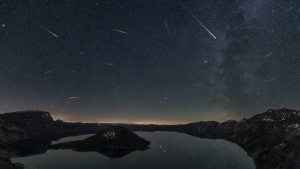
Comets, meteoroids, meteors, and meteor showers are closely linked but scientifically distinct. Their composition, origin, and appearance help explain some of the most important recurring sky events.
Core Concepts: Asteroids, Comets, and Meteors
| Object | Main Composition | Primary Location | Visual Features near Earth |
| Asteroid | Rock and metals | Asteroid Belt (between Mars and Jupiter) | Appears as a point of light without a tail. |
| Comet | Ice, dust, and organic compounds | Kuiper Belt and Oort Cloud | Develops a glowing coma and tail near the Sun. |
| Meteoroid | Small fragments of rock or metal | Outer space | Invisible until entering the atmosphere. |
| Meteor | Burning space debris | Earth’s atmosphere (mesosphere) | A brief streak of light in the night sky. |
| Meteorite | Leftover rock or metal | Earth’s surface | Solid physical fragment found on the ground. |
Nature and Structure of Comets
Comets are icy, small solar system bodies. When they pass close to the Sun, they heat up and release gases. This process is called outgassing.
- Nucleus: The solid, frozen core made of ice, dust, and rock.
- Coma: The dusty, hazy cloud of gas surrounding the nucleus.
- Tail: Comets typically develop two tails. The dust tail is curved and composed of small dust particles. The ion tail is straight, consisting of charged gases that point directly away from the Sun due to solar wind.
Comets travel in highly elliptical orbits. Short-period comets take less than 200 years to orbit the Sun and come from the Kuiper Belt beyond Neptune. Long-period comets take thousands of years to complete an orbit and originate from the Oort Cloud at the outer edge of the solar system.
Famous Comets in History
- Halley’s Comet (1P/Halley): This is a short-period comet visible from Earth every 75 to 76 years. It last appeared in 1986 and will return in 2061. It is the only short-period comet visible to the naked eye.
- Comet Swift-Tuttle (109P/Swift-Tuttle): This comet orbits the Sun every 133 years. It is the origin of the Perseid meteor shower debris.
- Comet Tempel-Tuttle (55P/Tempel-Tuttle): With an orbital period of 33 years, this comet is the parent body of the Leonid meteor shower.
- Comet Hale-Bopp (C/1995 O1): This was one of the most widely observed comets of the 20th century. It remained visible to the naked eye for a record 18 months.
- Shoemaker-Levy 9: This comet broke apart and collided with Jupiter in 1994. The event gave scientists their first direct view of a collision between two solar system bodies.
Mechanism of Meteor Showers
A meteor shower occurs when Earth passes through the trail of debris left behind by a comet. As Earth orbits the Sun, it crosses these dusty paths at the same time each year.
The tiny particles of dust and rock, called meteoroids, collide with Earth’s atmosphere at high speeds. Friction heats the air around the particles, creating the glowing streaks of light we call meteors.
All meteors in a shower appear to originate from a single point in the sky. This point is called the radiant. Astronomers name meteor showers after the constellation where the radiant lies.
Major Annual Meteor Showers
| Meteor Shower | Peak Date Range | Parent Body | Radiant Constellation |
| Quadrantids | January 3–4 | Asteroid 2003 EH1 | Bootes |
| Lyrids | April 21–22 | Comet Thatcher | Lyra |
| Eta Aquariids | May 5–6 | Comet Halley | Aquarius |
| Perseids | August 11–13 | Comet Swift-Tuttle | Perseus |
| Orionids | October 21–22 | Comet Halley | Orion |
| Leonids | November 17–18 | Comet Tempel-Tuttle | Leo |
| Geminids | December 13–14 | Asteroid 3200 Phaethon | Gemini |
| Taurids | November 4–5 | Comet Encke | Taurus |
Key Characteristics of Major Showers
Perseids
The Perseids are active in August. They are known for producing bright meteors and frequent fireballs. The warm summer weather makes them highly popular for observers in the Northern Hemisphere.
Geminids
The Geminids are unique because their parent body is an asteroid, 3200 Phaethon, rather than a comet. They produce dense, multi-colored meteors because of the presence of metals like sodium and calcium in the debris.
Leonids
The Leonids peak in November. Every 33 years, this shower can transform into a meteor storm, producing thousands of meteors per hour. The last major storm occurred in 2001.
Quadrantids
The Quadrantids have a very brief peak period, lasting only a few hours. The source is Asteroid 2003 EH1, which scientists believe is an extinct comet.
Orionids and Eta Aquariids
These two showers are related because they both originate from the debris of Halley’s Comet. The Eta Aquariids peak in May, while the Orionids peak in October.
Space Exploration Missions to Comets
- Rosetta Mission (European Space Agency): This mission orbited Comet 67P/Churyumov–Gerasimenko. Its lander, Philae, made the first soft landing on a comet nucleus in 2014.
- Stardust Mission (NASA): Launched in 1999, this spacecraft collected dust samples from Comet Wild 2. It returned the samples to Earth in 2006, allowing scientists to study comet dust in laboratories.
- Deep Impact Mission (NASA): This spacecraft sent an impactor to collide with Comet Tempel 1 in 2005. The collision exposed the internal structure and composition of the comet nucleus.
- Giotto Mission (European Space Agency): This spacecraft flew close to Halley’s Comet in 1986. It captured the first close-up images of a comet nucleus, confirming the “dirty snowball” theory.
Key Astronomical Facts and Trivia
- Meteor Storms: A standard meteor shower produces tens of meteors per hour. A meteor storm occurs when the count exceeds 1,000 meteors per hour.
- Comet Tails: A comet’s tail does not follow behind its path of motion. Instead, the solar wind pushes the tail, so it always points away from the Sun.
- Prebiotic Molecules: The Stardust mission found glycine, an amino acid, in comet dust. This discovery supports the hypothesis that comets delivered the building blocks of life to early Earth.
- Asteroid 3200 Phaethon: This parent body of the Geminids behaves like a comet by releasing dust when close to the Sun, earning the classification of an active asteroid.
Recent Context
The Perseid meteor shower remains active until August 24, 2026, with peak activity having occurred around August 12 under dark skies due to a new moon. The shower is best observed in the pre-dawn hours, especially from the Northern Hemisphere.
Rare Facts for Prelims
- Radiant effect: Meteor shower streaks seem to spread from one point because of perspective, not because the meteors are actually moving outward from that point.
- Perseid speed: Perseid meteors enter Earth’s atmosphere at about 59 km per second, making them one of the faster major showers.
- Comet nucleus size: Many comet nuclei are only a few kilometers across, yet they can produce very large visible comas and tails near the Sun.
- Dust tail behavior: A comet’s dust tail is often curved because the dust particles are affected by both the comet’s motion and solar radiation pressure.
- Fireballs: Bright meteors that outshine Venus are called fireballs and are often caused by larger or denser meteoroids.
- Leonid source: The Leonid meteor shower is linked to debris from Comet Tempel-Tuttle, which returns to the inner solar system roughly every 33 years.
| Related | |
|---|---|