Important Indian Heritage Artefacts Repatriated from Abroad
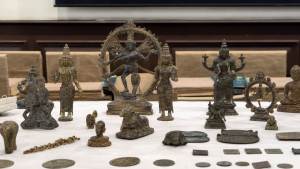
India has intensified efforts to recover stolen and smuggled cultural property from abroad. By June 2026, the country had brought back 662 historical artefacts, with the largest share returned by the United States. These recoveries reflect cultural diplomacy, international cooperation, and legal action against illicit antiquities trade.
Recent Context
According to the Ministry of Culture, India has retrieved 662 artefacts from foreign countries up to June 2026. Of these, 589 were returned by the United States, 51 by Australia, 21 by the United Kingdom, and 1 by the Netherlands.
Key Repatriated Artefacts and Their Historical Context
Anaimangalam Copper Plates (Leiden Plates)
- Origin and Period: 11th century CE, Chola Dynasty, under Rajaraja Chola I and Rajendra Chola I.
- Repatriated From: The Netherlands (Leiden University Library) in May 2026.
- Composition: 21 copper plates weighing around 30 kg, held together by a bronze ring with the royal seal of Rajendra Chola I.
- Historical Value: The inscriptions are in Sanskrit and Tamil. The Sanskrit portion records Chola genealogy, while the Tamil portion documents land revenue grants to the Chudamani Vihara, a Buddhist monastery in Nagapattinam built by Sri Mara Vijayotunga Varman of the Srivijaya Kingdom.
The Leiden Plates are important evidence of Chola maritime diplomacy, religious tolerance, and overseas links with Southeast Asia.
Celestial Dancer (Apsara)
- Origin and Period: 10th-11th century CE, Central India (Madhya Pradesh).
- Repatriated From: The United States in late 2024.
- Composition: A sandstone sculpture depicting a celestial dancer.
- Historical Value: Smugglers broke the sculpture into two halves in the early 1980s. It was later reassembled in New York and donated to the Metropolitan Museum of Art before being seized in 2023 and returned to India.
Tanesar Mother Goddess
- Origin and Period: 6th century CE, Rajasthan.
- Repatriated From: The United States in late 2024.
- Composition: Carved from green-grey schist.
- Historical Value: It belonged to a group of 12 mother goddess figures stolen from Tanesara-Mahadeva village in the early 1960s. The sculpture later passed through Manhattan art dealers before being acquired by the Metropolitan Museum of Art in 1993.
Chola Bronzes from the Smithsonian Institution
- Origin and Period: 10th to 16th century CE, Tamil Nadu.
- Repatriated From: The United States (Smithsonian’s National Museum of Asian Art) in May 2026.
- Specific Items: Shiva Nataraja bronze (circa 990 CE) from Sri Bhava Aushadesvara Temple, Thanjavur district; a 12th-century Somaskanda bronze; and a 16th-century Vijayanagara-period bronze of Saint Sundarar with Paravai.
Saint Tirumankai Alvar
- Origin and Period: 15th-16th century CE, Tamil Nadu.
- Repatriated From: The United Kingdom (Ashmolean Museum, University of Oxford) in 2024.
- Composition: A bronze depiction of the Vaishnavite saint-poet.
- Historical Value: The temple icon was stolen from an active place of worship in Tamil Nadu, sold at a London auction house in the 1960s, and later identified through temple records.
Annapurna Statue
- Origin and Period: 18th century CE, Varanasi, Uttar Pradesh.
- Repatriated From: Canada (University of Regina) in 2021.
- Composition: A stone sculpture of the deity Annapurna holding a bowl of kheer.
- Historical Value: The statue was stolen from Varanasi in 1913 and later reinstalled in the Kashi Vishwanath Temple after its return.
Late Chola Hanuman Idol
- Origin and Period: 14th-15th century CE, Ariyalur district, Tamil Nadu.
- Repatriated From: Australia in 2023.
- Composition: Bronze sculpture.
- Historical Value: It was stolen from the Shri Varatharaja Perumal temple in Ariyalur in 1961 and later handed back to the Tamil Nadu Idol Wing.
Regulatory and Legal Frameworks
Antiquities and Art Treasures Act, 1972
- Definition of Antiquity: Any article, object, or manuscript that has existed for not less than 100 years; for manuscripts or documents of historical value, the threshold is 75 years.
- Key Provisions: The Act prohibits export of antiquities without a Central Government permit, regulates internal trade in art treasures, and mandates registration of specified categories of antiquities.
Ancient Monuments and Archaeological Sites and Remains (AMASR) Act, 1958
- Scope: Provides for the preservation of ancient and historical monuments, archaeological sites, and remains of national importance.
- Enforcement: The Archaeological Survey of India (ASI) functions under the Ministry of Culture as the nodal agency for protection and recovery of heritage.
UNESCO 1970 Convention
- Name: Convention on the Means of Prohibiting and Preventing the Illicit Import, Export and Transfer of Ownership of Cultural Property.
- Application: India uses this treaty as the international legal basis to seek seizure and return of smuggled cultural property from foreign countries.
Cultural Property Agreement (2024)
- Parties: India and the United States.
- Objective: Restricts the import of certain archaeological and ethnological materials into the United States and helps confiscate and return illicitly trafficked Indian items.
Details of Prominent Repatriated Items
| Name of the Artefact | Dynasty / Period | Place of Origin | Repatriating Country | Year of Return |
| Anaimangalam Copper Plates | Chola Dynasty (11th century CE) | Nagapattinam, Tamil Nadu | Netherlands | 2026 |
| Shiva Nataraja | Chola Dynasty (circa 990 CE) | Thanjavur, Tamil Nadu | United States | 2026 |
| Somaskanda Bronze | Chola Dynasty (12th century CE) | Thanjavur, Tamil Nadu | United States | 2026 |
| Saint Sundarar with Paravai | Vijayanagara Period (16th century CE) | Tamil Nadu | United States | 2026 |
| Celestial Dancer (Apsara) | 10th-11th century CE | Madhya Pradesh | United States | 2024 |
| Tanesar Mother Goddess | 6th century CE | Rajasthan | United States | 2024 |
| Saint Tirumankai Alvar | 15th-16th century CE | Tamil Nadu | United Kingdom | 2024 |
| Lord Hanuman Idol | Late Chola (14th-15th century CE) | Ariyalur, Tamil Nadu | Australia | 2023 |
| Annapurna Statue | 18th century CE | Varanasi, Uttar Pradesh | Canada | 2021 |
Academic and Archaeological Importance of the Recovered Items
Historical Documentation
Epigraphs like the Leiden Plates preserve tax details, administrative hierarchies, and village council functions. They help historians cross-check Sanskrit royal genealogies with local Tamil records.
Religious Coexistence and Regional Ties
The Anaimangalam plates show that Chola rulers supported Buddhist institutions. The charter also records links with the Srivijaya world in Southeast Asia.
Technological Excellence
The returned bronzes highlight the lost-wax casting tradition. Their balance, detailing, and proportions reflect advanced metallurgical skill in ancient India.
Chronology and Iconography
Sculptures such as the Tanesar Mother Goddess help trace the evolution of iconographic styles from the post-Gupta phase to medieval regional temple art.
Rare Facts for Prelims
- Leiden Plates: They are among the most important Chola copper-plate charters preserved outside India for decades.
- Royal Seal: The Anaimangalam plates were bound with a bronze ring carrying the seal of Rajendra Chola I.
- Temple Theft Pattern: Several repatriated idols were traced through auction records and museum provenance research rather than police recovery alone.
- Lost-Wax Tradition: Chola bronzes are globally admired for the cire perdue technique, where a wax model is replaced by molten metal.
- UNESCO Role: The 1970 Convention is the main international instrument used to combat illicit trafficking of cultural property.
- ASI Mandate: Once a monument is delisted under Section 35 of the AMASR Act, the ASI’s statutory conservation responsibility ends.
| Related | |
|---|---|