Energy Security Frameworks and Policies of India
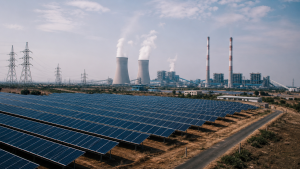
India’s energy security framework seeks to balance three priorities at once: reliable supply, affordable energy, and a faster shift to cleaner sources. The policy approach combines domestic production, strategic reserves, grid expansion, efficiency measures, and renewable-energy support to reduce import dependence and improve resilience.
Institutional Architecture and Regulatory Setup
India’s energy governance is spread across specialised ministries and statutory regulators. This structure helps manage the country’s large and diverse energy system across coal, oil, gas, power, renewables, and nuclear energy.
- Ministry of Power: Regulates power generation, transmission, distribution, and interstate electricity commerce.
- Ministry of Petroleum and Natural Gas (MoPNG): Oversees exploration, refining, pipeline distribution, and strategic petroleum reserves.
- Ministry of New and Renewable Energy (MNRE): Implements grid-connected and off-grid renewable projects, technology development, and green targets.
- Ministry of Coal: Manages coal production, allocation, and coal chemical utilisation projects.
- Department of Atomic Energy (DAE): Handles nuclear power generation under the Prime Minister’s direct oversight.
- Central Electricity Regulatory Authority (CERC): A statutory body under the Electricity Act, 2003, regulating tariffs of central generating companies and interstate transmission.
- Petroleum and Natural Gas Regulatory Board (PNGRB): Established under the PNGRB Act, 2006, regulating downstream refining, processing, storage, transportation, and distribution of petroleum products and natural gas.
- Bureau of Energy Efficiency (BEE): Created under the Energy Conservation Act, 2001, to develop policies that reduce energy intensity.
Energy Trilemma and Policy Direction
India’s energy policy is often explained through the energy trilemma: uninterrupted availability, economic affordability, and clean energy transition. This is linked to the long-term goal of achieving net-zero carbon emissions by 2070.
- Energy independence: Urja Aatmanirbharta by 2047 requires diversified primary energy sources.
- Infrastructure upgrade: Modernisation of the power system is necessary for reliability and renewable integration.
- Domestic buffers: Strategic reserves are used to reduce vulnerability to global supply shocks.
- Regulatory certainty: Strong institutions support investment, market stability, and long-term planning.
Exam fact: India imports nearly 88% of its crude oil and over 50% of its natural gas needs.
Strategic Petroleum Reserves and Fossil Fuel Measures
To cushion the economy from global disruptions and geopolitical volatility, India maintains strategic petroleum reserves and encourages domestic exploration and production.
- Strategic Petroleum Reserves (SPR): Phase I of Indian Strategic Petroleum Reserves Limited (ISPRL) created 5.33 million metric tonnes (MMT) of underground rock cavern storage.
- Visakhapatnam, Andhra Pradesh: 1.33 MMT capacity.
- Mangaluru, Karnataka: 1.5 MMT capacity.
- Padur, Karnataka: 2.5 MMT capacity.
- Phase II expansion: Additional 6.5 MMT storage is planned at Chandikhol (Odisha) and Padur (Karnataka) under public-private partnership models.
- Hydrocarbon Exploration and Licensing Policy (HELP): Introduced in 2016 to replace NELP.
- HELP features: Uniform Licensing System, Open Acreage Licensing Policy (OALP), Revenue Sharing Contracts, and marketing/pricing freedom for produced crude oil and natural gas.
- National Gas Grid: Aims to expand pipeline networks and raise the share of natural gas in the primary energy mix from about 6% to 15%.
- Coal Gasification Mission: Targets gasification of 100 MMT of coal to produce syngas, dimethyl ether, and synthetic natural gas.
Renewable Energy Schemes and Green Transition
India’s clean energy strategy supports large-scale capacity addition, household solarisation, alternative fuels, and emerging technologies such as green hydrogen and offshore wind. The larger goal is to reduce fossil dependence while expanding non-fossil capacity.
- 2030 targets: 500 GW of non-fossil fuel power generation capacity and 50% of electric power requirements from non-fossil sources.
- National Green Hydrogen Mission: Aims for at least 5 MMT per annum of green hydrogen production by 2030.
- SIGHT programme: Supports the National Green Hydrogen Mission through Strategic Interventions for Green Hydrogen Transition.
- PM-KUSUM: Promotes solarisation of agricultural pumps and provides standalone solar units and grid-connected options.
- PM Surya Ghar: Muft Bijli Yojana: Targets rooftop solar systems for up to 1 crore households.
- National Bioenergy Programme: Supports biomass pellet plants, waste-to-energy systems, and compressed biogas (CBG).
- SATAT: Sustainable Alternative Towards Affordable Transportation initiative linked to CBG deployment.
- Offshore Wind VGF Scheme: Provides central financial assistance for offshore wind projects off Gujarat and Tamil Nadu.
Grid Infrastructure, Storage and Energy Efficiency
Large-scale renewable integration requires stronger transmission networks, storage systems, and efficiency measures on the demand side. India’s policy response combines infrastructure expansion with industrial and consumer-side conservation tools.
- Green Energy Corridors (GEC): Helps synchronise renewable electricity with the national grid.
- Implementing agencies: MNRE and POWERGRID.
- National Programme on ACC Battery Storage: PLI scheme for domestic production of Advanced Chemistry Cell batteries for EVs and storage.
- Implementing ministry: Ministry of Heavy Industries.
- Perform, Achieve and Trade (PAT): Market-based mechanism under NMEEE to reduce specific energy consumption in energy-intensive industries.
- Standards & Labeling (S&L): Star-rating system for electrical appliances to promote consumer energy efficiency.
- Energy Conservation Building Code (ECBC): Sets minimum energy performance standards for commercial and high-density buildings.
- Implementing authority: BEE for PAT, S&L, and ECBC.
Quick Energy Facts
| Fact | Detail |
| Primary energy consumer rank | India is the 3rd largest primary energy consumer globally, after China and the United States. |
| Electricity generation mix | Coal accounts for nearly 70–74% of total electricity generation in the operational power grid. |
| Installed power capacity | Non-fossil fuel capacity accounts for over 40% of total installed electric power generation capacity. |
| Strategic reserve | Phase I SPR holds 5.33 MMT, equal to about 9.5 days of crude oil requirements. |
| Ethanol blending | The Ethanol Blended Petrol (EBP) Programme achieved 15% blending and aims for 20% blending nationwide. |
| Paris Agreement target | India’s updated NDC aims to reduce emission intensity of GDP by 45% below 2005 levels by 2030. |
| OALP | Open Acreage Licensing Policy allows companies to carve out exploration areas. |
Key Prelims Takeaways
- Energy security: India’s framework is built around availability, affordability, and clean transition.
- Import dependence: Crude oil import dependence is nearly 88%, and natural gas import dependence is over 50%.
- Key regulators: CERC, PNGRB, and BEE are central to tariff, downstream, and efficiency regulation.
- SPR Phase I: Storage capacity of 5.33 MMT exists at Visakhapatnam, Mangaluru, and Padur.
- HELP and OALP: HELP introduced uniform licensing and open acreage exploration, replacing NELP in 2016.
- Renewable targets: India has set 500 GW non-fossil capacity and 50% power from non-fossil sources by 2030.
- Efficiency tools: PAT, S&L, and ECBC are important demand-side management instruments under BEE.
| Related | |
|---|---|