Key Union Ministries and Their Primary Functions
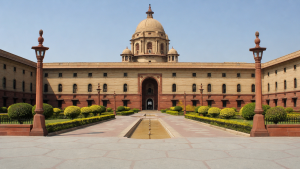
The Union Government functions through a network of Ministries and Departments that are assigned specific subjects under the Allocation of Business Rules, 1961. These bodies turn policy into action by handling legislation, regulation, schemes, public services and administrative coordination.
For Prelims revision, the key point is to link each Ministry with its core mandate, important departments and major statutory bodies or flagship programmes.
Core Security, External Affairs and Administrative Ministries
- Ministry of Home Affairs (MHA): Responsible for internal security, border management, Centre-State relations, Union Territories and disaster management.
- Key departments: Department of Internal Security, Department of States, Department of Official Language, Department of Home, Department of Jammu, Kashmir and Ladakh Affairs, and Department of Border Management.
- Key agencies: Central Armed Police Forces such as BSF, CRPF, CISF, ITBP and SSB; Intelligence Bureau; and National Disaster Management Authority (NDMA).
- Ministry of Defence (MoD): Formulates national defence policy, oversees territorial defence and manages military infrastructure for the three Armed Forces.
- Key departments: Department of Defence, Department of Defence Production, Department of Defence Research and Development, Department of Ex-Servicemen Welfare, and Department of Military Affairs.
- Ministry of External Affairs (MEA): Implements India’s foreign policy, handles diplomatic missions and bilateral and multilateral relations, and represents India at the United Nations.
- Key divisions: Development Partnership Administration (DPA), Consular, Passport and Visa (CPV) Division, and Indian Council for Cultural Relations (ICCR).
- Ministry of Finance: Deals with fiscal policy, public finance, tax administration and capital markets.
- Key departments: Department of Economic Affairs, Department of Expenditure, Department of Revenue, Department of Financial Services, Department of Investment and Public Asset Management (DIPAM), and Department of Public Enterprises (DPE).
- Ministry of Law and Justice: Coordinates legal matters for the Union Government, drafts central legislation and manages judicial administration.
- Key departments: Department of Legal Affairs, Legislative Department and Department of Justice.
Infrastructure, Energy and Industry Ministries
- Ministry of Road Transport and Highways (MoRTH): Builds and maintains National Highways, frames motor vehicle regulations and leads road safety policy.
- Key agencies: National Highways Authority of India (NHAI) and National Highways and Infrastructure Development Corporation Limited (NHIDCL).
- Ministry of Railways: Operates and manages Indian Railways, frames rail transport policy and develops dedicated freight corridors.
- Key body: Railway Board functions as the apex decision-making executive body.
- Ministry of Power: Oversees power generation, transmission, grid stability and rural electrification.
- Key bodies: Central Electricity Authority (CEA) and Bureau of Energy Efficiency (BEE).
- Ministry of New and Renewable Energy (MNRE): Promotes solar, wind, hydro, bio-energy and green hydrogen for clean energy transition.
- Ministry of Jal Shakti: Formed in 2019 by merging the Ministry of Water Resources, River Development and Ganga Rejuvenation with the Ministry of Drinking Water and Sanitation.
- Key departments: Department of Water Resources, River Development and Ganga Rejuvenation; Department of Drinking Water and Sanitation.
- Flagship programmes: Jal Jeevan Mission and Namami Gange Programme.
- Ministry of Electronics and Information Technology (MeitY): Drives digital governance, semiconductor manufacturing, cyber security and electronic hardware production.
- Key bodies: Unique Identification Authority of India (UIDAI), CERT-In and National Informatics Centre (NIC).
- Ministry of Commerce and Industry: Formulates Foreign Trade Policy, promotes foreign direct investment and supports domestic industrial growth.
- Key departments: Department of Commerce and Department for Promotion of Industry and Internal Trade (DPIIT).
Agriculture, Environment and Rural Development Ministries
- Ministry of Agriculture and Farmers Welfare: Handles price stabilisation, PM-KISAN, crop insurance and agricultural research.
- Key departments: Department of Agriculture and Farmers Welfare and ICAR.
- Ministry of Environment, Forest and Climate Change: Enforces environmental protection and forest-related laws, including the Wildlife Protection Act, 1972, and Environment Protection Act, 1986.
- Key bodies: Central Pollution Control Board (CPCB) and Forest Survey of India.
- Ministry of Rural Development: Executes MGNREGA, DAY-NRLM and Pradhan Mantri Awaas Yojana-Gramin.
- Key departments: Department of Rural Development and Department of Land Resources.
- Ministry of Panchayati Raj: Works on decentralisation, implements the 73rd Constitutional Amendment, and supports e-GramSwaraj and SVAMITVA.
- Ministry of Fisheries, Animal Husbandry and Dairying: Implements Pradhan Mantri Matsya Sampada Yojana and Rashtriya Gokul Mission.
- Key departments: Department of Fisheries and Department of Animal Husbandry.
Social Sector, Education and Healthcare Ministries
- Ministry of Education: Renamed from the Ministry of Human Resource Development under the National Education Policy 2020.
- Key departments: Department of School Education and Literacy; Department of Higher Education.
- Key statutory bodies: University Grants Commission (UGC), AICTE and NCERT.
- Ministry of Health and Family Welfare (MoHFW): Oversees public health infrastructure, medical education, disease control programmes and population control.
- Key departments: Department of Health and Family Welfare and Department of Health Research (DHR).
- Key regulatory bodies: National Medical Commission (NMC) and Food Safety and Standards Authority of India (FSSAI).
- Ministry of Ayush: Created in 2014 to promote traditional systems of medicine.
- Scope: Regulates Ayurveda, Yoga and Naturopathy, Unani, Siddha, Sowa-Rigpa and Homoeopathy.
- Ministry of Social Justice and Empowerment: Works for the welfare and empowerment of Scheduled Castes, Other Backward Classes, Persons with Disabilities, Senior Citizens and Transgender Persons.
- Key departments: Department of Social Justice and Empowerment and Department of Empowerment of Persons with Disabilities (Divyangjan).
- Ministry of Women and Child Development (MWCD): Formulates policies for child protection, maternal care and related welfare measures.
Other Important Ministries for Prelims
- Ministry of Labour and Employment: Deals with labour welfare, employment policy, industrial relations and social security for workers.
- Ministry of Skill Development and Entrepreneurship: Focuses on skill training, workforce development and entrepreneurship promotion.
- Ministry of Housing and Urban Affairs: Handles urban development, housing, municipal services and urban infrastructure.
- Ministry of Information and Broadcasting: Regulates public information, broadcasting policy and government communication.
- Ministry of Tribal Affairs: Works on the welfare, development and rights of Scheduled Tribes.
- Ministry of Parliamentary Affairs: Coordinates between the government and Parliament for legislative business.
- Ministry of Culture: Promotes and preserves India’s cultural heritage, monuments, museums and related institutions.
Key Prelims Takeaways
- Allocation of Business Rules, 1961: They distribute subjects among Union Ministries and Departments under Article 77(3).
- MHA: Internal security, border management, Union Territories, disaster management and Centre-State relations are its core functions.
- MoD and DMA: The Ministry of Defence handles overall defence policy, while the Department of Military Affairs is headed by the Chief of Defence Staff.
- Jal Shakti: Remember its 2019 creation by merging water resources and drinking water related ministries.
- MeitY: UIDAI, CERT-In and NIC are important bodies associated with it.
- Education and Health: UGC, AICTE, NCERT, NMC and FSSAI are key bodies to revise together.
- Rural and farm schemes: MGNREGA, DAY-NRLM, PM-KISAN, PMAY-G, Jal Jeevan Mission and Namami Gange are recurring Prelims terms.
Current General Studies comprises current-affairs-based, General Studies-rich study material on policies, laws, institutions, economy, science, environment, governance, international relations, and other varied but important topics for UPSC and State PSC Prelims examinations.
Fortnightly PDF compilations: Available here
Originally written on
May 9, 2026
and last modified on
September 6, 2026.
| Related | |
|---|---|