India’s Maritime Strategy in the Indian Ocean
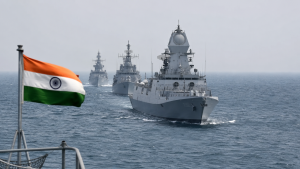
India’s Maritime Strategy in the Indian Ocean
The Indian Ocean Region is central to India’s security, trade, energy supply, and regional influence. With a long coastline, a large Exclusive Economic Zone, and key island territories, India’s maritime strategy now focuses on securing sea lanes, strengthening partnerships, and building capacity across the littoral states.
More than a land power, India has increasingly adopted a rules-based maritime posture to protect commercial routes, natural resources, and wider regional stability. This approach combines naval deterrence, coastal surveillance, diplomacy, and humanitarian assistance.
Strategic Importance of the Indian Ocean
- Coastline and EEZ: India’s coastline spans 7,516.6 kilometers, while its Exclusive Economic Zone extends over 2.37 million square kilometers.
- Island strategy: The Andaman and Nicobar Islands and Lakshadweep strengthen India’s reach and surveillance capability in the Indian Ocean.
- Trade dependence: Over 95% of India’s commercial trade by volume and 68% by value moves through sea routes.
- Energy security: Nearly 80% of crude oil imports pass through critical chokepoints such as the Strait of Hormuz, Bab-el-Mandeb, and the Strait of Malacca.
- Maritime lifelines: Sea Lines of Communication (SLOCs) are vital for India’s economic continuity and national security.
Core Maritime Vision and Policy Frameworks
- SAGAR: Launched in 2015 during Prime Minister Narendra Modi’s visit to Mauritius, Security and Growth for All in the Region is India’s foundational maritime doctrine.
- SAGAR focus: It emphasizes collective security, blue economy growth, disaster management, and technical assistance to island nations.
- Mission SAGAR: Under this initiative, India has deployed naval vessels to deliver medical supplies, food aid, and humanitarian support in Indian Ocean territories.
- MAHASAGAR: The Mutual and Holistic Advancement for Security and Growth for All in the Region framework builds on SAGAR and reinforces the Neighbourhood First approach.
- Operational cooperation: MAHASAGAR stresses naval interaction, maritime domain awareness, and joint maintenance support for partner countries.
- Example of support: India carried out the major refit of the Maldivian Coast Guard Ship MNDF Huravee in Mumbai.
- IPOI: The Indo-Pacific Oceans Initiative was announced at the East Asia Summit in 2019 as an open, non-treaty-based practical mechanism.
- IPOI pillars: Maritime Security, Maritime Ecology, Maritime Resources, Capacity Building and Resource Sharing, Disaster Risk Reduction, Science and Technology Cooperation, and Trade Connectivity.
Coastal Security and Surveillance Architecture
- Three-tier model: India uses a multi-agency security system to protect territorial waters and tackle piracy, smuggling, human trafficking, and illegal fishing.
- Tier 1: State Marine Police operate in shallow waters up to 12 nautical miles from the baseline.
- Tier 1 duties: Near-shore patrolling, port security, and coastal crime prevention.
- Tier 2: The Indian Coast Guard functions in the intermediate zone from 12 to 200 nautical miles, covering the EEZ.
- Tier 2 duties: EEZ protection, anti-poaching operations, marine pollution control, and the role of Lead Intelligence Agency.
- Tier 3: The Indian Navy secures the high seas and provides overall coastal defence.
- Tier 3 duties: Blue-water security, sea lane defence, strike capability, and deep surveillance.
- NMSC: The National Maritime Security Coordinator functions under the National Security Council Secretariat and aligns civil, military, and intelligence efforts.
- IFC-IOR: The Information Fusion Centre – Indian Ocean Region, established in 2018 at Gurugram, is a key hub for maritime domain awareness.
- IFC-IOR functions: It tracks merchant vessel movement, processes white shipping data, and hosts International Liaison Officers from over 15 partner nations.
- ANC: The Andaman and Nicobar Command at Port Blair is India’s first and only joint tri-service command.
- Strategic location: Its position near the Malacca Strait supports rapid power projection into Southeast Asian sea lanes.
- ICSS: The Integrated Coastal Surveillance System uses coastal radars, automatic identification system receivers, and electro-optic sensors along the coastline.
- Feeder stations: The system also has feeder stations in Mauritius, Seychelles, Sri Lanka, and the Maldives.
Regional Diplomacy and Maritime Cooperation
- IORA: The Indian Ocean Rim Association, established in 1997, brings together 23 member states.
- IORA purpose: It promotes maritime security, trade facilitation, and ocean conservation.
- IONS: The Indian Ocean Naval Symposium was launched by the Indian Navy in 2008.
- IONS role: It provides a biennial forum for navy chiefs of 27 littoral nations to discuss counter-piracy, search and rescue, and disaster relief.
- Colombo Security Conclave: Initially formed by India, Sri Lanka, and the Maldives, with Mauritius joining later, it addresses maritime safety, terrorism prevention, cyber security, and critical infrastructure protection.
- QUAD cooperation: India works with the United States, Japan, and Australia on initiatives such as the Indo-Pacific Partnership for Maritime Domain Awareness (IPMDA).
- IPMDA objective: It helps track dark shipping across regional waters.
Key Strategic Challenges
- China’s maritime footprint: Dual-use naval bases in Djibouti and commercial port investments at Gwadar, Hambantota, and Kyaukpyu create strategic competition.
- Research vessel activity: Frequent deployment of research and hydrographic survey vessels adds to maritime concern.
- Piracy and maritime insecurity: Resurgence of Somali piracy in the Western Indian Ocean and drone strikes on commercial traffic in the Red Sea demand sustained operations such as Operation Sankalp.
- IUU fishing: Illegal, Unreported, and Unregulated fishing by unflagged foreign trawlers threatens marine stocks and coastal livelihoods.
- Underwater Domain Awareness: India needs better submarine detection, deep-sea sensor networks, and autonomous underwater vehicles to strengthen subsurface monitoring.
Key Prelims Takeaways
- SAGAR was launched in 2015 in Mauritius by Prime Minister Narendra Modi.
- India’s coastline measures 7,516.6 kilometers and its EEZ is over 2.37 million square kilometers.
- IFC-IOR operates from Gurugram, Haryana, and supports maritime domain awareness.
- Andaman and Nicobar Command at Port Blair is India’s only operational tri-service command.
- IONS was launched by the Indian Navy in 2008.
- Indian Coast Guard is the principal agency for the 12 to 200 nautical mile zone.
- India’s maritime strategy combines security, diplomacy, surveillance, and humanitarian support.
Current General Studies comprises current-affairs-based, General Studies-rich study material on policies, laws, institutions, economy, science, environment, governance, international relations, and other varied but important topics for UPSC and State PSC Prelims examinations.
Fortnightly PDF compilations: Available here
Originally written on
May 1, 2026
and last modified on
September 5, 2026.
| Related | |
|---|---|